Napoleon Bonaparte
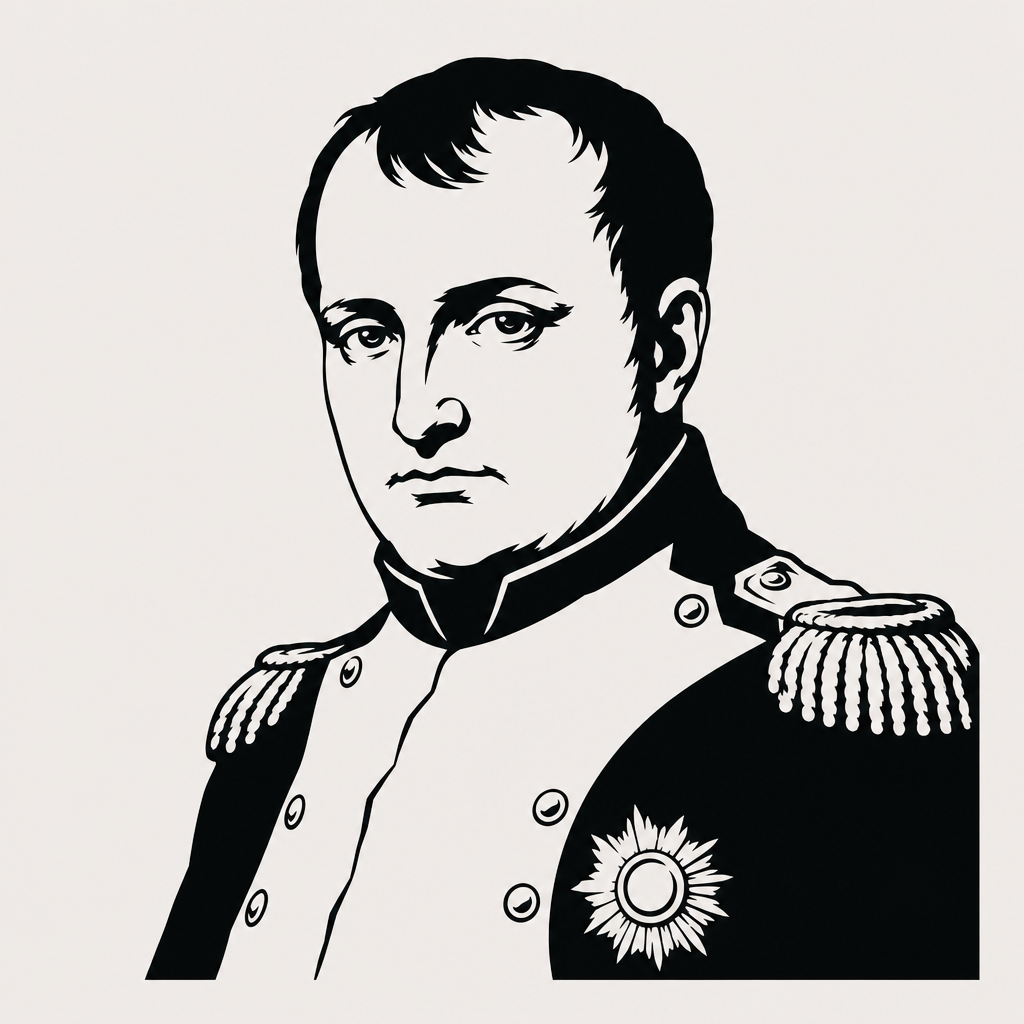
The Crown and the Hands
On December 2, 1804, inside a cold and crowded Notre-Dame, Pope Pius VII sat beside the altar while a thirty-five-year-old man lifted a golden laurel crown, held it a moment above the heads of the assembled dignitaries of Europe, and set it on his own head. Then he crowned his wife. The Pope, who had traveled from Rome to bless the ceremony, was reduced to a witness.
The self-crowning has been told for two centuries as pure arrogance — the upstart brushing past God’s representative. The truth is more calculated. The gesture was worked out in advance; Pius knew it was coming. But the symbolism was exactly what Napoleon intended: he owed his crown to no dynasty, no anointing, no inheritance. He had made himself, and he wanted all of Europe to see that no one had handed him anything.
Ten years earlier those same hands had belonged to an unemployed artillery officer with a Corsican accent, briefly jailed as a suspected radical, whose family had fled their island as refugees. There is no parallel to the speed of that rise in modern European history, and no cleaner example of a life in which extraordinary talent, blind ambition, and pure luck are impossible to separate.
The hardest thing about Napoleon is that both stories told about him are true. He carried the French Revolution’s promise of legal equality across a continent and left a code of law that still governs much of the world. In the same years, he restored colonial slavery, built a police state, and sent perhaps a million Frenchmen to their deaths. Any honest account keeps both ledgers open — and remembers that much of what we think we know about him, he arranged for us to believe.
An Island of Losers
Napoleone di Buonaparte was born in Ajaccio, Corsica, on August 15, 1769 — into a defeated cause. Just fifteen months earlier, Genoa had sold the island to France; three months before his birth, French troops had crushed the Corsican independence movement of Pasquale Paoli at Ponte Nuovo. His father, Carlo, had been a Paoli partisan who then made his peace with the new French masters. Napoleon entered the world already on the losing side, already learning that survival meant switching allegiance to power.
He was the second of eight surviving children of Carlo Buonaparte and Letizia Ramolino — a formidable, unsentimental mother who would one day watch her son rule Europe and reportedly mutter, “so long as it lasts.” The family’s minor nobility, formally recognized in 1771, unlocked everything: it qualified young Napoleon for a scholarship meant for the sons of poor gentry. In May 1779, not yet ten, he was sent to the military school at Brienne, a boy who spoke Corsican Italian and struggled with French, mocked by wealthier classmates for his accent and his poverty. He answered with work. From Brienne he went to the elite École Militaire in Paris, and in 1785 was commissioned a second lieutenant of artillery.
That same year his father died — of stomach cancer, at thirty-eight. It is a detail that will return.
Then the world cracked open. The Revolution of 1789 did what no reform could have done for a provincial lieutenant: it demolished the aristocratic ceiling above him. Careers were suddenly open to talent, and the new Republic, at war with every monarchy in Europe, needed officers who could fight. Napoleon spent the early revolutionary years shuttling between France and Corsica, finally breaking with Paoli so completely that in June 1793 the entire Buonaparte clan fled the island for good, refugees on the French mainland.
He had lost his homeland. He had gained a revolution with an infinite appetite for ambitious young men.
Toulon, Italy, and the Whiff of Grapeshot
The break came at Toulon. In late 1793 the great naval port had been handed to a British and royalist force, and the Republic was struggling to retake it. The young artillery commander saw what others missed: seize the heights above the harbor, and the enemy fleet would have to flee. His plan worked on December 17, 1793. At twenty-four, he was a brigadier general.
Politics nearly killed the career before it began. When Robespierre fell in 1794, Napoleon — associated with the Jacobins — was arrested and held for two weeks. He survived, out of favor, until October 1795, when a royalist mob threatened the government in Paris and he was handed a battery of cannon. He cleared the streets with what history remembers as a “whiff of grapeshot” — a phrase, like many attached to him, that may be a later coinage. The grateful Republic gave him command of the ragged, unpaid Army of Italy.
Two days before leaving, on March 9, 1796, he married Joséphine de Beauharnais, the widow of a guillotined general — older than him, elegant, and unfaithful. His letters to her are among the most passionate ever written by a head of state; they stayed married through her affairs, for now.
In Italy, the outsider became a legend — and learned to manufacture one. Against larger Austrian armies he won at Lodi, Arcola, and Rivoli through speed and audacity, then negotiated the Treaty of Campo Formio himself in October 1797, dictating terms as if he were already a sovereign. He shipped looted Italian masterpieces to Paris, founded newspapers, wrote his own battlefield bulletins, and commissioned the paintings that made him heroic — the famous image of him seizing a flag on the bridge at Arcola was largely staged after the fact. “To lie like a bulletin” became a proverb in his own army. From the start, Napoleon understood that the story of a victory mattered nearly as much as the victory.
Egypt, in 1798, was where the method saved him from disaster. The expedition began with the Battle of the Pyramids, then collapsed when Nelson destroyed the French fleet at the Nile, stranding the army. There was scientific glory — the scholars he brought turned up the Rosetta Stone — and there was atrocity: at Jaffa in 1799, several thousand Ottoman prisoners, by most accounts between 3,000 and 5,000, were executed. Napoleon abandoned his army in August 1799 and sailed home, where his own censored bulletins had made him a conquering hero. The failures never reached the French public.
Consul, Emperor, and the Moral Hinge
France was tired of the corrupt, unstable Directory, and a cabal of politicians wanted a general to lend muscle to a coup. On November 9–10, 1799, Napoleon supplied it — badly. Jeered and jostled in the legislative chamber, he froze; it was his brother Lucien, presiding over the assembly, who called in the grenadiers and saved the day. The plotters expected a figurehead. They got a ruler. Within weeks the Constitution of the Year VIII made Napoleon First Consul, effectively master of France at thirty.
What he did next is the part his admirers rightly celebrate. In a few years he rebuilt the French state on foundations that outlasted him by two centuries. He made peace with the Catholic Church through the Concordat of 1801, healing the Revolution’s deepest wound. He founded the Bank of France, the lycée school system, and the Legion of Honour, and created the prefect system that still administers France. Above all he oversaw the Civil Code of 1804, later renamed the Code Napoléon: it swept away feudal privilege and guaranteed equality before the law, secure property, and religious toleration — while sharply curtailing the rights of women, restoring the authority of husbands and fathers. Exported by conquest across Europe, it remains the spine of civil law in dozens of countries today. He called these institutions his “masses of granite,” and he was right.
And in exactly these years, he did the thing that sits at the center of any honest reckoning. The Revolution had abolished slavery in the French colonies in 1794. On May 20, 1802, his government reversed course. The letter of the law “maintained” slavery only where abolition had never taken hold — but his secret instructions ordered the colonial commanders to restore it wherever they judged fit, and they did, in Guadeloupe and Guyana, through brutal repression. Historians debate his motives — the pressure of the colonial sugar lobby and the diplomacy of the moment versus outright racial contempt — but Thierry Lentz, who directs the leading Napoleonic research institution, concludes that geopolitics and economics engaged Napoleon keenly and “the human aspect” not at all.
The catastrophe fell hardest on Saint-Domingue, the richest colony on earth. To crush the Black revolution led by Toussaint Louverture, Napoleon sent an army of more than twenty thousand men. Toussaint was seized through treachery and shipped to die in a frozen French fortress in 1803. But yellow fever and ferocious resistance destroyed the French force, and on January 1, 1804 — in the same year Napoleon crowned himself — his enemies declared the independence of Haiti, the first Black republic, born by defeating him. The Caribbean wars of 1802–1804 killed on the order of 100,000 people, most of them Black. A lurid modern accusation that Napoleon planned a colonial “genocide,” complete with gas-chamber ships, has been rejected by specialists who found no archival basis for it — but the documented reality is grim enough without exaggeration, and it is the permanent stain on the consular record.
The self-made emperor arrived in 1804 by way of another crime: in March, French agents kidnapped the Duc d’Enghien from neutral territory and shot him after a sham trial — an act one contemporary called “worse than a crime, a blunder.” Two months later a plebiscite made Napoleon Emperor of the French, and in December came the crown and the hands.
The Gambler’s Ruin
At its height the Empire was staggering. In 1805 Napoleon shattered the combined armies of Austria and Russia at Austerlitz, his masterpiece; in 1806 he destroyed Prussia in a single day at Jena–Auerstedt. He redrew the map of Europe, dissolved the thousand-year-old Holy Roman Empire, and planted his brothers on the thrones of Naples, Holland, Spain, and Westphalia — the empire run as a family business, and the family mostly bad at it. Only Britain stayed beyond reach: Nelson’s victory at Trafalgar in 1805 gave the seas to the Royal Navy for good, and Napoleon’s answer — the Continental System, an economic blockade of Britain — mostly strangled Europe instead.
The same qualities that won Austerlitz — speed, audacity, absolute certainty — eventually destroyed him, because he could not stop. In 1808 he decoyed the Spanish royal family off their throne and installed his brother Joseph. Spain rose in fury, and the guerrilla war that followed, immortalized in Goya’s paintings of French reprisals, bled France for five years and cost hundreds of thousands of lives.
Then came Russia. In June 1812 Napoleon crossed the Niemen with a multinational army of well over half a million men. He won the ground he fought for — Borodino in September was the bloodiest single day of the entire era — and occupied Moscow, only to watch the city burn the night he entered it. There was nothing to negotiate and no shelter for the winter. The retreat through mud, then ice, harried by Cossacks and climaxing in the desperate crossing of the Berezina, annihilated the Grand Army; perhaps a hundred thousand effective troops staggered out. His own bulletin admitted the disaster and closed, notoriously, “His Majesty’s health has never been better.” He was already racing home by sledge, ahead of the ruin.
After Russia, all of Europe converged. The “Battle of the Nations” at Leipzig in October 1813 broke him in Germany. A brilliant defensive campaign on French soil only delayed the Allies, who took Paris in March 1814. His own marshals refused to fight on. He abdicated at Fontainebleau, tried to poison himself with a sachet that had lost its potency, and was exiled to the toy kingdom of Elba. At his farewell the veterans of the Old Guard wept.
The last act was the shortest and most theatrical. In March 1815 he escaped Elba and landed in southern France with barely a thousand men. At Laffrey he walked alone toward a regiment sent to arrest him, opened his coat, and — by the accounts of those present — invited them to fire on their Emperor. They carried him to Paris instead, without a shot. For a hundred days he ruled again, issuing a liberal constitution and abolishing the slave trade — conviction and a bid for public opinion at once. It ended on June 18, 1815, at Waterloo, where Wellington held until the Prussians arrived and the Imperial Guard, unbeaten until then, finally broke. Napoleon abdicated a second time and surrendered to the British, imagining he might live quietly in England. They sent him to the most remote rock they controlled.
The Last Campaign
Saint Helena is a speck in the South Atlantic, roughly 1,200 miles from the nearest continent. Napoleon reached it in October 1815 and settled into Longwood House — damp, rat-infested, windswept — watched by a garrison of thousands, in a petty, grinding feud with the governor, Hudson Lowe, who refused to address him as Emperor.
And there, deprived of an army, he won his last and most durable campaign: the one for his own memory. He dictated his memoirs and his version of every battle, and turned even captivity into theater, maintaining imperial court etiquette in a rotting bungalow. Above all he talked, for months, to a devoted follower named Las Cases, who wrote it all down. Published in 1823 as the Mémorial de Sainte-Hélène, it became the bestseller of the century and the gospel of the Napoleonic legend: the portrait of a peace-loving liberal and champion of European unity, betrayed by the reactionary monarchies. It was, to a great degree, retrospective invention. When the original manuscript resurfaced in 2004, comparison showed the published version had been heavily padded and rewritten; famous maxims now central to the legend — including “What a novel my life is!” — are absent from the original. A scholar who has studied it puts the authorship of that line honestly: it may belong to Napoleon, or to Las Cases the wordsmith, and “for the moment, it is impossible to say.”
His health collapsed from 1817. By the spring of 1821 he was bedridden and vomiting, and the day-by-day notebooks of the loyal General Bertrand record the decline without sentiment, down to the dying man’s cruel rages at those around him. He dictated a will claiming he had been “assassinated by the English oligarchy,” and died on May 5, 1821, at fifty-one. Both autopsy reports agreed: an extensive cancerous lesion of the stomach — his father’s disease.
That is also the scholarly consensus today. Modern medical studies comparing the 1821 autopsy findings against thousands of contemporary cases conclude that Napoleon died of advanced gastric cancer. The rival theory — slow poisoning with arsenic — was launched in 1961 from analysis of his hair and has never entirely died, because it rests on a genuine chemical fact: authenticated strands really do carry very high levels of arsenic. But comparably high readings turn up in his boyhood hair, and in hair from Joséphine and his son, pointing to the ordinary chronic exposure of the age — arsenical medicines, cosmetics, and pigments — rather than murder. Cancer is the verdict; arsenic is the myth that refuses to die, with a real residue at its heart.
Every Generation’s Napoleon
He was buried on Saint Helena under a blank slab, because Britain and France could not agree on what to carve: the British would permit “Napoleon Bonaparte,” the French would allow only “Napoléon,” and so the stone said nothing at all. It was a fitting monument to a man two nations could not agree how to name.
The legend outran the grave. In 1840 his remains were returned to Paris in the Retour des cendres, met by crowds approaching a million, and entombed at Les Invalides, where they rest today. His nephew rode the family name to a second French empire. The historian Pieter Geyl, writing after surviving a Nazi camp, showed how every French generation had refought Napoleon according to its own politics — hero, tyrant, martyr, warning — so that there was never one Napoleon but a shelf of them.
The debate has not cooled. He was, on one accounting, the great modernizer who gave Europe rational law and careers open to talent; on another, the first modern dictator, ruling by plebiscite, propaganda, and police, who plunged a continent into wars that killed on the order of a million French soldiers and well over a million other Europeans, with civilian deaths beyond counting. He was the heir of the Revolution who re-enslaved the Caribbean, and whose defeat there produced the first Black republic. Comparisons to the twentieth century’s genocidal tyrants are rejected by serious historians — there was no extermination program, no mass political murder — but “the first modern dictator” is a defensible verdict, and so is “the Enlightenment on horseback.” Both are documented; neither cancels the other. (He was not, for the record, short: at roughly 1.68 meters he was average for a Frenchman of his day, and the myth grew mostly from British caricature — history’s most successful campaign of body-shaming.)
That, in the end, is the truest thing about him. He fought his last battle not with cannon but with a memoirist and a will, editing the story of his life for a century that would believe him. Two hundred years on, we are still checking his account against the record — which is exactly the argument he wanted us to keep having.
Sources & Further Reading
- Fondation Napoléon — napoleon.org, including the “Napoleon, the dark side” series on the 1802 reinstatement of slavery, the human cost of the wars, and the timelines of his early years and last days (napoleon.org)
- Lentz, Thierry — “Why did Napoleon bring back slavery?” and related essays, Fondation Napoléon (napoleon.org); with Pierre Branda, Napoléon, l’esclavage et les colonies (Fayard, 2006)
- Roberts, Andrew — Napoleon: A Life (Viking, 2014)
- Dwyer, Philip — Napoleon: The Path to Power (Yale University Press, 2008), Citizen Emperor (Yale, 2013), and Napoleon: Passion, Death and Resurrection (Bloomsbury, 2018)
- Gueniffey, Patrice — Bonaparte: 1769–1802 (Harvard/Belknap, 2015)
- Mikaberidze, Alexander — The Napoleonic Wars: A Global History (Oxford University Press, 2020)
- Lugli, A., et al. — “Napoleon Bonaparte’s gastric cancer,” Nature Clinical Practice Gastroenterology & Hepatology 4(1) (2007), and “The medical mystery of Napoleon Bonaparte,” Advances in Anatomic Pathology 18(2) (2011)
- Geyl, Pieter — Napoleon: For and Against (1949)