Charlemagne
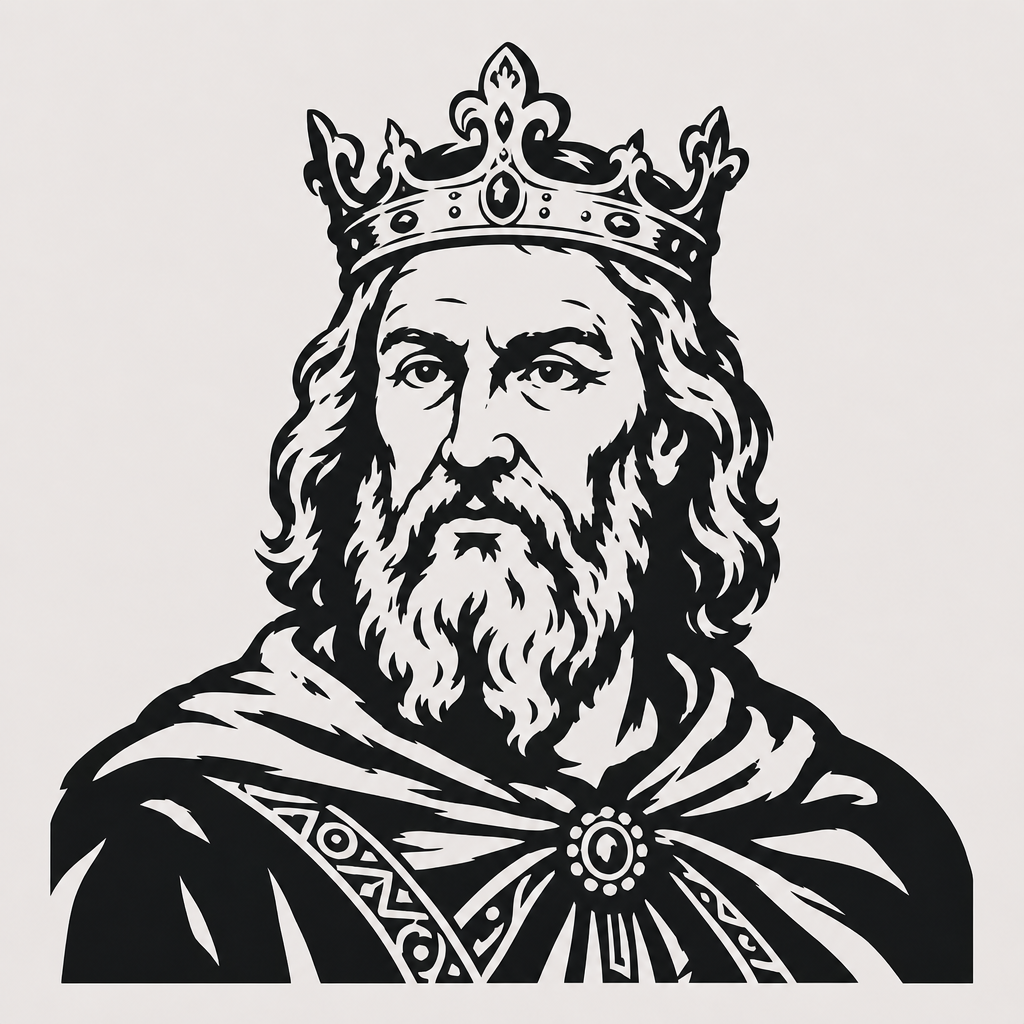
The Statue Paris Almost Refused
On the parvis in front of Notre-Dame de Paris there stands a colossal bronze horseman, an emperor in a Roman-looking crown flanked by two armored knights. It is one of the most photographed monuments in the city, and for years the city very nearly did not want it. When the sculptors Charles and Louis Rochet unveiled their equestrian Charlemagne at the 1878 Exposition Universelle, the Paris municipal council balked at putting it up. Voices on the left called Charlemagne a tyrant, an anti-republican figure — and, most tellingly, a man who “had little to do with the history of the capital.” They were not wrong. Charlemagne never made Paris his seat; his capital was a hot-springs town on what is now the German border. The statue went up only in 1882, on a provisional basis, after the foundry offered to erect it at its own expense, and the city did not even buy it outright until 1896.
The bronze is a tissue of anachronisms. The crown was designed roughly a century and a half after the man died; one of the flanking knights, Olivier, is fictional; the other, Roland, was killed twenty-two years before Charlemagne became emperor. The monument, in other words, is not a portrait but a memory — an argument in metal about who Charlemagne was and who gets to claim him. That argument is the truest thing about him. Because the historical Charlemagne, stripped of the later mythology, is stranger and larger than the legend: a Frankish warlord who could not write his own name, who had thousands of prisoners beheaded in a single day, who gathered Europe’s finest minds to a palace on the Rhine’s edge, and who on one Christmas morning was handed back the Roman Empire that the West had lost three centuries before.
The Usurper’s Son
We do not know for certain when he was born, and his own biographer confessed as much. Einhard, the courtier who wrote his life a decade or so after his death, declared it “folly” to write about a birth on which “nothing has ever been written.” For centuries the accepted date was 742, derived from Einhard’s statement that Charles died in his seventy-second year — a suspiciously round biblical span. Modern scholars, following Karl Ferdinand Werner and Matthias Becher, now favor 2 April 748, from an abbey’s commemoration and a near-contemporary annal. The birthplace is simply unknown; the popular guess of Aachen is almost certainly wrong. He was the eldest son of Pepin the Short and a woman named Bertrada, and into that uncertainty he was born to a family in the middle of stealing a throne.
The Franks were ruled, in name, by the long-haired Merovingian dynasty. In fact they were ruled by their chief officials, the mayors of the palace — Charlemagne’s own ancestors. In 751 Pepin finished the job his forebears had begun: he deposed the last Merovingian, Childeric III, packed him into a monastery, and had himself made king, the coup blessed by the Church. In 754 Pope Stephen II crossed the Alps and personally anointed Pepin and his two sons, Charles and Carloman, with holy oil. The boy Charles was sent to escort the pope on the road. He grew up, in other words, inside the founding transaction of the Middle Ages: a bargain in which the papacy conferred legitimacy on Frankish kings, and Frankish kings became the armed protectors of Rome. Everything that happened to him in the year 800 was written into that first exchange.
When Pepin died in 768 the realm was split between the brothers, and the two ruled in mutual suspicion until, in December 771, Carloman died suddenly at twenty. Charlemagne moved at once, seizing his brother’s kingdom and pushing aside Carloman’s widow and small sons, who fled south to the Lombard court in Italy. Three years later, when Charlemagne captured the Lombard city of Verona, those nephews vanish from every record. Historians have compared their disappearance to that of the Princes in the Tower; whether they were murdered, hidden, or quietly walled away in a cloister, their fate is unknown. It is the first of several convenient silences that cleared his path to sole power.
Conquest, Conversion, and the River Aller
For more than forty years Charlemagne was almost never at peace. He roughly doubled the territory he inherited, and the map of Western Europe still carries the outline of what he did. In 773–774 he crossed the Alps, besieged the Lombard capital of Pavia, and did something contemporaries found astonishing: he annexed the ancient Lombard kingdom outright and added “King of the Lombards” to his own titles. He absorbed Bavaria and deposed its duke, his own cousin Tassilo, into a monastery. In the 790s his armies broke the Avars of the Danube plain and carted their fabled treasure-hoard, the “Avar Ring,” back home in wagons. In 778 a Spanish campaign ended badly when Basques ambushed his rearguard in a Pyrenean pass called Roncevaux; among the dead was a minor officer named Hruodland, “Governor of the March of Brittany.” Three centuries later, poets would transform that squalid little massacre of a baggage train into the Song of Roland, a Christian epic against Saracen hordes — and give France the founding monument of its literature. The layers should never be confused: the history was an ambush by fellow Christians; the legend was a crusade.
The longest and cruelest war was against the Saxons of the pagan north, and it defines the moral problem of his reign. It ran, on and off, for more than thirty years; Einhard said no war was ever “carried on with such persistence and bitterness.” It began in 772 with the destruction of the Irminsul, the Saxons’ sacred pillar, and it was from the start a war of religion as much as conquest — conversion at the point of the sword. In 782, after a Saxon rebellion under a leader named Widukind wiped out a Frankish force, Charlemagne exacted a terrible reckoning. According to the Royal Frankish Annals — a source written to flatter him, not to condemn him — 4,500 Saxon prisoners were beheaded in a single day on the river Aller, at a place called Verden. Around the same time he issued a capitulary imposing death for a long list of pagan practices: a program of forced conversion.
The number may be exaggerated; some historians think even a tenth of it would have been catastrophic in Saxon memory. An old attempt to explain the massacre away as a copyist’s error — “deported” misread as “beheaded” — is generally rejected. What the sources will not allow is doubt that something monstrous happened. Johannes Fried writes that “the basic truth of the event is not in doubt”; Alessandro Barbero calls Verden “perhaps the greatest stain on his reputation.” The victims left no written voice at all, so the record survives only in the words of the men who did the killing. And not everyone at court was silent: Alcuin of York, the scholar Charlemagne trusted most, protested against conversion by terror and the crushing tithes imposed on the conquered. The war ground on until Widukind himself submitted and was baptized in 785, with Charlemagne standing as his godfather — though Saxon revolts flared for another twenty years.
The Palace of the Warm Springs
Here is the paradox that makes him more than a conqueror. This man who converted a people by the blade also spent the last decades of his life trying to rebuild learning across a continent that had largely lost it. From the 790s he settled at Aachen, drawn by its hot springs, and built there a palace and the octagonal Palatine Chapel that still stands — “the best-preserved building from the Carolingian period” and Germany’s first UNESCO World Heritage Site. He was a physical marvel by every account: tall (well over six feet by later measurement of his bones), a tireless rider and hunter, and a swimmer so strong, Einhard wrote, that “none could surpass him.” He bathed in the springs with scores of courtiers at once. He loved roast meat straight off the spit, disliked fasting, and had Augustine’s City of God read aloud at dinner.
To Aachen he summoned the best minds of the age: Alcuin from York, Theodulf from Spain, Paul the Deacon, Peter of Pisa, and the young Einhard. What they produced is now called the Carolingian Renaissance. They standardized Latin, reformed the schools, corrected the liturgy, and developed a clear, rounded script — Carolingian minuscule — that is the direct ancestor of the lowercase letters you are reading now. Some ninety thousand manuscripts were copied in the ninth century; much of what survives of classical Latin literature reaches us through Carolingian copies. Charlemagne backed all of it with decrees, most famously the Admonitio generalis of 789, and governed his sprawling realm by written capitulary and by roving inspectors, the missi dominici, sent out in pairs to check his counts.
And yet the emperor of this empire of the mind could not fully enter it. Einhard tells us that Charlemagne kept writing tablets under his pillow and practiced forming letters at night, but “as he did not begin his efforts in due season, but late in life, they met with ill success.” He could not write. Whether he could read at all is genuinely debated — Fried thinks it likely; Paul Dutton finds the evidence “circumstantial and inferential at best.” He spoke a Germanic dialect and fluent Latin and understood some Greek; he collected the old heroic songs of the Franks and began a grammar of his own tongue. He simply never mastered the pen. The man who did more than anyone to preserve the written word in the West could not sign his own name.
Christmas Day, 800
The defining scene is set in Rome, and no one has ever fully agreed on what it meant. In 799 Pope Leo III, cornered by Roman enemies who tried to blind him and cut out his tongue, escaped and fled north to throw himself on Charlemagne’s protection at Paderborn. The pope as suppliant at the Frankish court dramatized the whole relationship. The following year Charlemagne came south to settle the matter. On 23 December 800 Leo cleared himself of the charges against him by a public oath. Two days later, at Christmas Mass in Old St. Peter’s, as Charlemagne rose from prayer, Leo set a crown upon his head and the Roman crowd acclaimed him Imperator — emperor. It was the first emperor in the West since the last Roman one had been deposed in 476.
Einhard famously claimed that Charlemagne “would not have set foot in the Church the day that they were conferred… if he could have foreseen the design of the Pope.” Historians have argued about that sentence ever since. Some take it at face value, or read it as annoyance at the manner of the thing — for a pope to crown an emperor set a precedent the papacy would exploit for centuries. Others call it a humility formula, a literary pose. The evidence cuts against pure surprise: a court poet had already hailed Charlemagne as “the revered pinnacle of Europe” and called Aachen a “second Rome”; Alcuin was already speaking of a Christian empire; Roger Collins argues the coronation was planned from the Paderborn meeting, and Fried thinks Charlemagne meant to take the title “by 798 at the latest.” A related question is whose interests it served — Leo badly needed a protector, and one contemporary justification held that the imperial throne was simply vacant, because in Constantinople a woman, the Empress Irene, had blinded and deposed her own son to rule alone. The honest answer is that we cannot resolve it, and the ambiguity is the point: an event that reshaped a thousand years of European politics was one that perhaps no single person fully controlled.
What Charlemagne did next is revealing. He never adopted the grand title “Emperor of the Romans,” which would have enraged Constantinople; he styled himself, carefully, as an emperor “governing the Roman empire” who was also “king of the Franks and the Lombards.” He left Italy in 801 and never returned to Rome. He went on wearing Frankish dress, ruling from Aachen, an emperor who declined to be swallowed by Rome. And in 813, when his last surviving son needed to be made co-emperor, Charlemagne did it himself, in his own chapel at Aachen, placing the crown on Louis’s head with his own hands — no pope in sight. Whether that was a comment on the year 800 or simple practicality, it was the quiet counterpart to the scene in St. Peter’s. (The title “Holy Roman Emperor,” it is worth saying, belongs to a later tradition; Charlemagne was crowned “emperor,” and the Holy Roman Empire as such was named for the line that followed Otto I.)
The Custody Battle
Charlemagne died at Aachen on 28 January 814, of pleurisy after a week’s illness, and was buried the same day in the chapel he had built. His dynasty had already begun to collapse inward: two of his sons died before him, leaving only Louis the Pious. Within thirty years the empire he had assembled was carved apart by his grandsons at the Treaty of Verdun in 843, splitting into a West Francia that became France, an East Francia that became Germany, and a contested strip between them. The rivalry of France and Germany is, in caricature, his estate stuck in probate ever since.
What did not fracture was his name, and the fight to own it has never stopped. Both France and Germany number their monarchs from him. In 1165 the emperor Frederick Barbarossa had him canonized — but by an antipope, so Rome never recognized the sainthood, even as a local cult flourished at Aachen and French schoolchildren long kept the feast of Saint-Charlemagne. His tomb still holds him, moved in 1215 into the golden shrine where he lies today. His chapel became the coronation church of German kings for six centuries. Napoleon posed as his heir even while dissolving the empire Charlemagne had founded. The philosophes fought over him too: Voltaire, disgusted by Verden, branded him a “thousandfold murderer.”
The twentieth century made the custody battle lethal. The Nazis first built a memorial at Verden casting Charlemagne as the “butcher of the Saxons” for slaughtering good Germanic pagans — and then, in 1942, Hitler reversed course entirely and celebrated him as a Germanic unifier. After 1945 the pendulum swung again, deliberately: a Charlemagne remade as the patriarch of a united, peaceful Europe. The phrase “father of Europe” is genuinely old — his own court poet used it around 800 — but its modern currency is a conscious postwar repair job. Since 1950 the city of Aachen has awarded the Charlemagne Prize for services to European unification, in a hall built on the foundations of his palace; its laureates run from the founders of the European project to, in 2026, Mario Draghi.
And so we return to the bronze horseman outside Notre-Dame — installed provisionally, over the objection that he had “little to do with the history of the capital,” and never taken down. The objection was accurate. Paris was a Merovingian city, not a Carolingian one; his line lost West Francia to the Capetians in 987; his real capital sits in modern Germany. Yet France venerated him anyway, from the Song of Roland to the classroom feast to the statue on the cathedral square. That is the deepest truth about Charlemagne: the man was a Frankish warlord of the eighth century, brilliant and pious and brutal by turns, but the figure is something the last twelve centuries built and rebuilt to explain themselves. The statue Paris almost refused is not a likeness of him. It is a portrait of everyone who has needed him since.
Sources & Further Reading
- Einhard — The Life of Charlemagne (Vita Karoli Magni), trans. Samuel Epes Turner, full text at the Internet Medieval Sourcebook, Fordham University (sourcebooks.fordham.edu/basis/einhard.asp)
- Royal Frankish Annals (Annales regni Francorum), trans. Bernhard Walter Scholz in Carolingian Chronicles (University of Michigan Press, 1970)
- Aachen Cathedral (Aachener Dom) — official site (aachenerdom.de/en)
- Internationaler Karlspreis zu Aachen — official site (karlspreis.de)
- Nelson, Janet L. — King and Emperor: A New Life of Charlemagne (Allen Lane / University of California Press, 2019)
- McKitterick, Rosamond — Charlemagne: The Formation of a European Identity (Cambridge University Press, 2008)
- Fried, Johannes — Charlemagne (Harvard University Press, 2016)
- Barbero, Alessandro — Charlemagne: Father of a Continent (University of California Press, 2004)
- Collins, Roger — Charlemagne (Macmillan, 1998)