Marie Curie
The Telegram and the Mob
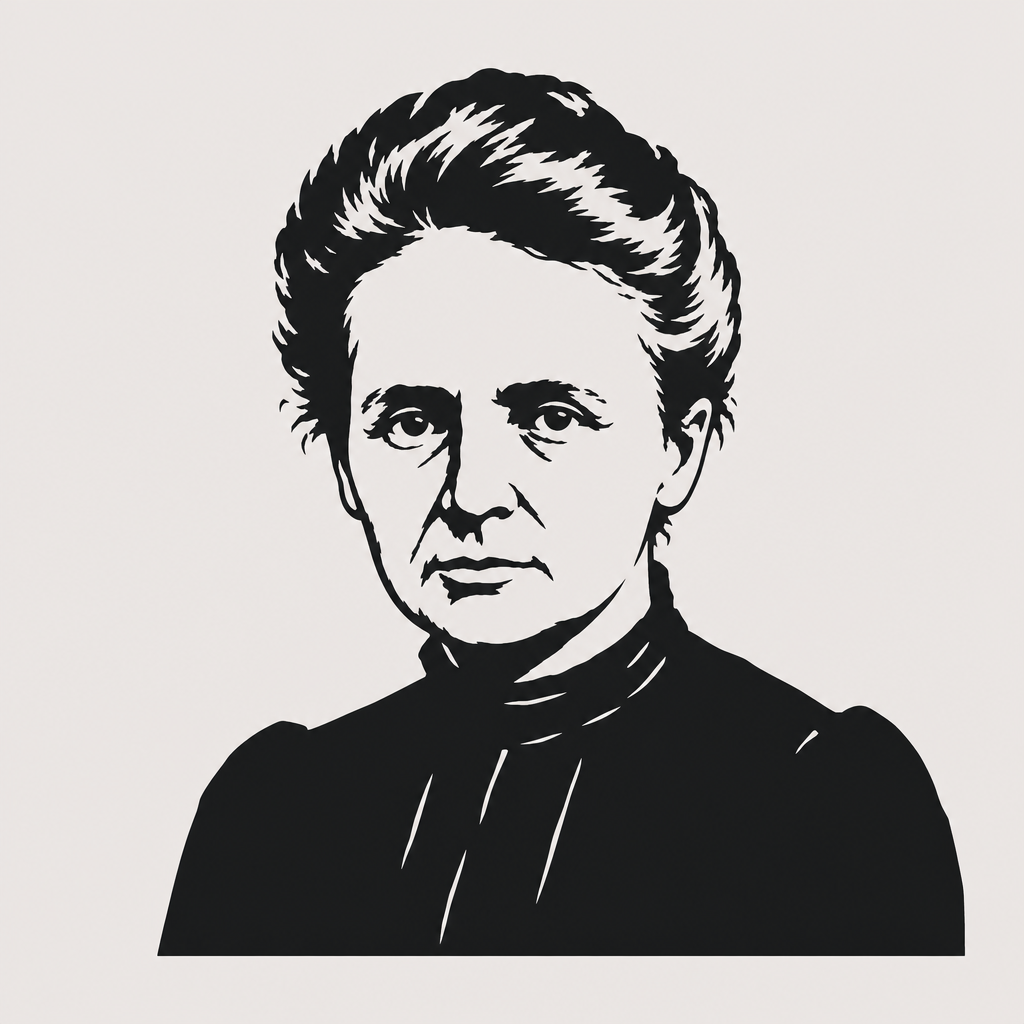
In the first week of November 1911, a crowd gathered outside a house in the Paris suburb of Sceaux and began to shout. Inside were two frightened girls — Irène, fourteen, and Ève, not yet seven — and their mother, the most famous woman scientist in the world, whom the morning papers had just recast as a foreign home-wrecker. A Paris daily had published stolen intimate letters said to be between Marie Curie and the physicist Paul Langevin, a married former student of her late husband. The nationalist press ran with the story and then embroidered it: she was a seductress, an interloper, a Pole, and — a lie repeated because it was useful — a Jew who had wormed her way into French glory. It was insinuated that she had driven her husband Pierre to his death. None of it was true, and it very nearly worked. Duels were fought over her honor. Friends who sheltered her family were threatened with the ruin of their own careers.
In the middle of that frenzy, a telegram arrived from Stockholm. The Nobel committee had awarded her a second Nobel Prize — this time in Chemistry, and hers alone — for discovering polonium and radium and isolating radium in its pure form. No one had ever won two. Then a second message followed, from the chemist Svante Arrhenius, urging her, for the sake of decorum, not to come to the ceremony until her name was cleared.
She went anyway. With her sister Bronya and her daughter Irène beside her, she traveled to Stockholm, accepted the prize, and delivered a lecture reasserting her scientific priority. Her reply to the suggestion that she stay home survives in her biographers’ reading of the correspondence: there was, she insisted, no connection between her scientific work and the facts of her private life. It is the whole of her in one sentence — the refusal to let anyone, French or Swedish, admirer or attacker, decide where the work stopped and the woman began.
A Country Off the Map
She was born Maria Salomea Skłodowska in Warsaw on November 7, 1867, into a country that officially did not exist. Poland had been partitioned out of the map decades earlier, and the Warsaw of her childhood belonged to the Russian Empire, which policed the Polish language and russified the schools. Both her parents were teachers of downwardly mobile gentry stock, patriotic and cultivated and short of money. Her father taught mathematics and physics and kept his confiscated laboratory instruments at home, where his youngest daughter looked at them and wondered. When Czar Alexander II was assassinated in 1881, the thirteen-year-old Maria and a classmate danced.
Sorrow came early and shaped her. Her eldest sister died of typhus; then, in May 1878, when Maria was ten, her mother died of tuberculosis. Ève Curie’s later account describes a grief that hardened into the first of the depressions that would shadow her mother’s whole life. Maria finished her gymnasium first in her class, with a gold medal, and then collapsed into a year of recovery in the countryside — the pattern of ferocious achievement followed by exhaustion that would repeat at every crisis to come.
The universities of Warsaw were closed to women. So she studied where women could: the clandestine, illegal “Flying University,” which met in shifting private rooms to teach Polish students in Polish. Patriotism, for her generation, was itself an act of study. And she made a pact with her sister Bronya that reads like a fable but is documented in the family’s own letters. Marie would work as a governess and send her earnings to Paris so Bronya could study medicine; once qualified, Bronya would fund Marie’s turn. For roughly six years Maria raised other people’s children, most unhappily in the village of Szczuki, where she fell in love with the family’s son, Kazimierz Żorawski, and where his parents forbade the match — she was, after all, only the governess.
In November 1891, at twenty-four, she arrived in Paris and enrolled at the Sorbonne under the French form of her name, Marie. The garret years that followed became the core of her legend, largely through Ève’s telling: living on bread and tea, so cold in winter that she piled every garment she owned on the bed, once fainting from hunger over her books. Whatever the embellishments, the achievement is not in doubt. In 1893 she took her licence in physical sciences ranked first in her class; in 1894 a licence in mathematics. A paid commission to study the magnetic properties of various steels sent her looking for laboratory space — and led her to a shy, brilliant, institutionally marginal physicist named Pierre Curie.
The Shed
Pierre Curie, eight years her senior, had already done first-rate work on piezoelectricity and the physics of symmetry, and was going nowhere in a career sense, teaching at a Paris trade school for industrial physics and chemistry. He proposed; she hesitated, tempted to return to Poland; he offered to follow her there. They married in a civil ceremony at Sceaux on July 26, 1895. She wore a dark dress practical enough to wear afterward in the laboratory, and wedding-gift money bought two bicycles for the honeymoon. Their first daughter, Irène, was born in 1897; Pierre’s widowed father moved in to help raise her, the quiet domestic arrangement that made a scientific marriage of two equals actually possible.
For her doctoral subject Marie chose a phenomenon almost no one was working on. In 1896 Henri Becquerel had noticed that uranium salts fogged photographic plates through opaque wrappings, emitting some mysterious radiation. Using an electrometer built by Pierre and his brother, Marie did what Becquerel had not: she measured the rays quantitatively, treating their intensity as a number to be pinned down. In early 1898 she found that the mineral pitchblende was far more active than its uranium content could explain. There had to be an unknown element hiding inside it. In April she showed that thorium, too, emitted the rays — evidence that this was a property of certain atoms themselves, not a quirk of uranium. (The German physicist Gerhard Schmidt had reached the thorium result independently, weeks earlier.) The insight was radical: matter was not inert. Pierre abandoned his own crystals to join her.
That year they announced two new elements. In July came polonium, which she named for her erased homeland — a political act smuggled into a physics paper, which also introduced the word “radio-active.” In December came radium, announced with the chemist Gustave Bémont. But to announce an element and to prove it exists are different things. Skeptics wanted the pure substance and its atomic weight. So began the labor that defined them. In a leaky former dissection shed — one visitor called it a cross between a stable and a potato cellar — Marie processed ton after ton of pitchblende residue, shipped cheaply from the mines of Bohemia, boiling it down in great vats and stirring with an iron rod nearly as tall as she was. It was brutal, filthy chemistry on an industrial scale, done by hand.
She later called these the best and happiest years of their life. At night they would return to the shed to see the tubes of concentrated radium salts glowing faintly on the shelves, like, in the recollection preserved by Ève, faint fairy lights. In 1902 she isolated a decigram of pure radium chloride and fixed radium’s atomic weight, silencing the doubters. She and Pierre made a deliberate, documented choice not to patent the isolation process; radium’s benefits, she believed, belonged to everyone. The glow that enchanted them was, they did not yet grasp, already burning their fingers and their bones.
In June 1903 she became the first woman in France to earn a doctorate in science. That same month, when the couple was invited to the Royal Institution in London, custom barred a woman from lecturing, so Pierre spoke and credited her while Lord Kelvin sat beside her. In the autumn came the Nobel Prize in Physics, shared with Pierre and Becquerel — the first ever awarded to a woman. According to the standard biographical accounts of the Nobel archives, the committee had at first contemplated honoring only the two men; a sympathetic Swedish mathematician tipped off Pierre, who insisted his wife be included. Too ill and overworked to travel, the Curies did not deliver their Nobel lecture until 1905.
Nothing to Do with Private Life
The triumph was thin protection against catastrophe. On April 19, 1906, Pierre — weak and distracted, almost certainly already sick from radiation — stepped into the rue Dauphine in the rain and slipped under the wheels of a heavy horse-drawn wagon. He was killed instantly. Marie, thirty-eight, was widowed with two small children. She began a private mourning journal addressed to him, and she refused a state pension, insisting she could support her family herself.
Two weeks later the Sorbonne offered her Pierre’s teaching post. She became the first woman to teach there. When she gave her first lecture that November, the amphitheater was packed with people expecting a widow’s tears; instead she resumed the course exactly where Pierre had left it, opening with the physics. In 1908 she was named a full professor, the first woman to hold such a chair in French higher education. In 1910, with André Debierne, she isolated radium as a pure metal, and the international congress on radiology defined a unit of radioactivity — the curie — in the Curies’ name.
Then came 1911, the year that contained her entire life in miniature. In January the Académie des Sciences held an election to fill a vacant seat, and she stood. The campaign against her fused every prejudice available: she was a woman, she was a foreigner, and the false rumor that she was Jewish was floated to inflame a France still raw from the Dreyfus Affair. She lost, by the narrowest of margins, to the inventor Édouard Branly. She never stood again; the Académie would not admit a woman as a full member until 1979. That autumn she was the only woman among the physicists — Einstein, Rutherford, Planck, Poincaré, and Langevin among them — at the first Solvay Conference in Brussels. And it was then that the Langevin affair broke into the papers, and the mob came to Sceaux, and, in the same weeks, the second Nobel Prize.
The asymmetry is what historians insist on. The relationship with Langevin was real, established from the correspondence; almost everything the press added to it was invented. Yet Langevin’s marriage and career survived largely intact, while Curie was hospitalized with kidney disease and depression, hid for months under her maiden name, and at her lowest reportedly felt too disgraced even to use Pierre’s. Her laboratory notebook shows a gap of nearly fourteen months — the only time in her life the work stopped. Einstein, watching from a distance, wrote to encourage her to ignore the “rabble.” She recuperated in England with the physicist Hertha Ayrton, and by the end of 1912 she was writing in her notebook again.
Radioactive Past Death
The First World War gave her a second act as something no one expected: a logistics commander. When war broke out in 1914, she first carried France’s entire research stock of radium — a single gram in a lead-lined box — by train to a bank vault in Bordeaux, personally evacuating her element from the advancing German army. Then she built a mobile X-ray service almost from nothing. She equipped somewhere between eighteen and twenty motorized radiology units — soldiers called them the “petites Curies” — and helped establish some two hundred fixed radiological posts. She trained around 150 women as technicians, learned to drive so she could reach the front herself, and pressed her teenage daughter Irène into service beside her. By her own service’s estimate, more than a million wounded men were examined by X-ray during the war. She also extracted radon gas from her gram of radium and sealed it into tubes for treatment — handled, like everything else, without shielding.
After the war she became a fundraiser and a monument. An American editor, Marie “Missy” Meloney, organized campaigns in which American women raised the money to buy her a gram of radium; on a triumphal tour in 1921, President Harding presented it at the White House. The trips were exhausting and cemented an image of her as a kind of secular saint. In 1922 she was elected — without asking — to the Académie de Médecine, the body of French medicine that recognized what radium could do against cancer, even as the Académie des Sciences held out. Her Radium Institute in Paris grew into one of the world’s great centers of radioactivity research, producing hundreds of publications and deliberately making room for women and for Poles. She helped found a sister institute in Warsaw, directed by Bronya. In January 1934 she lived to see Irène and her husband, Frédéric Joliot-Curie, create artificial radioactivity in her own laboratory — work that would earn them their own Nobel Prize the following year.
By then the price of the glow was almost paid. Her fingertips were scarred and cracked; a double cataract, a radiation injury, had nearly blinded her and required repeated surgery. She left the laboratory ill one afternoon in May 1934 and never returned. She died on July 4, 1934, at a sanatorium in the French Alps. The physician’s diagnosis named an aplastic anemia produced, he wrote, by “a long accumulation of radiations” that had injured her bone marrow. That her work killed her is beyond serious dispute. Precisely which work is not: some later specialists argue that her massive, unshielded X-ray exposure during the war may have contributed as much as the radium — and that measurements taken when her remains were moved in 1995 found them only mildly contaminated. She had been slow, all her life, to concede the danger at all, once writing to Bronya that radium might have something to do with her troubles, though it could not be affirmed with certainty.
She was buried beside Pierre at Sceaux, and her brother and sister dropped a handful of Polish earth onto the coffin. In 1995 France moved the remains of both Curies to the Panthéon, and Marie became the first woman honored there for her own achievements; the president spoke of the equality of men and women as her legacy. Her laboratory notebooks are held today at the national library, still measurably radioactive from the radium-226 that will take some sixteen centuries to halve, and stored in lead-lined boxes; a reader who wants to consult them is asked to sign a waiver. Both facts belong to the same woman: honored past death, and radioactive past death. She had said there was no connection between her science and her private life. History has left them, finally, inseparable.
Sources & Further Reading
- American Institute of Physics, Center for History of Physics — “Marie Curie and the Science of Radioactivity” (history.aip.org/exhibits/curie/)
- Musée Curie, Paris — “Biographie de Marie Curie” and “Pierre et Marie Curie : chronologie” (musee.curie.fr)
- NobelPrize.org — Facts, biographical notes, and lectures for the 1903 Physics and 1911 Chemistry prizes (nobelprize.org)
- Science History Institute — “Marie Sklodowska Curie” scientific biography (sciencehistory.org)
- Curie, Ève — Madame Curie (Gallimard / Doubleday, 1937)
- Curie, Marie — Pierre Curie, with Autobiographical Notes (Macmillan, 1923)
- Quinn, Susan — Marie Curie: A Life (Simon & Schuster, 1995)
- Goldsmith, Barbara — Obsessive Genius: The Inner World of Marie Curie (W. W. Norton, 2005)