Charles de Gaulle
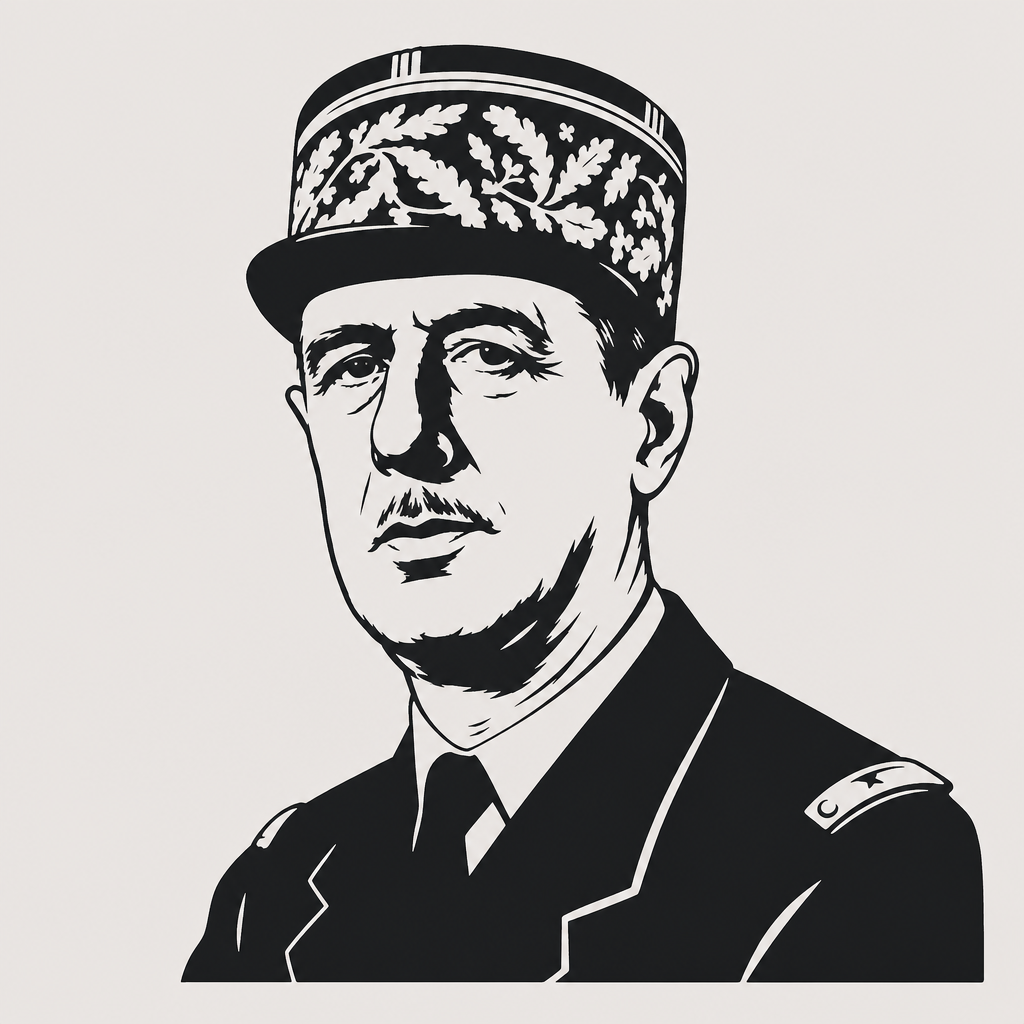
Four Minutes Nobody Recorded
On the evening of June 18, 1940, a French general almost no one had heard of walked into a BBC studio in London and told his country that it had not lost the war.
He had reason to sound absurd. France was finished — six weeks of blitzkrieg had shattered its armies, the government of Marshal Pétain was suing for an armistice, and Charles de Gaulle was a newly minted, temporary one-star general with no troops, no territory, and no authority beyond his own voice. Within six weeks a French military court would condemn him to death in absentia. He spoke for about four minutes. “Whatever happens,” he said, “the flame of French resistance must not be extinguished and will not be extinguished.”
Almost nobody heard it. The BBC did not record the broadcast; French listeners were scattered in the great exodus south, few tuned to London radio, and historians now agree that most people who later “remembered” hearing it live were remembering something else — a recorded speech four days later, or the printed poster from August. Of roughly 100,000 French soldiers then in Britain, some 7,000 stayed to join him. Of 10,000 French civilians, perhaps 300.
And yet June 18 is the founding date of modern France — the moment, in national memory, when the nation refused to surrender. That is the puzzle of de Gaulle’s whole life. He was a man who staked everything on a claim that had almost no backing in fact: that he, and not the legal government, embodied the true France. Everything afterward — Free France, the Liberation, the Fifth Republic, and the way he walked away from power twice — was an attempt to collect on that unbacked claim, and to make a nation ratify it. “All my life,” his memoirs begin, “I have had a certain idea of France.”
A Certain Idea
He was born in Lille on November 22, 1890, at his grandmother’s house, the third of five children in a family that was Catholic, patriotic, and drawn to the vanished order of monarchy. His father, Henri, taught letters and history at a Jesuit college and raised his sons on the wound of the age: the loss of Alsace-Lorraine to Germany in 1871, the humiliation that a whole generation was meant to avenge. The boy grew up in the France of revanche and the Dreyfus Affair — and, unusually for their milieu, Henri thought Dreyfus innocent. Family legend has the child de Gaulle playing war games in which he always took the part of France, leaving lesser countries to his brothers.
When France’s anti-clerical laws pushed the Jesuits out, he finished school with them across the border in Belgium, then won admission to the military academy at Saint-Cyr in 1908, ranked a middling 119th. He was already unmistakable: nearly two meters tall, aloof, bookish, nicknamed la grande asperge — the great asparagus. In 1912 he joined the 33rd Infantry Regiment at Arras, commanded by a colonel named Philippe Pétain. The mentorship that began there — the coming man attaching himself to the famous soldier — would end three decades later with each condemning the other, the great tragic symmetry of de Gaulle’s life.
The First World War nearly killed him and then merely disappointed him. Wounded three times, he was bayoneted and left for dead at Douaumont, near Verdun, in March 1916, and taken prisoner. He made five escape attempts — too tall to hide, always recaptured — and sat out the rest of the war in German fortress camps, freed only by the Armistice. He called the captivity a gnawing uselessness. For a man who believed he was born to act at the decisive hour, missing the greatest event of his generation was a formative humiliation. In 1921 he married Yvonne Vendroux, who would be beside him for forty-nine years; their third child, Anne, was born in 1928 with Down syndrome, and his tenderness toward her became the one crack in the public glacier. He is buried beside her.
Between the wars he made himself both brilliant and unpromotable. At the École de Guerre he was graded down for insubordination; in a series of books — above all Le Fil de l’épée (1932), a philosophy of leadership built on prestige and distance, and Vers l’armée de métier (1934) — he argued for a professional army built around fast armored divisions. France built the Maginot Line instead. He was, in the phrase of his era, a prophet without honor: a colonel by 1937, certain of his destiny, watching his country prepare for exactly the wrong war.
Building France From Nothing
May 1940 gave him four days of vindication and then a catastrophe. Commanding an improvised armored division, he mounted real counterattacks at Montcornet and Abbeville — among the few French offensive successes of a collapsing campaign — and was promoted to temporary brigadier general at the start of June, aged 49, the youngest general in the army. Premier Paul Reynaud made him an under-secretary of state for war and sent him to London, where he pleaded for the fight to continue from France’s empire. On June 16 Reynaud fell; Pétain took power and asked Germany for terms. On June 17 de Gaulle flew to London on a British plane with almost nothing but the conviction that legality had just capitulated and legitimacy had to be picked up off the floor.
This is the paradox that organizes his war: he was a rebel against the legal government of France, and he insisted he was France. The tools were meager. Britain recognized him as leader of the Free French at the end of June; Vichy sentenced him to death in August. He had to build a state from a few thousand volunteers and a scattering of colonies: Chad and French Equatorial Africa rallied to him, an expedition to seize Dakar failed humiliatingly, and Free French troops won a battle honor at Bir Hakeim in 1942. In occupied France, the delegate he parachuted home, Jean Moulin, unified the internal Resistance under a single council in May 1943, then was arrested weeks later and died under Gestapo torture — the sacrificial partner in the enterprise of legitimacy.
His hardest battles were with his allies. Franklin Roosevelt found him insufferable and repeatedly tried to sideline him, backing rival French generals and planning an Allied military government for liberated France as if it were enemy territory. De Gaulle answered contempt with granite ingratitude: France’s interest, he held, excused any personal grievance, and he was France. He outmaneuvered his rivals to lead the French Committee of National Liberation by 1943 and turned it into a Provisional Government in 1944. Told of D-Day only on its eve, he was furious — but his triumphant reception at Bayeux helped make an Allied occupation government politically impossible.
Then came his own city. On August 25, 1944, the French 2nd Armored Division and the U.S. 4th Infantry liberated Paris; the German commander surrendered. At the Hôtel de Ville, de Gaulle delivered the speech that sealed his myth: “Paris! Paris outraged! Paris broken! Paris martyred! But Paris liberated! Liberated by itself, liberated by its people.” It was magnificent state-building rhetoric, and it was tendentious. It erased the Allies — the American division that fought for the city, the fact that Eisenhower had to be persuaded to divert to Paris at all. It also erased the men who actually led the column in: the first unit into central Paris, La Nueve, was made up overwhelmingly of Spanish Republican exiles, unacknowledged for sixty years. And the victory parade down the Champs-Élysées the next day was, according to documents reported decades later, deliberately “whitened” — non-white colonial soldiers, about a quarter of the liberating division’s strength, were swapped out at Allied command’s insistence for a white-led march. The next day, as de Gaulle stood in Notre-Dame, shots rang out; the crowd dove for cover and the two-meter general stood motionless. The image was true. The story around it was already being edited.
The Republic in His Own Image
Power, once won, he abandoned — and then took back on his own terms. As head of the provisional government he granted women the vote, built social security, and commuted Pétain’s death sentence to life. But the same VE Day that crowned his victory, May 8, 1945, saw the bloody repression of nationalist unrest at Sétif and Guelma in Algeria; under his provisional government, army, settlers, and aircraft killed Algerians in numbers still bitterly disputed — from roughly a thousand in official tallies to tens of thousands claimed, with scholarly estimates in the thousands. It is absent from every monument to him. In January 1946, impatient with the squabbling parties writing a constitution he despised, he resigned, expecting to be recalled. He was not. There followed twelve years in the political wilderness — a failed mass movement, then solitude at his house in Colombey-les-Deux-Églises, where he wrote his war memoirs and waited.
The wait ended in a crisis that reads either as rescue or as coup. In May 1958 the Algerian war brought the Fourth Republic to collapse: French settlers and army officers in Algiers rose in insurrection, seized Corsica, and readied paratroopers to drop on Paris. Amid the threat of a military takeover, de Gaulle let it be known he was ready to assume power — while insisting on legal forms. “Why,” he asked at 67, “would I begin a career as a dictator?” The National Assembly invested him legally; a referendum gave his new constitution nearly 83 percent approval. Historians conclude the threat of force was the decisive immediate factor, and de Gaulle neither organized the plot nor discouraged the plotters’ hopes. His lifelong rival François Mitterrand called the whole system a “permanent coup d’état” — and then governed with it for fourteen years.
Algeria was the knot at the center of it all. On June 4, 1958, from a balcony in Algiers, de Gaulle told a delirious crowd of European settlers: “Je vous ai compris!” — “I have understood you.” Everyone heard what they wished; the words promise nothing. Whether the ambiguity was deception from the start or genuine open-endedness that hardened as options narrowed is still debated — but within sixteen months he had offered Algerians self-determination. The settlers who had brought him to power turned against him. In April 1961 four generals seized Algiers in a putsch; de Gaulle, in his old uniform on the new medium of television, called on the nation — “Françaises, Français, aidez-moi!” — and conscripts listening on transistor radios refused their officers. The coup collapsed in days. It was the purest demonstration of his singular weapon: legitimacy plus voice.
The endgame was ugly on every side. A secret settler terror organization, the OAS, waged a bombing and assassination campaign against him. And under his presidency, on October 17, 1961, Paris police commanded by prefect Maurice Papon attacked a peaceful demonstration of some 30,000 Algerians protesting a discriminatory curfew; men were beaten, shot, and thrown bound into the Seine, their bodies surfacing for weeks. The state denied it for thirty-seven years, then admitted around 40 dead; historians estimate 200 to 300. What de Gaulle himself knew and felt remains genuinely uncertain — a report Papon addressed to him went missing from the archives — but it happened under his government, on his prefect’s orders, with total impunity, and his own responsibility hangs unresolved between negligence, distraction, and acquiescence. When Algeria became independent in 1962 after the Évian accords, roughly a million European settlers fled, and the harkis — Muslim Algerians who had fought for France — were largely denied evacuation and slaughtered in reprisals; France has only recently acknowledged the abandonment. In August 1962 an OAS commando raked his car with gunfire at Petit-Clamart, some 140 rounds, Yvonne in the back seat; the Citroën drove through on shot-out tires. From the attempt he extracted a constitutional revolution — direct popular election of the president — pushed through by a referendum route most jurists called unconstitutional. He won anyway. The precedent stands.
The Last Performance
For a decade he governed as if France were still a great power, and half-conjured the fact into being. He gave France its own atomic bomb, pulled out of NATO’s integrated command while staying in the alliance, vetoed Britain’s entry into the Common Market twice, recognized Communist China, denounced the Vietnam War, and cried “Vive le Québec libre!” from a Montreal balcony to Canada’s fury. Whether this was vision or vanity — a middle-rank nation run as a great one — was the standing question of his rule. Language was always his instrument; he wrote his own speeches and memorized his television addresses.
Then the oldest head of government in the West met the youngest revolt. In May 1968 a student uprising touched off a general strike of roughly ten million workers. His first broadcast fell flat. On May 29 he vanished — flying secretly to a French army base at Baden-Baden, in Germany, to sound out General Massu. Whether it was a genuine collapse of nerve or a staged disappearance to manufacture the shock of his return, historians still argue; the accounts conflict and it is better left open. On May 30 he was back in Paris with a four-minute radio speech of pure defiance: he would stay, and he dissolved the Assembly. A vast Gaullist crowd filled the Champs-Élysées; June elections gave his party a landslide. It was the 1940 trick performed one last time — and, as even his own foundation concedes, the bond between de Gaulle and the French people was never the same again.
He had always framed his referendums as plebiscites on himself, and in April 1969 the people finally said no, rejecting a modest reform of the Senate and the regions by 52.4 percent. He had not needed to call the vote. At ten past midnight a communiqué went out from Colombey: “I am ceasing to exercise my functions as President of the Republic. This decision takes effect today at noon.” No speech, no return. The man who had twice seized legitimacy by force of will obeyed a democratic “no” and went home — the anti-climax that proved the whole point of the life.
What the Monument Leaves Out
He died at Colombey on November 9, 1970, at the card table, thirteen days short of eighty. “General de Gaulle is dead,” his successor Pompidou told the nation. “France is a widow.” By his own written instruction there was no state funeral: no presidents, no ministers at the grave. His coffin was carried on an armored vehicle to the village church and buried beside Anne under a plain slab bearing only his name and dates, while the world’s heads of state attended a separate memorial at Notre-Dame — two funerals he had, in effect, scripted himself.
The legacy is genuinely double, and the sources refuse both the marble statue and the counter-myth. The Fifth Republic is his: the constitution still in force, the powerful presidency directly elected, the office every French leader since has inhabited, cut to his measure. Gaullism — national independence, a strong state, sovereignty — remains a permanent pole of French politics, claimed today across a spectrum that includes heirs of the far right that fought him and the left that once called him a putschist. His name is on the airport, the aircraft carrier, the hilltop cross above his village; polls regularly vote him the greatest Frenchman.
But he was also the chief author of his own myth, and the myth had a purpose. The historian Henry Rousso named it résistancialisme: the postwar pretense, substantially de Gaulle’s construction, that France had been a nation of resisters with Vichy a mere parenthesis. It rebuilt a shattered nation’s self-respect, and it buried a reckoning — with collaboration, with Sétif, with October 17, 1961, with the harkis, with the whitened parade — that France has only slowly, and partially, exhumed. A French president acknowledged the 1961 massacre in 2012; another called it an “inexcusable crime” in 2021. De Gaulle was, at once, the man who talked a defeated country into believing in itself and the man whose gift for narrative kept its darkest chapters off the monument. The most honest verdict is the one the plain slab at Colombey seems to invite: hold both, and do not let the marble smooth them into one.
Sources
- Jackson, Julian — A Certain Idea of France: The Life of Charles de Gaulle (Allen Lane / Harvard University Press, 2018)
- Lacouture, Jean — De Gaulle: The Rebel 1890–1944 and The Ruler 1945–1970 (Seuil / Collins Harvill)
- House, Jim, and Neil MacMaster — Paris 1961: Algerians, State Terror, and Memory (Oxford University Press, 2006)
- de Gaulle, Charles — Mémoires de guerre (3 vols., 1954–59)
- Fondation Charles de Gaulle — “Biographie de Charles de Gaulle” (charles-de-gaulle.org) and the Élysée official biography (elysee.fr)
- INA, “De Gaulle, paroles publiques” (fresques.ina.fr/de-gaulle)
- Rousso, Henry — The Vichy Syndrome (Harvard University Press, 1991)
- Fenby, Jonathan — The General: Charles de Gaulle and the France He Saved (Simon & Schuster, 2010)