Edward Dwight
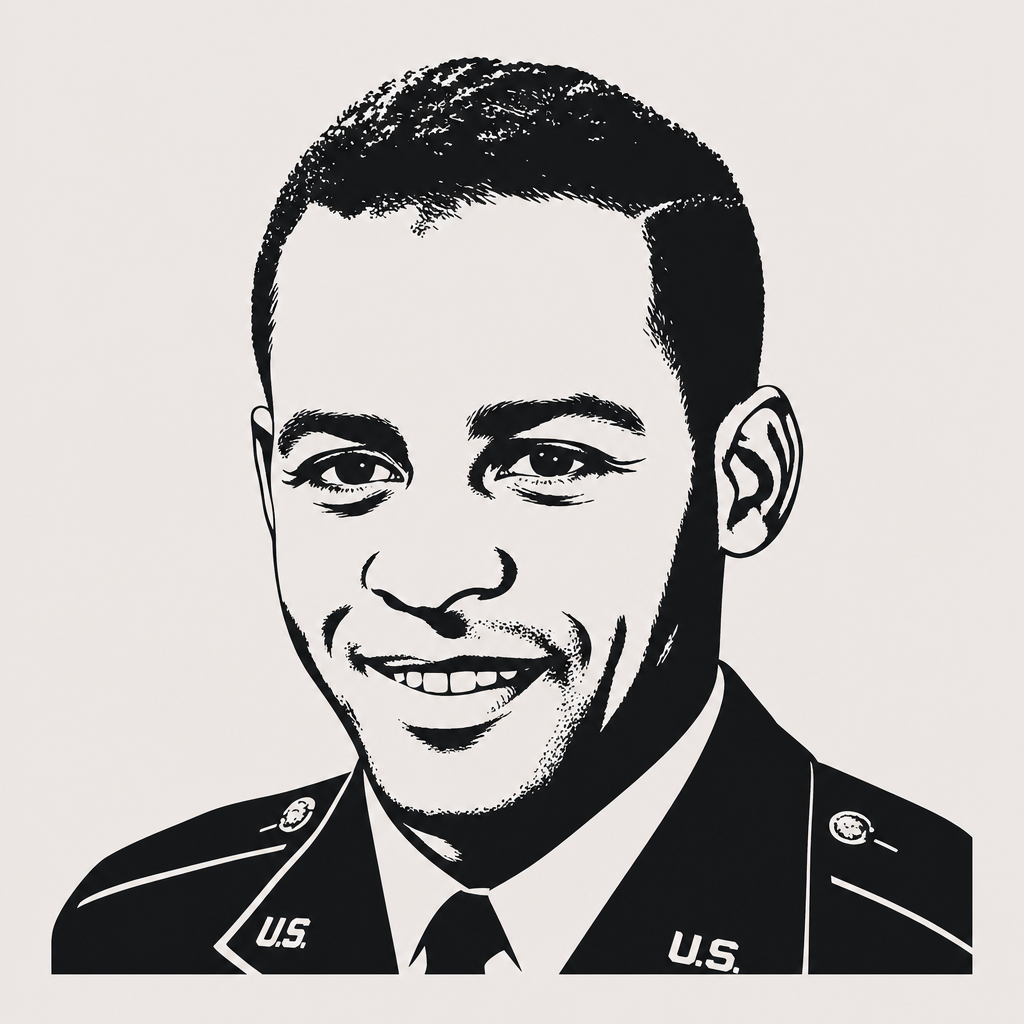
The Door Opens in the Desert
On the morning of May 19, 2024, a capsule swung down under its parachutes into the scrubland of West Texas — two parachutes, technically, since the third never fully filled, though the capsule is built to land safely that way. Inside were six passengers who had just spent ten minutes riding a Blue Origin rocket to the edge of space. When the hatch opened, the first thing the cameras caught was a small, wiry man of ninety pumping his fist in the desert air.
“Long time coming,” said Ed Dwight.
It had been sixty-one years. In 1963, Dwight’s face had been on magazine covers on five continents as the man expected to become the first Black astronaut. President Kennedy’s White House had engineered his path into the Air Force’s elite test-pilot school; the Black press had anointed him; schoolchildren wrote him letters. Then NASA passed him over, Kennedy was killed, and the whole project of Ed Dwight, astronaut, quietly ceased to exist. He resigned from the Air Force in 1966 and disappeared from the story of American spaceflight so completely that when he finally crossed the hundred-kilometre line at age ninety — the oldest human being ever to do so — many of the people watching had never heard of him.
What they had probably seen, without knowing it, was his other life’s work. For fifty years, in a Denver studio, Dwight had been building memorials in bronze — Frederick Douglass, Harriet Tubman, Martin Luther King Jr., the Underground Railroad, more than 130 public monuments across North America. Denied the chance to make history, he had spent half a century making sure history itself was not denied.
The Monarch’s Son
Edward Joseph Dwight Jr. was born on September 9, 1933, in Kansas City, Kansas, the son of two children of formerly enslaved people. His father, Ed Sr., played second base and centerfield for the Kansas City Monarchs, the flagship franchise of the Negro Leagues — a daily demonstration that Black excellence and exclusion could coexist in the same box score. His mother, Georgia Baker Dwight, supplied the family’s unbending will. When she decided her son would attend Bishop Ward, the local white Catholic high school, and the school resisted, she pressed her appeal up the Church hierarchy — by Dwight’s account, all the way toward the Vatican — until the door opened. In 1951 Ed became the school’s first Black male graduate.
The boy who walked through that door carried two obsessions that would take turns running his life. He was painting by age eight, good enough to earn a scholarship to the Kansas City Art Institute. And from the age of five or six he was hanging around the local airfield, cleaning airplanes for the chance to sit in them. Aviation won the first round. Dwight took an associate’s degree in engineering from Kansas City Junior College in 1953 and enlisted in the Air Force the same year.
He was commissioned in 1955 and proved to be exactly the kind of officer the service said it wanted: a jet pilot who completed a bachelor’s degree in aeronautical engineering, cum laude, at Arizona State in 1957 while on active duty, and steadily accumulated flight hours in high-performance aircraft. By the end of his career he would log some 9,000 hours in the air, more than 2,000 of them in jets. He was skilled, credentialed, ambitious — and, in the Air Force of the 1950s, almost uniquely inconvenient, because the country was about to need a Black man with precisely his résumé.
A Symbol at Mach 2
The need was geopolitical. As the space race began, Soviet propaganda relentlessly pointed at American segregation, and Washington knew it. In 1961 Edward R. Murrow, the broadcast legend then running the U.S. Information Agency, urged NASA to fly “the first non-white man in space” and thereby “retell our whole space effort to the whole non-white world, which is most of it.” The Kennedy administration went looking for a candidate. Dwight would later say the civil rights leader Whitney Young had personally pressed the idea on Kennedy — a story Young’s biographer disputes — but however the decision was made, the search produced a letter that reached Captain Ed Dwight in 1961, inviting him to apply to the Aerospace Research Pilot School at Edwards Air Force Base: the school that fed NASA’s astronaut corps, commanded by Chuck Yeager, the first man to break the sound barrier.
The announcement made Dwight an international celebrity overnight. Ebony, Jet, and Sepia put him on their covers; letters arrived by the thousand, from Black schoolchildren who had a new hero and from strangers who had a new hatred. Inside Edwards, the reception was colder. By Dwight’s account, Yeager resented his politically driven admission and told staff and classmates to keep their distance, hoping he would wash out. Yeager, for his part, denied any sabotage to the end of his life, insisting only that Dwight was an average pilot pushed forward by pressure from Washington — pressure that was real: when Dwight initially missed the cut for the school’s second phase, Air Force Chief of Staff Curtis LeMay, prodded by Attorney General Robert Kennedy, simply expanded the class until there was room for him. Both versions agree on the essential fact — that Dwight flew every day inside an institution where his success was a directive from above and his failure was, for some around him, devoutly wished.
He did not wash out. Dwight completed both the experimental test pilot course and the aerospace research course, and in 1963 the Air Force put him among the twenty-six names it recommended to NASA for the third class of astronauts.
That October, NASA announced its selections. Fourteen men. Dwight was not one of them. His classmate David Scott was; Scott would one day walk on the Moon. How close Dwight came is unknowable — accounts vary, NASA published no rankings, and no memo has ever surfaced proving a racial veto. What survives instead is the pattern: every astronaut selected until 1978 was white, and the assessment of Yeager’s own deputy, Thomas McElmurry, that Dwight was “perfectly capable of being a good astronaut,” but that flying him “wasn’t important enough to somebody in this country at this stage of the game.”
Five weeks after the announcement, Kennedy was murdered in Dallas. Whatever protection the White House had extended died with him. Dwight was transferred to Wright-Patterson Air Force Base in Ohio, a test-flying job pointed firmly away from space. He hung on for two more years, wrote to the new administration challenging NASA’s claim that no qualified African American could be found, and in 1966 resigned his commission, saying racial politics had forced him out. He was thirty-two. The first African American to actually reach space, Guion Bluford, would not fly until 1983 — twenty years after the class that turned Dwight away.
Bronze
What does a man do with the rest of his life when its whole trajectory has been amputated at the apex? Dwight’s first answer was ordinary American scrambling: engineering work, a stint at IBM, real estate and construction ventures, even a barbecue restaurant in Denver. For nearly a decade the most famous almost-astronaut in America was, deliberately, nobody in particular.
The second answer arrived in 1974, wearing the uniform of Colorado politics. George L. Brown — a Tuskegee Airman who had just become the first Black lieutenant governor in the United States — commissioned Dwight to sculpt a bronze bust of him for the State Capitol. Dwight had not seriously touched art since childhood, but the scholarship kid from the Kansas City Art Institute was still in there. Brown saw the result and pushed him hard: close the businesses, go to art school, do this. Dwight enrolled at the University of Denver, took his MFA in sculpture in 1977, and opened a studio.
Then came one of the most prolific second acts in American art. A Frederick Douglass memorial for the National Park Service in 1978. A series, “Black Frontier Spirit in the American West,” resurrecting the Black cowboys, soldiers, and settlers written out of the frontier myth. Seventy-plus bronzes of jazz — Armstrong mid-blast, Ellington at the keys, Ella, Bird, Miles. A Hank Aaron statue outside Atlanta’s stadium in 1982. Memorials to the Underground Railroad facing each other across the Detroit River — “Gateway to Freedom” in Detroit, “Tower of Freedom” in Windsor, Ontario — so that the escape route itself is bracketed in bronze. The African American History Monument at the South Carolina State House, unveiled in 2001 on grounds where a Confederate flag still flew. A Martin Luther King Jr. memorial in Denver’s City Park in 2002, one of many Kings he would sculpt. The Texas African American History Memorial at the state capitol in Austin, dedicated in 2016. A sculpture of the Obama family at the 2009 inauguration that entered the Smithsonian’s collections. By late 2024 the count stood at 132 public memorials and some 18,000 gallery pieces from a 25,000-square-foot Denver studio.
The subject matter was not incidental. The man whose own chapter had been cut from the space program spent five decades casting the cut chapters of American history in the one medium that does not fade, yellow, or go out of print. Asked about it over the years, Dwight has been consistent: bronze is an argument. A monument on a capitol lawn says this happened, and it says it for centuries.
Ten Minutes, Sixty-One Years Late
The story might have ended there — honored, prolific, and a footnote in space history books. Instead, the twenty-first century slowly turned back toward him. His 2009 memoir, Soaring on the Wings of a Dream, put his version on the record. In 2020 the Air Force gave him its Commander’s Award for Public Service and the Pentagon made him an honorary member of the new Space Force. In 2021 an asteroid was named 92579 Dwight. The 2023 National Geographic documentary The Space Race introduced him to a generation born decades after Edwards, and members of Congress began introducing legislation to award him the Congressional Gold Medal.
Then the nonprofit Space for Humanity offered to buy him a seat on a rocket.
Dwight hesitated. He was ninety; he had spent sixty years telling himself, as he put it, that he didn’t need spaceflight in his life. On May 19, 2024, he strapped into Blue Origin’s New Shepard capsule at Corn Ranch, Texas, with five other passengers — the company’s first crewed flight in nearly two years. The rocket crossed the Kármán line at roughly 107 kilometres. Dwight was weightless above the Earth he had been promised in 1961. Nine minutes and fifty-three seconds after liftoff, the capsule was back on the desert floor, and the fist came up through the hatch: “Long time coming.”
At 90 years, 8 months, and 10 days old, he had edged William Shatner by about two months to become the oldest human ever in space. He told interviewers afterward that he had been wrong all those years — he did need it, and it had changed his life. The record was almost beside the point. The point was the correction: the man from the 1963 magazine covers, finally in the sky, with the cameras once again watching.
The Man Who Made the Record Permanent
There is a clean version of the Ed Dwight story — hero denied, justice delayed, justice done — and Dwight himself has never told it quite that way. He was never a NASA astronaut, and he is careful about titles: he was the first African American astronaut candidate. Robert Lawrence, selected to an Air Force space program in 1967, was the first Black astronaut chosen for any program, and died in a training crash before he could fly; Bluford was the first in space. Dwight’s distinction is harsher and more instructive: he is the man on whom the country ran its first experiment in integrating space, and the experiment’s result — capable, qualified, unselected — measured exactly how much that country wanted it in 1963. Not enough.
What elevates him is what he built on the far side of that verdict. A ten-minute suborbital hop at ninety made him news; the memorials made him consequential. Millions of people encounter Douglass, Tubman, King, the Black West, and the Underground Railroad through his hands, mostly without knowing his name or his history — which may be the quietest irony of all, since permanence-without-recognition was precisely his fate in the space program he helped integrate by losing.
He kept working in his Denver studio into his nineties, past the flight, past the documentaries, still casting history faster than institutions could commission it. The Kansas City airfield kid had wanted the sky; the country gave it to him sixty-one years late and only for ten minutes. The bronze, though — the bronze was his own doing, and it will outlast every rocket in the story.
Sources
- Smithsonian Magazine — “Ed Dwight Was Going to Be the First African American in Space. Until He Wasn’t” (https://www.smithsonianmag.com/history/ed-dwight-first-african-american-space-until-wasnt-180974215/)
- Encyclopaedia Britannica — “Ed Dwight” (https://www.britannica.com/biography/Ed-Dwight)
- Ed Dwight Studios — official biography (https://eddwight.com/about)
- Spaceflight Now — “Blue Origin resumes passenger flights, carries crew of six and 90-year-old aerospace pioneer to space,” May 20, 2024 (https://spaceflightnow.com/2024/05/20/blue-origin-resumes-passenger-flights-carries-crew-of-six-and-90-year-old-aerospace-pioneer-to-space/)
- Ed Dwight, Soaring on the Wings of a Dream: The Untold Story of America’s First Black Astronaut Candidate (2009)
- Congress.gov — “Edward J. Dwight, Jr. Congressional Gold Medal Act” (S.734, 119th Congress) (https://www.congress.gov/bill/119th-congress/senate-bill/734/text)