Léon Foucault
The Invitation
In the first days of February 1851, cards went out to the scientists of Paris carrying one of the most audacious invitations in the history of science: “You are invited to come and see the Earth turn.”
Not deduce it. Not calculate it. See it.
For three centuries, since Copernicus, every educated person had accepted that the Earth spins on its axis. But the proof had always been astronomical — inferred from the wheeling of the heavens, argued from the motions of other bodies. No one had ever produced a demonstration you could stand in front of, here on the ground, and watch the planet move. On February 3, in the Meridian Hall of the Paris Observatory, the guests found a heavy bob hanging from a wire, swinging in a slow, patient arc. They watched. And over the minutes, the plane of that swing crept steadily clockwise across the floor — not because anything pushed it, but because the floor, the room, the city, the whole of France was rotating beneath a pendulum that refused to turn with it.
The man who had arranged this was 31 years old. He had no degree in science. He had flunked out of medicine at the sight of blood. He had never held an academic post and never would hold one that his own country’s scientific establishment was willing to give him. He earned his living as a newspaper columnist. And he had just done, with a wire and a weight, something that Galileo, Newton, and every mathematician of the intervening centuries had not managed to do.
His name was Léon Foucault, and making the invisible visible was the thing he did better than anyone alive.
The Boy Who Fainted
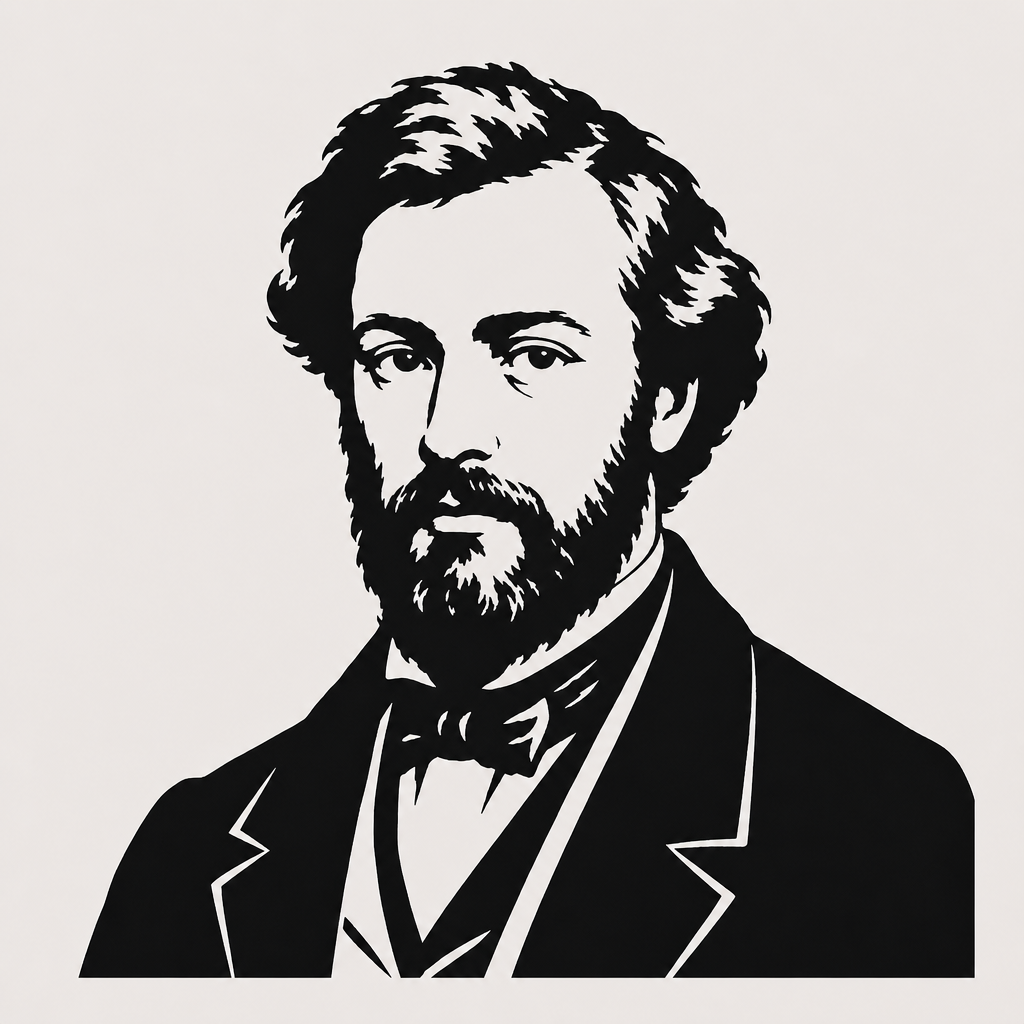
Jean Bernard Léon Foucault was born in Paris on September 18, 1819, the son of a publisher known for a respected series on the history of France. It was not a scientific household, and it was not, for long, a happy one. His father’s health failed; the family retired to Nantes, where the elder Foucault died in 1829, when Léon was nine. Mother and son returned to Paris, to a house at the corner of the rue de Vaugirard and the rue d’Assas whose cellar would, two decades later, become famous.
By every account Léon was an unpromising child: frail, shy, solitary, with mismatched eyes — one near-sighted, one far-sighted — that made him self-conscious. At the Collège Stanislas his teachers wrote him off as lazy, and his mother resorted to private tutors at home. His boyhood friend Jules Lissajous, later a distinguished physicist himself, remembered that “nothing about the boy announced that he would be illustrious some day.”
But there was one thing the boy could do. His hands were extraordinary. As a teenager he built working models that were genuinely sophisticated — a miniature steam engine, a telegraph, mechanisms far beyond a hobbyist’s toys. It was this manual genius, his mother decided, that pointed toward surgery, a career where a delicate and precise hand was everything. So in 1839 Léon enrolled in medical school.
It ended almost at once. On his first real hospital experience, confronted with blood, he fainted. He tried to master the phobia and could not, and he withdrew. The career his mother had chosen for him was over before it began.
What saved him was a teacher. Alfred Donné, a professor working on microscopic anatomy, saw past the fainting student to the pair of gifted hands, and took Foucault on as his experimental assistant. It was the first of two rescues Donné would perform. In the early 1840s Foucault threw himself into the newest marvel of the age — photography, barely born from Daguerre’s 1839 announcement. With his old schoolfriend Hippolyte Fizeau he improved the daguerreotype process, and to photograph specimens through a microscope he built a powerful electric arc lamp for illumination. In 1845 he and Donné published a landmark atlas of microscopy illustrated with eighty photographic micrographs — the instrument-builder announcing himself before the physicist ever did.
That same year the two doors of Foucault’s real life swung open. The great astronomer François Arago, impressed by the micrographs, asked Foucault and Fizeau to try photographing the Sun; on April 2, 1845, they produced the first successful daguerreotype of it, sunspots and all. And Donné, giving up his side career as science editor of the influential daily Journal des Débats, handed the column to his 25-year-old assistant. So a man with no degree and no scientific publications became, overnight, the arbiter of French science for the reading public — a post he would hold for the rest of his life. The Académie’s future secretary Joseph Bertrand recalled that this young journalist’s “quiet authority and frankness” irritated a good many established scientists. It would not be the last time.
The Settler of Questions
Foucault was never a builder of grand theories. He was something rarer and, in its way, more useful: a man who closed arguments other people had opened. Give him a question that the credentialed elite had posed but could not resolve, and he would build the apparatus that answered it.
The first great one came from Arago himself. For decades physicists had fought over the nature of light — was it a wave, as Fresnel argued, or a stream of particles, as Newton had held? Arago had designed a decisive test: measure whether light travels faster in air or in water. The wave theory predicted water would slow it; the particle theory predicted the opposite. But Arago’s eyesight was failing, and around 1847 he handed the cherished experiment to the two brilliant young men who had photographed the Sun for him. Foucault and Fizeau, once collaborators, quarrelled and split — the precise cause is thinly documented — and pursued it separately, each racing the other.
In April 1850, using a steam-driven rotating mirror to catch light’s fractional-second flight, Foucault showed that light travels slower in water than in air. It was the verdict the wave theory demanded, and it was widely taken as the last nail in the coffin of Newton’s corpuscular picture. He beat Fizeau’s version of the experiment by a matter of weeks. Foucault’s own summary of the achievement is the truest thing he ever said about himself: “I did not invent the spinning mirror, nor the achromatic lens… but I have had the good fortune to be able to put these instruments, devised by other scientists, together in such a way that I have solved a problem which was posed twelve years ago.” He was a combiner and a perfecter, and he was proud of exactly that. (He would write it up formally as a doctoral thesis in 1853 — one of the few conventional credentials he ever bothered to collect.)
Then came the idea that would make him immortal. Some time in the first days of January 1851 — the story, drawn from his notebooks, places the flash of insight at two in the morning — Foucault was watching a thin steel rod vibrate as it was clamped in the chuck of a lathe. As he turned the chuck, the rod kept vibrating in the same plane, indifferent to the rotation beneath it. What if, he reasoned, a pendulum could be hung so freely that it, too, would keep the plane of its swing fixed in space — while the Earth turned underneath?
He tested it in the cellar of the rue d’Assas house with a two-meter pendulum. By some accounts the first wire snapped; within days he had it working, and he watched the plane of the swing drift slowly clockwise. He was, in that moment, almost certainly the first human being to see the planet rotate.
Arago gave him the Observatory for a grander version, and on February 3, 1851, the invitation cards summoned Paris to the Meridian Hall to watch an eleven-meter pendulum do the same. The same day, Arago read Foucault’s paper to the Académie des Sciences. In it Foucault stated, without proof, the elegant law governing the effect: the time for the swing plane to complete a full circuit depends on latitude, going as one over the sine of the angle — so the veer is fastest at the poles and vanishes at the equator. He had arrived at it empirically, apparently unaware of the mathematics Coriolis had published in 1832. Within two weeks the mathematician Jacques Binet supplied the full derivation; others rushed to catch theory up with the experiment. It emerged that the great Poisson had once considered such an effect and dismissed it as not worth pursuing, and that back in the 1660s the Accademia del Cimento in Florence had actually noticed pendulums drifting and filed it away as a nuisance. Others had glimpsed the phenomenon, or held the equations. Foucault alone saw what it meant, and built the thing that made it undeniable.
Under the Great Dome
The Observatory demonstration was for scientists. What made Foucault a household name was what happened next, and it happened because a politician who dabbled in science decided to lend him the grandest room in Paris.
Louis-Napoléon Bonaparte, then Prince-President of the Second Republic, authorized Foucault to use the Panthéon — the vast domed former church at the top of the Latin Quarter. There, in late March 1851, with the precision engineer Paul-Gustave Froment, Foucault hung a 28-kilogram bob of brass-covered lead from a steel wire 67 meters long, reaching up into the dome. A stylus fixed beneath the bob traced a line in a ring of sand laid on a wooden platform. Each swing took about sixteen and a half seconds. And with every pass, the stylus cut its groove a couple of millimeters to the side of the last one, the plane of the great pendulum wheeling roughly eleven degrees an hour — a full circuit, at the latitude of Paris, in about thirty-two hours.
Ordinary Parisians came in crowds to stand under the dome and watch the sand line creep. There was nothing to take on faith. The evidence was mechanical, silent, and utterly persuasive: the pendulum held its plane, and the sand told you that everything else — the platform, the Panthéon, the city, you — was turning. Within months, replica pendulums were swinging in churches and lecture halls across Europe and America. A fact that had lived for three hundred years only in books had become, for anyone who could walk into a room, an experience.
The showmanship was of a piece with the man. For twenty years Foucault had explained science to newspaper readers; the sand, the invitation cards, the ceremonial hush were the instincts of a great popularizer as much as a great experimenter. But the Panthéon demonstration was cut short by history. On December 2, 1851, Louis-Napoléon staged the coup d’état that would make him Emperor Napoleon III, the Panthéon reverted to religious use, and Foucault’s pendulum came down.
What the Hands Left Behind
The pendulum did not settle the argument as cleanly as Foucault wished — the Musée des Arts et Métiers notes that his instrument “had not finished dividing the scientific community” — and so in 1852 he built a second proof, one that would work at any latitude. He took a fast-spinning rotor mounted so its axis was free to point anywhere, and found that the axis held its direction against the stars while the Earth turned beneath it. He named it the gyroscope, from the Greek for “to see rotation.” In his own century it was a scientific curiosity of little practical use. In the next it would become the beating heart of navigation, guiding ships, aircraft, and spacecraft.
Recognition came, but not from home. In 1855 the Royal Society of London awarded him the Copley Medal, its highest honor, for his “very remarkable experimental researches” — the English scientific establishment honoring him a full decade before his own would. That same year Napoleon III, who could not persuade the Académie to give Foucault a post, simply created one for him: Physicist Attached to the Imperial Observatory, the first and only scientific job Foucault ever held. It placed him under the autocratic director Urbain Le Verrier, the discoverer of Neptune, and the two men did not get along.
The instruments kept coming. In 1855 he discovered the eddy currents — still called Foucault currents — induced in a metal disc spun between magnet poles, the basis of induction braking and heating. Around 1857–58 he transformed astronomy’s most important tool: he replaced the tarnish-prone speculum-metal telescope mirror with silvered glass, and invented the “knife-edge test,” a beautifully simple way to measure a mirror’s figure to a fraction of a wavelength. Mirror-making stopped being hit-or-miss and became measurement, and the modern reflecting telescope was born — the technique is still used by amateur mirror-grinders today. In 1862, with a refined rotating-mirror apparatus, he measured the speed of light at 298,000 kilometers per second, within about 0.6 percent of the modern value and low enough to force a downward revision of the scale of the solar system.
Only in 1865, after being turned away repeatedly over the years, was Foucault finally elected to the Académie des Sciences, in its mechanical section. He was 45. He had, by then, decided the nature of light, made the Earth’s rotation visible, handed astronomy its modern mirror, and measured the speed of light more accurately than anyone before him. The American Physical Society would later put the establishment’s long resistance bluntly: it “had never accepted Foucault because of his lack of scientific training,” was slow to credit his greatest result, and “some tried to claim priority.” Possibly, it added, they were simply annoyed they had not thought of it themselves.
He had little time to enjoy the vindication. In October 1867 his hands went numb, and a paralysis set in and progressed with frightening speed. His mother nursed him; near the end he returned to the Roman Catholic faith he had earlier set aside. On February 11, 1868, Léon Foucault died in Paris, aged 48. The cause has never been settled: most modern accounts point to a rapidly advancing multiple sclerosis, though some have blamed cumulative poisoning from a lifetime of laboratory chemicals, mercury above all. His own century could only call it a creeping paralysis. He was buried in Montmartre Cemetery.
The Pendulum Still Swings
Foucault’s afterlife has been curiously lopsided. The gyroscope, the silvered mirror, the eddy currents, the rotating-mirror method that Michelson would later refine on the road to relativity — these quieter gifts are woven so deeply into modern technology that his name has fallen off most of them. What everyone remembers is the wire and the weight.
And that memory has been faithfully kept. In 1902 the astronomer and popularizer Camille Flammarion restaged the Panthéon experiment for its fiftieth anniversary before a crowd of more than two thousand, a minister of the Republic ceremonially burning the cord to set the great bob loose. Foucault’s name is carved into the frieze of the Eiffel Tower among the seventy-two honored French scientists; a lunar crater and an asteroid bear it; Umberto Eco borrowed it for a bestselling novel. A pendulum was permanently reinstalled beneath the Panthéon’s dome in 1995 and, after restoration, set swinging again in 2015, and one swings daily at the Musée des Arts et Métiers under the vault of a medieval priory. (The museum preserves Foucault’s original spheres and runs the demonstration continually; which exact bob hangs and swings there has been a matter of some confusion, and is best left to the curators.)
It is a fitting shape for the legacy of a man who spent his life making invisible truths visible. The French scientific establishment’s long verdict on the untrained outsider — that he was a clever mechanic, not a real scientist — has been almost entirely forgotten. The demonstration he built to overturn it goes on turning, silently, in front of anyone who cares to look, proving the same thing it proved in 1851: that the ground beneath our feet is moving, and that a patient man with good hands could find a way to let us see it.
Sources & Further Reading
- Tobin, William — The Life and Science of Léon Foucault: The Man Who Proved the Earth Rotates (Cambridge University Press, 2003) — the standard modern scholarly biography.
- Aczel, Amir D. — Pendulum: Léon Foucault and the Triumph of Science (Atria/Washington Square Press, 2003) — narrative popular history; borrowable at the Internet Archive.
- Foucault, Léon — “Démonstration physique du mouvement de rotation de la Terre au moyen du pendule,” Comptes rendus de l’Académie des sciences 32 (1851), and Recueil des travaux scientifiques de Léon Foucault (Paris, 1878) — the primary record; Recueil at archive.org.
- O’Connor, J. J. & Robertson, E. F. — “Jean Bernard Léon Foucault,” MacTutor History of Mathematics Archive, University of St Andrews (mathshistory.st-andrews.ac.uk).
- American Physical Society — “This Month in Physics History: February 3, 1851” (APS News, February 2007).
- Panthéon / Centre des monuments nationaux — “Foucault’s pendulum” (paris-pantheon.fr); Musée des Arts et Métiers — Foucault pages (arts-et-metiers.net).
- Ashworth, William B., Jr. — “Scientist of the Day: Léon Foucault,” Linda Hall Library, 2018 (lindahall.org).