Victor Hugo
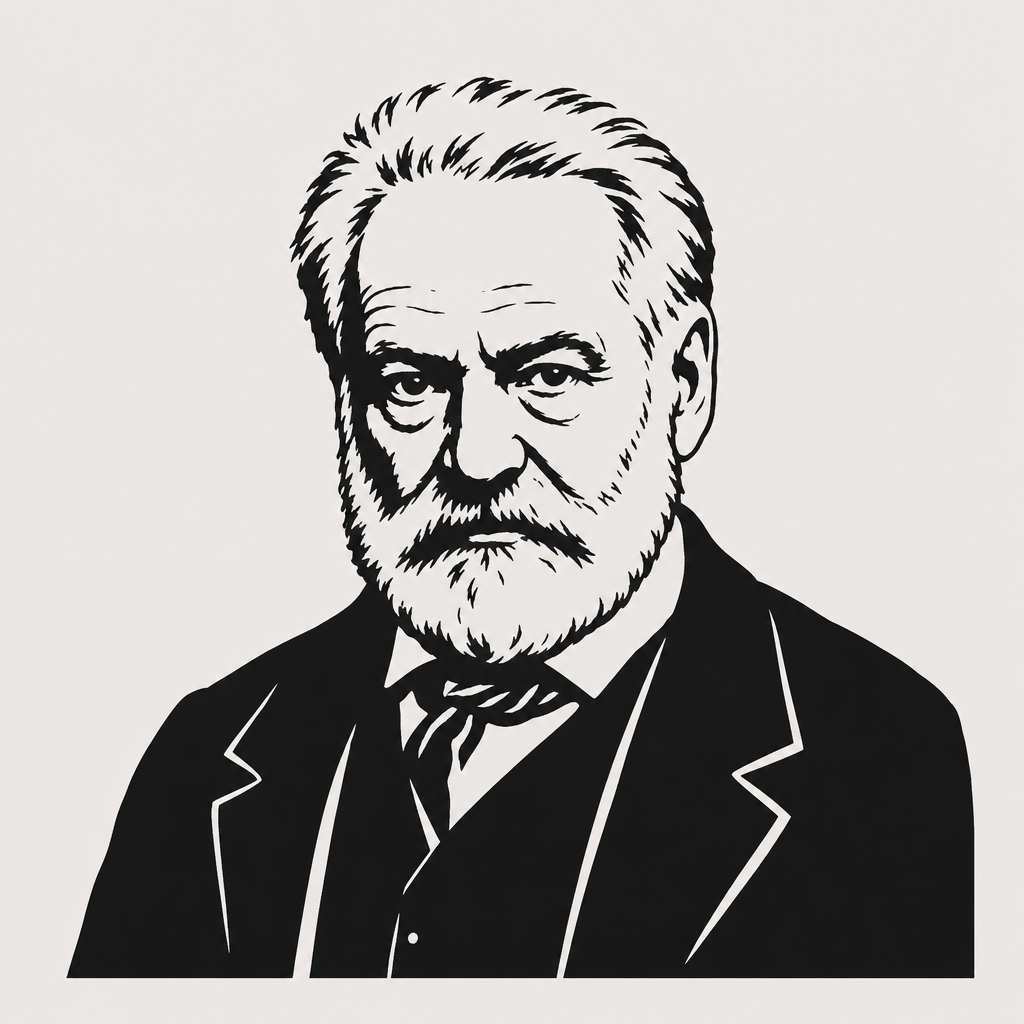
A Cart Under the Arch
On the night of May 31, 1885, the largest triumphal arch in Europe was draped in black. Beneath the Arc de Triomphe, built to glorify an emperor’s armies, lay the coffin of an eighty-three-year-old poet, guarded through the dark by relays of schoolboys and mounted cuirassiers while Paris filed past by torchlight. The state had voted him the honors of a demigod: the Chamber had deconsecrated the Panthéon to receive him, taking the building back from the Church for good.
Then, at dawn, the machinery of glory produced its strangest object. Not a gilded catafalque, but the plainest black wagon in the city — the corbillard des pauvres, the hearse reserved for those too poor to pay for a funeral. Victor Hugo had demanded it in his will, in words read aloud across France: “I give fifty thousand francs to the poor. I wish to be carried to the cemetery in their hearse. I refuse the oration of every church; I ask for a prayer from every soul. I believe in God.”
Twenty-one cannon fired at half past ten. Then the cheapest hearse in Paris rolled down the Champs-Élysées toward the Panthéon behind nineteen orators and more than eleven hundred delegations, watched by a crowd variously counted at two million and three — larger, by any reckoning, than the living population of the city. In a single morning the whole double nature of the man was on display: the secular saint who wanted no priests, the incorrigible showman whose humility filled the streets, the outsider the establishment could not stop canonizing. To understand how a cart came to pass under that arch, you have to go back thirty-four years, to another night when the same man left France in the dark with false papers in his pocket.
The Century Was Two Years Old
He was born in Besançon on February 26, 1802 — “this century was two years old,” he later wrote, dating himself to the age as if the two had been issued together. The claim was characteristic. Hugo would become the greatest self-mythologizer in French letters; his biographer Graham Robb opens by dismantling Hugo’s own tale that he was conceived in mid-air on a mountain peak, a legend so durable that pranksters later planted a memorial stone to mark the imaginary spot.
The truth of the family was stranger than the myth and less flattering. His father, Léopold, was a general of Napoleon’s armies, a soldier of the Revolution serving the Bonaparte kings. His mother, Sophie Trébuchet, was a royalist from Nantes whose sea-captain father had made his money on slave-trading voyages. The marriage was a running war, and its front lines ran through the children; the parents separated for good in 1818. Young Victor’s childhood shuttled between his mother’s Paris — the wild garden of the Feuillantines — and his father’s postings, including a year in Madrid in 1811 that stocked his imagination with the Spain he would later pour into Hernani and Ruy Blas.
The ambition arrived early and undisguised. At fourteen he wrote in his diary: “I shall be Chateaubriand or nothing.” He very nearly skipped the “nothing.” At fifteen he won a mention in an Académie française competition — the judges suspected him of lying about his age. A prize at the Toulouse Floral Games followed, then a royal pension from the Bourbon court for an ode mourning the assassinated Duc de Berry. His first collection, Odes et poésies diverses, appeared in 1822, the work of a devout Catholic royalist rewarded by the restored monarchy. That October he married his childhood sweetheart, Adèle Foucher, over the memory of his mother’s objections; she had died the year before. Five children came in eight years, and one, Léopoldine, born in 1824, would become the great love and the great wound of his life. In 1825 Charles X made him a Chevalier of the Legion of Honor and invited him to the coronation at Reims. He was twenty-three, decorated, pensioned, and pious — the model insider. Almost nothing about the young Hugo predicted the old one.
Storming the Citadel
The turn began in the theater. In 1827, the preface to his unstageable play Cromwell became the manifesto of French Romanticism — a demand to smash the airless rules of classical drama and let the grotesque sit beside the sublime, as it does in life. Words were cheap; the battle came in 1830. On February 25, his verse drama Hernani premiered at the Comédie-Française, and Hugo ran the night like a military operation, packing the pit with young Romantic partisans hours early to shout down the outraged Classicists. The howling matches went on for weeks. Romanticism took the citadel; five months later, the July Revolution took the throne. The literary insurgency and the political one rhymed, and Hugo would spend his life hearing the echo.
Then came the prose that made him immortal. Notre-Dame de Paris (1831) turned a crumbling cathedral into the hero of a novel and helped ignite the movement to save France’s Gothic heritage — Viollet-le-Duc’s restoration of the actual building began in 1844. In 1832 the family moved to a grand apartment on the Place Royale, today the Place des Vosges, now the museum that preserves his rooms. The same year the censors banned his play Le Roi s’amuse after a single performance; the fight over it radicalized him on the freedom of the press and the stage. (Verdi would later smuggle the banned play back to the world as Rigoletto.)
His private life was accumulating its shadows. His wife Adèle, worn down by his fame and his appetites, drifted into a long attachment to his closest friend, the critic Sainte-Beuve — the great literary friendship-poisoning of the age. In 1833, during rehearsals for Lucrèce Borgia, Hugo met an actress named Juliette Drouet and began a relationship that would last fifty years. She gave up the stage, became his copyist and traveling companion, lived in near-seclusion for his sake, and wrote him some twenty thousand letters. He never married her. She is the first entry in a private ledger that the public monument was built to hide: a wife pushed away, a mistress kept in the wings, and, documented beyond dispute by Robb and by Hugo’s own coded notebooks, a lifetime of other affairs pursued into his eighties.
The election to the Académie française finally came in 1841, after several rejections. By 1843 he was at the summit — and then the floor gave way.
The Café at Rochefort
On September 4, 1843, Léopoldine, nineteen years old and married just seven months, drowned in the Seine at Villequier when a squall capsized a small boat. Her husband, Charles Vacquerie, drowned trying to save her; they were buried together. Hugo was traveling in the south of France with Juliette Drouet. He learned that his daughter was dead days later, on September 9, when he opened a newspaper at a café in Rochefort. The grief silenced him. He published no new book for years, and when the mourning finally became poetry — Demain, dès l’aube, À Villequier — it appeared only in 1856, in a collection he divided into “Long Ago” and “Today,” before and after that single date. It is his most beloved work, and it carries a queasy edge his admirers rarely name: the most public man in France turned his most private catastrophe into a masterpiece and a monument.
Power came anyway, and with it disgrace. Made a Peer of France in 1845, he was caught that July in an affair with a married woman, Léonie Biard. She was sentenced to two months in prison and six in a convent; he, protected by his peerage, walked home untouched — the double standard of his private life written into law. Within weeks he began the sprawling draft, then called Les Misères, that would become Les Misérables.
Politics finished the transformation. In the Revolution of 1848 he rallied to the new Republic and won a seat in the Assembly; that September he demanded the abolition of the death penalty in a single line — “You have overthrown the throne. Now overthrow the scaffold” — reviving a cause he had championed since 1829 and would carry to his grave. Crucially, and inconveniently for the later legend, he supported Louis-Napoléon Bonaparte’s run for the presidency. Then he watched the man govern, broke with the conservatives, and in 1849 rose to declare that misery itself could be abolished by law. By July 1851 he was mocking the president’s imperial ambitions from the rostrum: because France had once had Napoléon the Great, must it now endure Napoléon le Petit — Napoleon the Small? The insult would cost him nineteen years.
The One Choice He Could Not Curate
On December 2, 1851, Louis-Napoléon seized absolute power in a coup. Hugo and other deputies of the left tried to organize resistance in the streets — building barricades, printing proclamations. His own account, Histoire d’un crime, casts him as its fearless director; sober historians find the resistance real but brief and his role smaller and safer than he later made it sound. What is not in doubt is the ending. With arrest looming, he fled to Brussels on December 11 under a false passport, in the workman’s disguise of a man who had run out of other options. This was the choice, when it finally came, that Hugo could not stage-manage: submit to the new Empire, or leave. He left, and stayed gone for almost two decades.
Exile turned France’s most decorated insider into its incorruptible outsider, and it made him a better writer. Expelled from Belgium after his pamphlet Napoléon le Petit sold by the tens of thousands as contraband inside France, he moved to Jersey in the Channel Islands and, in 1853, published Les Châtiments, a book-length poem lashing the Second Empire. That same year the fashionable craze of table-turning reached his house when Delphine de Girardin introduced séances at Marine Terrace. For roughly two years the exiled family transcribed conversations with the spirits of “Shakespeare,” “Dante,” and “Death”; the first voice the table produced, they believed, was Léopoldine’s. The transcripts are real and voluminous. What they mean is not: readings range from raw grief, to a family unconsciously ventriloquizing Hugo’s own style through his son Charles as medium, to sincere metaphysical conviction. He stopped in 1855 and never published the records in his lifetime.
Expelled again from Jersey that year, he crossed to Guernsey, and there, with the proceeds of the triumphant Les Contemplations (1856), he bought Hauteville House — the only home he ever owned. He spent three years turning it into a habitable work of art, crowned by a glass “lookout” study on the roof where he wrote standing up, facing the sea and, on clear days, the coast of the country he refused to re-enter. In 1859 Napoleon III offered an amnesty to the exiles. Hugo refused it: “When liberty returns, I will return.” From that rock he finished Les Misérables, which detonated across Europe in 1862 — the exile’s greatest work, published from inside the Empire that had banished him. The same year he began serving weekly dinners to poor Guernsey children at his own table.
The Republic’s Conscience
The Empire fell at Sedan in 1870. The Republic was proclaimed on September 4; Hugo returned to Paris on September 5, to a hero’s welcome, after nineteen years. He stayed through the Prussian siege, recording in his diary the menu of a starving city eating the animals of the zoo. What followed was not triumph but attrition. He watched the Commune rise and fall, condemned both its violence and the savagery of its repression, and spent years pressing for amnesty for its survivors. Grief kept pace with politics: his sons Charles and François-Victor both died before him, in 1871 and 1873, and in 1872 his surviving daughter, Adèle, was brought home from the Caribbean after years spent pursuing a British officer who did not want her. She was institutionalized and lived, in and out of asylums, until 1915 — the only one of his five children to outlive him, and the strongest evidence for the human cost of orbiting Victor Hugo. Truffaut would film her story in 1975.
The last decade rebuilt him as the nation’s grandfather — white-bearded, raising his grandchildren Georges and Jeanne, publishing L’Art d’être grand-père (1877), elected senator, feted in 1881 by a street festival in which hundreds of thousands filed past his window and the avenue outside was renamed for him while he still lived. He could receive letters addressed simply to “Monsieur Victor Hugo, in his avenue, Paris.”
The reckoning has to keep two ledgers, as his life did. One holds the moral causes with receipts: the death penalty, fought from 1829 to the end and cited in abolitions from Geneva to Colombia; amnesty for the Communards, finally won in 1880; free education; a “United States of Europe” he named as early as 1849. The other holds the contradictions. He was an abolitionist who wrote to campaigners in America that the nation must “renounce slavery or renounce liberty,” and who pleaded for John Brown’s life in 1859 — and he was the man who, at an 1879 banquet celebrating the abolition of slavery, declared of Africa: “God offers Africa to Europe. Take it.” The universalist’s “universal” was Europe, and the same tongue could preach emancipation and conquest in the same breath. Neither the saint nor the satyr alone is the man.
He died of pneumonia on May 22, 1885, at eighty-three. Days earlier he had written a note that survives — “To love is to act.” Household memoirs report a whispered last line, “I see black light,” which belongs to legend more than to record. Then came the black-veiled arch, the pauper’s hearse, and the river of two million. The young Third Republic was inventing its own civic religion — its saints, its scriptures, its shrine — and in burying Victor Hugo it performed its founding rite. He had spent a lifetime curating his own myth. In the end the nation finished the job, and, for once, the monument and the man very nearly matched.
Sources & Further Reading
- Maisons de Victor Hugo (Paris Musées) — “Questions about Victor Hugo’s Life” timeline and Hauteville House history (maisonsvictorhugo.paris.fr)
- Robb, Graham — Victor Hugo: A Biography (W. W. Norton, 1997)
- Hovasse, Jean-Marc — Victor Hugo (Fayard, 2 vols., 2001–2008)
- Panthéon (Centre des monuments nationaux) — “The Crypt” (paris-pantheon.fr)
- Hugo, Victor — Le Livre des Tables: Les séances spirites de Jersey, ed. Patrice Boivin (Gallimard, 2014); and the posthumous Choses vues and Actes et paroles
- Guillemin, Henri — L’Engloutie: Adèle, fille de Victor Hugo (Seuil, 1985)