Jomo Kenyatta
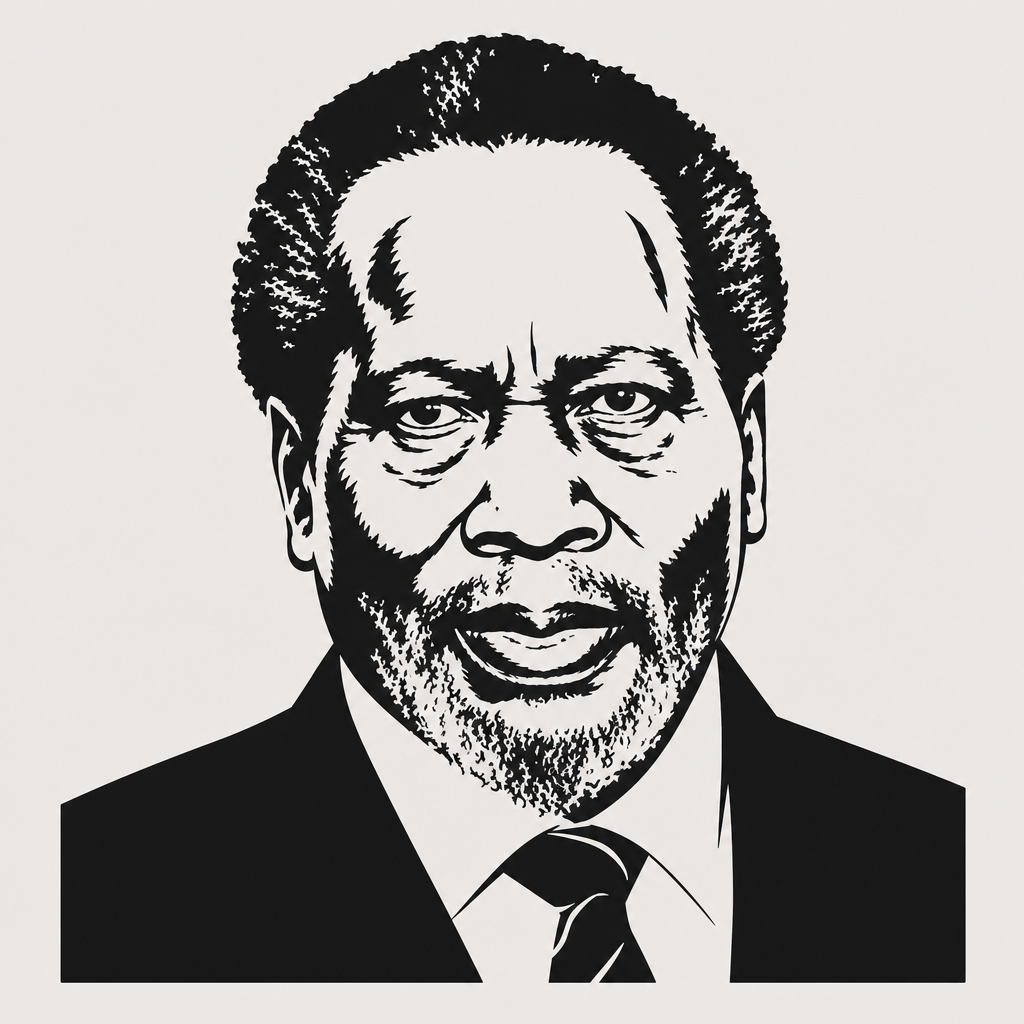
The Schoolhouse at the End of the Line
In December 1952, the British Empire put a man on trial in a place chosen so that almost no one could watch.
Kapenguria was a remote district station near Kenya’s border with Uganda — no telephone, no railway, no hotel, reachable only by permit. There, in a converted schoolroom, the colonial government charged Jomo Kenyatta and five other nationalists with “managing” Mau Mau, the secret insurgency then burning through Kenya’s White Highlands. The judge, Ransley Thacker, had been brought out of retirement for the job; colonial records unearthed decades later show the government arranged to pay him £20,000. The star witness, Rawson Macharia, swore that Kenyatta had personally administered a Mau Mau oath to him. Six years later Macharia would swear a fresh affidavit: he had lied, the witnesses had been coached, and he had been promised a university course in England and a government job for his testimony.
The deepest irony sat in the dock. Weeks before his arrest, at a huge public meeting at Kiambu, Kenyatta had cursed the movement he was accused of running — “Let Mau Mau perish forever,” as the press reported his words. The militants in his own party considered the older man an obstacle, too moderate, too fond of constitutions. The empire had caught the wrong man, and the trial was rigged anyway. In April 1953 Thacker sentenced Kenyatta to seven years’ hard labour.
It was, in the long run, the most spectacular miscalculation in the history of British Kenya. The colony’s rulers meant to bury a politician. Instead they manufactured a martyr — and then found, when the Emergency ended, that the only man who could deliver a peaceful Kenya was the one they had locked in the desert.
Three Names
The man in the dock had already lived several lives, under several names, and did not know his own birthday. He was born Kamau, son of Muigai and Wambui, Kikuyu farmers at Ichaweri near Gatundu, sometime in the 1890s — conventionally around 1897, though no record was made and estimates range across nearly a decade. His father died when he was young; his mother remarried his uncle Ngengi, making the boy Kamau wa Ngengi.
Around 1909 he walked to the Church of Scotland Mission at Thogoto — brought there, by most accounts, for surgery on an infected foot and spine — and stayed, learning English, the Bible, and carpentry. Baptized “Johnstone Kamau” in 1914, he moved to Nairobi and found the sweet spot of the colonial economy: a clerk’s job reading water meters, a bicycle, and the beaded belt, the kinyata, that gave him his chosen surname. Around him was a colony built on a simple arrangement: the best farmland — the “White Highlands,” much of it taken from the Kikuyu — was reserved for European settlers, while Africans carried pass-books, paid hut tax, and had no elected voice at all.
Politics found him in the 1920s, after colonial police fired on a Nairobi crowd protesting the arrest of the pioneer agitator Harry Thuku. By 1928 Kenyatta was general secretary of the Kikuyu Central Association and editor of its journal Muigwithania — “The Reconciler” — the first Kikuyu-language newspaper. In 1929 the association sent him to London to press the land grievance. Apart from one return trip, he stayed away fifteen years.
Those years made him. He studied at the Communist University of the Toilers of the East in Moscow — and drifted away as Comintern politics soured; his Marxism was always a tool, never a faith. He played an African chief in the film Sanders of the River beside Paul Robeson, scraped by as a farm laborer in Sussex during the war, and married an English wife, Edna Clarke, whom he would leave behind with their son when Kenya called. Above all, he studied anthropology at the London School of Economics under the great Bronisław Malinowski, and in September 1938 published Facing Mount Kenya — the first anthropological monograph about an African people written by one of its own. It was scholarship as politics: a proud, romanticized defense of Kikuyu land tenure and custom (including, uncomfortably for modern readers, female initiation), signed with a new name that fused the beaded belt with a Kikuyu given name: Jomo Kenyatta. In October 1945 he helped organize the Pan-African Congress in Manchester with George Padmore and Kwame Nkrumah — the meeting where a generation of future presidents resolved that petitioning was over and mass politics would begin.
Leader to Darkness and Death
Kenyatta sailed home in September 1946 to a colony at the edge of its patience. A returning soldier generation had come back from fighting for freedom abroad to landlessness at home; squatters were being squeezed off settler farms; Nairobi seethed. Kenyatta became principal of the independent African teachers’ college at Githunguri and, in June 1947, president of the Kenya African Union. For six years he was the colony’s commanding African voice — a showman with a booming laugh, a flywhisk, and an unmatched gift for holding a crowd of fifty thousand — demanding land and the vote while younger, harder men like Bildad Kaggia and Fred Kubai built something else beneath the surface: an oath-bound underground the settlers called Mau Mau.
When the killing began in 1952 — of African “loyalists” first and foremost, and of a small number of settlers — the government declared a State of Emergency and, on the night of 20 October, arrested Kenyatta and some 180 others. The Kapenguria trial followed, then the years in the desert: hard labour at Lokitaung, breaking stones and cooking for his fellow prisoners, several of whom despised him as a moderate; then, after the sentence ended in 1959, indefinite “restriction” at Lodwar and Maralal.
Outside, Britain won the war and lost the argument. Crushing Mau Mau took eight years, tens of thousands of Kikuyu dead, over a thousand hangings, and a detention-camp system whose systematic brutality Britain formally acknowledged — with compensation — only in 2013. By 1960 London had accepted that settler Kenya was finished. The new African politicians, Tom Mboya and Jaramogi Oginga Odinga at their head, formed the Kenya African National Union, elected the prisoner president in absentia, and refused to govern without him. Governor Sir Patrick Renison, resisting the inevitable, told the colony in 1960 exactly what officialdom thought of Kenyatta: he was “the African leader to darkness and death.”
In August 1961, after nearly nine years, the leader to darkness and death walked free — an old man of about sixty-four with a white goatee, inheriting a nation that had been assembled around his absence. What happened next astonished nearly everyone. At Nakuru in August 1963, weeks before independence, the new prime minister stood before three hundred white farmers — men who had toasted his conviction — and told them there was no society of angels, that everyone had made mistakes, and that Kenya would forgive and forget the past. The farmers, many of whom had been packing for Australia or South Africa, rose and cheered him. On 12 December 1963 the flag came down; a year later Kenya became a republic with Kenyatta as president. The empire’s prisoner had become the West’s favorite African statesman without a drop of settler blood spilled in revenge.
Harambee and the Hidden Ledger
Kenyatta governed under a Swahili watchword: Harambee — “let us all pull together.” In its sunlit version, the record was real. Kenya avoided the coups and civil wars consuming its neighbors. The economy grew around six percent a year; schools multiplied at a pace few new nations matched; life expectancy climbed from about forty-five years toward fifty-five. Sessional Paper No. 10 of 1965 dressed the choice in the language of “African Socialism,” but the substance was capitalist, pro-Western, and open for business — and business came.
The hidden ledger was land, the very grievance that had made him. Independence’s central promise was resolved not by restitution but by market transfer: Britain lent Kenya money to buy out settler farms on a “willing buyer, willing seller” basis, and the land flowed largely to those with access to credit and connections — which increasingly meant the circle around State House. The Kenyatta family itself accumulated vast holdings in Central Province, the Rift Valley, and the Coast; the precise extent has never been authoritatively quantified, but by his death the family ranked among the country’s largest landowners. The Mau Mau fighters and detainees who had paid the war’s price mostly got nothing — and were told, in effect, to disappear. Kenyatta had no wish to celebrate the movement he had been jailed for leading; Mau Mau, he reportedly declared in 1962, was “a disease which had been eradicated, and must never be remembered again.” When his old co-defendant Bildad Kaggia kept demanding free land for the landless, Kenyatta mocked him publicly for having failed to enrich himself. Forgiveness, it turned out, flowed upward — to Britain and the settlers — more readily than downward, to the poor who had fought.
The Graves of the Critics
Power in Kenyatta’s Kenya narrowed by stages, each with a body or a prison at the end of it.
The opposition went first. The rival party KADU voluntarily dissolved into KANU in 1964. When Vice-President Oginga Odinga broke away in 1966 to found the leftist Kenya People’s Union, the constitution was amended within weeks to allow detention without trial, and the new party was harassed toward extinction. In February 1965 Pio Gama Pinto — the socialist MP who had once smuggled support to Mau Mau and campaigned for Kenyatta’s release — was shot dead in his car, his young daughter beside him: independent Kenya’s first political assassination. A scapegoat served thirty-six years; Kenya’s Truth, Justice and Reconciliation Commission later found circumstantial evidence of government involvement and condemned the smothering of the investigation.
In July 1969 Tom Mboya, the dazzling Luo minister many saw as the next president, was shot dead on a Nairobi street. A Kikuyu gunman was convicted; his reported courtroom question — why not go after “the big man”? — was never pursued. Luo Kenya erupted; Kikuyu elites answered with mass loyalty oathing at Kenyatta’s own Gatundu home. That October, Kenyatta’s motorcade visited Kisumu, Odinga’s heartland, where a jeering crowd pressed in and his bodyguard and police opened fire on civilians — eleven dead by the official count, far more by witness estimates. The KPU was banned days later, Odinga detained. Kenya was now a one-party state in fact and function.
The last warning voice was J. M. Kariuki, a former Mau Mau detainee turned populist MP, famous for the jibe that Kenya had become a nation of “ten millionaires and ten million beggars.” In March 1975 he was taken from the Hilton Nairobi by men linked to the security services and found in the Ngong Hills, murdered and mutilated. A parliamentary inquiry named senior figures in Kenyatta’s circle; the government buried the report, and MPs who protested were detained. No court ever traced any of the three murders to Kenyatta’s own hand or word, and historians have found no document that does. What is documented is the pattern: each killing served the regime, each investigation died, and impunity reached to the gates of State House. In 1977 the state was still at it, jailing the novelist Ngugi wa Thiong’o without trial for a play performed by peasants.
Mzee
By then Kenyatta was “Mzee” — the Old Man — a title of reverence that doubled as a description of government. He was around eighty, drowsing through meetings at the coast while courtiers fought over the succession. A Kikuyu insider faction schemed to change the constitution so that Vice-President Daniel arap Moi, a Kalenjin, could not inherit; Kenyatta, to his credit, let the scheme die. When he died in his sleep at State House, Mombasa, on 22 August 1978, the transition ran exactly as the constitution said — a quiet, orderly transfer of power that was itself a kind of monument in 1970s Africa. He was buried in a mausoleum at Parliament grounds; the airport, the main university, the currency, and eventually — through his son Uhuru, president from 2013 to 2022 — the presidency itself carried the family name onward.
What should we make of him? The founding achievement is genuine: a stable, growing, schooled nation conjured out of a settler colony and a dirty war, and a reconciliation with yesterday’s enemies that remains one of decolonization’s most remarkable acts. So is the darker inheritance: the imperial-style presidency, detention without trial, political murder without consequence, an ethnic patronage machine, and a land question left so unhealed that it still convulses Kenyan politics. Even the record of his suffering was curated — his official memoir was titled Suffering Without Bitterness — while the suffering of the Mau Mau rank and file was ordered forgotten. It was left to Britain, in 2013, to compensate the Emergency’s torture victims; the state Kenyatta built never tried.
The most honest verdict may be the one his life keeps forcing into a single sentence: the British jailed him for a rebellion he did not lead, and he forgave them; his own people asked him for the land and justice the rebellion had been about, and he did not forgive that. Kamau of Ichaweri, Johnstone of the mission, Jomo of the beaded belt — the man of three names founded a nation, and taught it, for better and worse, how power in that nation would behave.
Sources
- Encyclopaedia Britannica — “Jomo Kenyatta” (britannica.com/biography/Jomo-Kenyatta)
- LSE History Blog — “Jomo Kenyatta, LSE and the independence of Kenya” (blogs.lse.ac.uk/lsehistory, 2017)
- Murray-Brown, Jeremy — Kenyatta (George Allen & Unwin, 1972)
- Anderson, David — Histories of the Hanged: The Dirty War in Kenya and the End of Empire (W. W. Norton, 2005)
- Kenyatta, Jomo — Facing Mount Kenya: The Tribal Life of the Gikuyu (Secker & Warburg, 1938)
- The Elephant — “Pio Gama Pinto: Independent Kenya’s First Political Assassination” (theelephant.info, 2025); with The EastAfrican — “The case that immortalised Kenya’s ‘Kapenguria Six’” (theeastafrican.co.ke)