Eliud Kipchoge
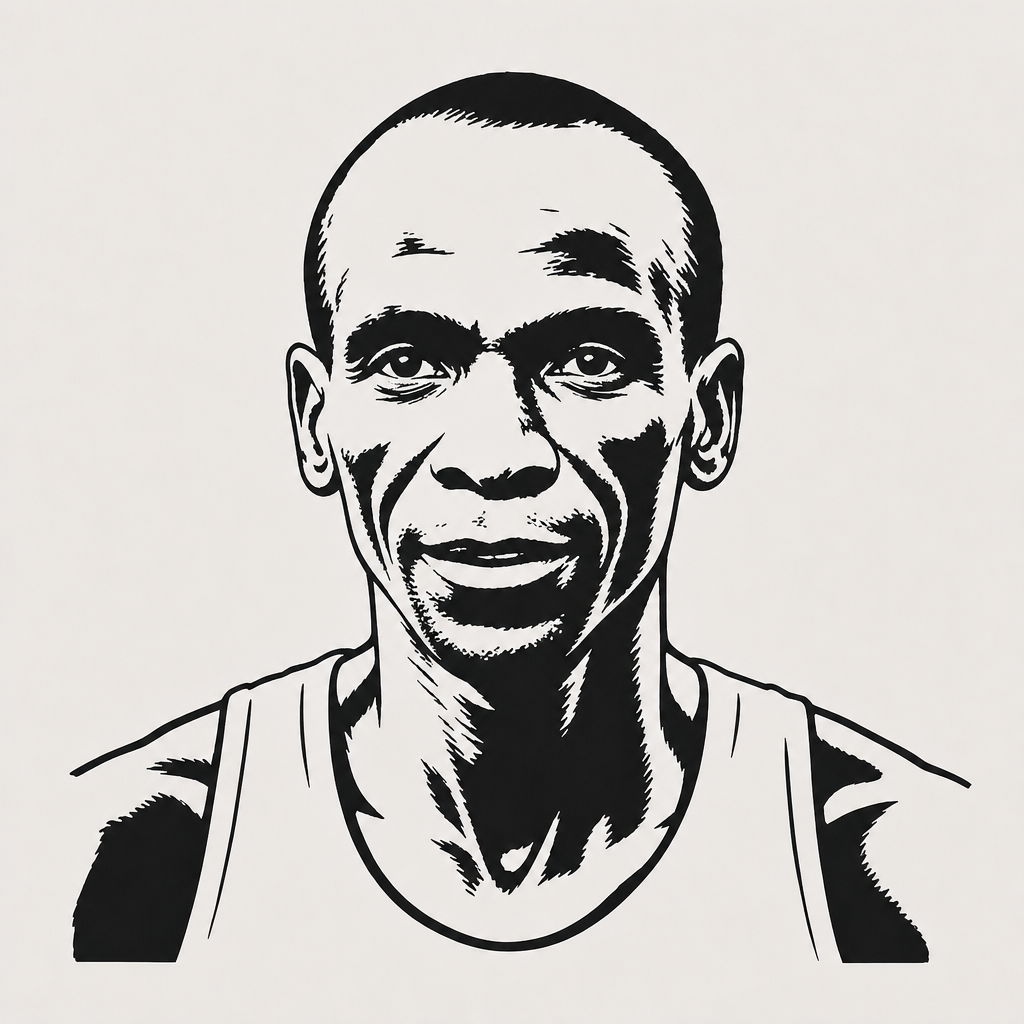
Ten Seconds in the Prater
Just after 8:15 on the morning of October 12, 2019, in a long green park in Vienna, a slight Kenyan man in a white singlet did something no human being had ever done. With five hundred metres left, the pacemakers who had shielded him for nearly two hours peeled away, and Eliud Kipchoge ran alone down an avenue of chestnut trees, pointing at the roaring crowd, thumping his chest, smiling — actually smiling — at the end of a marathon. He crossed the line in 1 hour, 59 minutes, 40 seconds.
For as long as people had raced the marathon’s 26.2 miles, two hours had stood as the distance’s four-minute mile: a barrier discussed by physiologists, mythologized by runners, and placed by one scientific paper just barely inside the edge of human possibility. Kipchoge had now run under it.
And yet the time counts for nothing. No record book contains it. The run in Vienna was an exhibition, engineered by a corporate sponsor: forty-one rotating pacemakers in an aerodynamic formation, an electric car projecting a laser line onto the road, drinks handed up by bicycle, a course chosen for its flatness and its still morning air. Under the rules of athletics, none of that is a race, and World Athletics does not recognize the time as a record.
Kipchoge knew all of this before he started, and it was, in a sense, the point. He was not trying to set a record. He already held the record. He was trying to prove a sentence he had been repeating for years, a sentence that would end up on posters and shoe boxes and the lips of weekend joggers on five continents: No human is limited.
The question of what, exactly, he proved that morning — and what it cost a lifetime of monkish discipline to get there — is the story of the greatest marathon runner who has ever lived.
The Boy Who Ran to School
Eliud Kipchoge was born on November 5, 1984, in Kapsisiywa, a village in Nandi County in Kenya’s Rift Valley highlands — the thin-aired, red-soiled running country that has produced a wildly disproportionate share of the world’s great distance runners. He was the youngest of four children, raised by his mother, a schoolteacher. His father died when Eliud was young; he has said he knew him only from photographs.
Nothing about his childhood announced a champion. He ran, but so did everyone: about three kilometres to school, three kilometres back, sometimes twice a day, not for glory but because that is how you got there. After finishing at Kaptel Secondary School in 1999, he did not go on to further studies. He collected milk from neighbors’ farms and sold it in town, saving the small proceeds. He was, by his own description, an ordinary rural boy with a bicycle and a routine.
The turn came through a neighbor. Patrick Sang had grown up in the same area and gone much further: a steeplechase silver medal at the 1992 Barcelona Olympics, a professional career in Europe, an education abroad. In 2001, a sixteen-year-old Kipchoge approached Sang at a local track and asked for a training program. Sang scribbled one out, assuming he would never see the boy again. Two weeks later Kipchoge was back, having done every session, asking for the next one. For months Sang handed him workouts without knowing his name.
He learned it soon enough. In 2003, the eighteen-year-old won the junior race at the World Cross Country Championships. That August in Paris, in the 5000 metres final at the World Championships, he lined up against Hicham El Guerrouj — the greatest miler in history, fresh off a 1500m title — and Kenenisa Bekele, the Ethiopian prodigy who would dominate track distance running for a decade. On the last lap, the teenager did not merely hang on; he outkicked them both, winning in a championship record of 12:52.79, four hundredths of a second ahead of El Guerrouj.
It remains one of the great arrivals in the history of the sport. It was also, in a way that took years to become visible, a false summit. Kipchoge would spend nearly a decade as a very good track runner — Olympic bronze in Athens in 2004, silver in Beijing in 2008, a world championship silver in between — without ever again winning the biggest prize. The runner who became untouchable had first to learn how to be beaten.
Twenty-Six Miles Without a Mistake
The pivot came through failure. In 2012, Kipchoge did not make Kenya’s Olympic team for the London Games. He was twenty-seven, no longer the fastest kicker in a track field, and at a crossroads familiar to aging speed: move up or fade out. He moved up — first to the half marathon in the autumn of 2012, then, in April 2013, to the marathon itself in Hamburg.
He won it in 2:05:30, a course record, running with a composure that startled observers seeing his marathon debut. Five months later in Berlin he finished second to Wilson Kipsang, who broke the world record that day. It would be a long time before anyone beat Eliud Kipchoge in a marathon again.
From 2014 through 2019 he won ten marathons in a row: Rotterdam and Chicago in 2014; Berlin in 2015, 2017, and 2018; London in 2015, 2016, 2018, and 2019; and, in August 2016, the Olympic marathon in Rio de Janeiro, which he won by 70 seconds — the largest margin in the event in over four decades. He did not just win; he won the same way every time, sitting patiently in the pack, floating at a pace that broke other men, and pulling away in the final miles with his face fixed in a strange half-smile. He said he smiled to relax, to tell his body the pain was not in charge.
Behind the serenity was a regimen of almost monastic severity. During training blocks Kipchoge lived not in his comfortable family home near Eldoret but in a spartan camp in Kaptagat, at 2,400 metres altitude, sharing simple dormitories with training partners young enough to idolize him. He took his turn at the chores, scrubbing toilets and cutting vegetables, a multimillionaire waiting for the rota like everyone else. He logged every workout by hand in notebooks he has kept since the early 2000s. He read management books and philosophy, quoted Aristotle to journalists, and distilled his method into sentences of almost comic plainness: “I train, I eat, I rest.” Fellow athletes called him The Philosopher. His most quoted line was about freedom, not speed: “Only the disciplined ones in life are free.”
The world discovered him properly through a marketing campaign. In May 2017, Nike staged Breaking2, an attempt to break the two-hour marathon under controlled conditions on a Formula One circuit at Monza, Italy. Of the three athletes chosen, only Kipchoge stayed on pace, finishing in 2:00:25 — twenty-five seconds short, and ineligible for records, but by far the fastest a human had ever covered the distance. Where others saw a failed stunt, Kipchoge saw a reconnaissance. “The world,” he said afterward, “is now only 25 seconds away.”
First, though, he took the record the ordinary way. At the Berlin Marathon on September 16, 2018 — a real race, in real conditions — Kipchoge ran 2:01:39, obliterating the world record by 78 seconds, the largest single improvement in the men’s mark in half a century. His second half was faster than his first. He was thirty-three years old, and there was now no serious argument about who was the greatest marathoner alive. The only remaining opponent was a number.
One Fifty-Nine Forty
The INEOS 1:59 Challenge was announced in 2019, bankrolled by the British petrochemical company INEOS and its billionaire owner, Jim Ratcliffe. Everything about it was optimized: Vienna’s Prater park for its long, flat, tree-sheltered avenue; an October date chosen for cool, still air; a start time set only days in advance to catch perfect weather; forty-one elite pacemakers — among them Olympic champions and the Ingebrigtsen brothers — rotating in pods of seven, arranged in a wind-tunnel-tested V formation around Kipchoge; an electric pace car beaming a green laser onto the asphalt at exactly two-hour pace; prototype carbon-plated Nike shoes on his feet.
Purists grumbled, with reason, that this was not sport but theatre — a time trial dressed as history, staged to sell shoes and soften a chemical company’s image. All true, and Kipchoge never pretended otherwise. He compared the attempt to landing on the moon: not a race, a demonstration. The campaign slogan was his own mantra, No Human Is Limited, and he spoke about the run less like an athlete than like a missionary. “Any human being can go beyond their limits,” he said. “But self-belief is crucial.”
On the morning of October 12, 2019, enormous crowds lined the Hauptallee, and millions more watched live around the world. Kipchoge ran the entire distance within a couple of seconds of perfect pace, kilometre after kilometre of inhuman evenness. When the pacers released him near the end he accelerated, gesturing to the crowd, and finished in 1:59:40.2 — then fell into the arms of his wife, Grace, at the line.
The time was never submitted for ratification; it could not be. His official record remained 2:01:39, which he himself lowered to 2:01:09 at Berlin in 2022, at age thirty-seven. But the Vienna run did what records cannot. Sub-two went from physiological speculation to accomplished fact, with an asterisk the size of the achievement itself. Kenya declared celebration; President Uhuru Kenyatta made him an Elder of the Order of the Golden Heart. Runners everywhere absorbed the slogan. Like Roger Bannister’s mile, the barrier mattered because everyone had agreed to believe in it — and one man, under admittedly artificial conditions, had made believing in it impossible.
In between his two record runs came a quieter feat that may be the better measure of him. At the pandemic-delayed Tokyo Olympics in August 2021, on a brutal, humid course in Sapporo, Kipchoge won his second consecutive Olympic marathon by 80 seconds — only the third person ever to defend the title, after Abebe Bikila and Waldemar Cierpinski. No gimmicks, no lasers: just every rival in the world, beaten again.
The Long Walk in Paris
Greatness in the marathon does not end; it erodes. Kipchoge’s erosion began gently — a shock eighth place in London in 2020, which he attributed to a blocked ear, then a return to winning — and arrived in earnest in 2023. In April, in the cold rain of his first Boston Marathon, he missed a water bottle, faded, and finished sixth. In September he won Berlin for a record fifth time, at thirty-eight. It would prove to be his last major victory.
Two weeks later, a twenty-three-year-old Kenyan named Kelvin Kiptum ran 2:00:35 in Chicago and took the world record. World Athletics ratified the mark on February 6, 2024. Five days after that, Kiptum was dead, killed with his coach in a car crash near Kaptagat — the same training country that had made them both. Kipchoge, suddenly, was no longer the record holder, and mortality had entered the sport’s succession story in the cruelest way possible.
His own reckoning came that summer. At the Paris Olympics on August 10, 2024, chasing a third straight gold at thirty-nine, Kipchoge began hurting around his waist and back before halfway. Just past the 30-kilometre mark he stopped — the first time in his life he had failed to finish a race. Then he walked, and spectators came off the barriers and walked with him, hundreds of them, escorting the greatest marathoner in history through the streets of Paris at a stroll. “My worst marathon,” he called it, and announced there would be no Los Angeles 2028.
What he did next was, in its way, as distinctive as anything he ran. Rather than retire on the memory of dominance, he kept racing — and kept losing, publicly and without complaint. Sixth in London in 2025, at forty. Ninth in Sydney. Then, on November 2, 2025, he ran the New York City Marathon for the first time, finished seventeenth in 2:14:36, collected the Six Star medal for completing all the majors, and announced his goodbye to competitive racing on his own terms: a project he called Eliud’s Running World — seven marathons on seven continents over two years, raising money for education, libraries, and sustainability through his foundation. The tour began in Cape Town in May 2026 and reached Porto Alegre, Brazil, that July, where the two-time Olympic champion splashed home twelfth in the rain, ten minutes behind the winner, apparently content.
What a Limit Is
Every hard case against Kipchoge’s legend contains some truth. The sub-two-hour run was a sponsored spectacle that no record book acknowledges. His fastest years coincided with carbon-plated “super shoes” that made the whole sport faster and made comparisons with earlier eras unreliable. The slogan No Human Is Limited is, taken literally, false — humans are limited; that is what makes them interesting — and it was delivered by a man drafting behind forty-one pacers and a laser.
And yet the record that does stand is not really the Vienna time, or even the 2:01:09. It is the career: two Olympic golds and a near-miss at a third, ten consecutive marathon victories across six years, five Berlins, four Londons, two world records, and a demeanor so steady that his rivals described racing him as psychologically hopeless. The shoes were on everyone’s feet; only one man went undefeated for six years in them. The pacers blocked the wind in Vienna; they could not run the 1:59:40.
Kipchoge’s deeper achievement may be what he made discipline look like. In an era of talent worship, he insisted, monotonously and by example, that greatness was mostly a schedule: train, eat, rest, sleep, write it down, do it again for twenty-five years. He scrubbed the camp toilets. He kept the notebooks. When the losing came, as it comes for every runner, he treated it with the same equanimity as the winning, and converted his decline into a fundraising pilgrimage rather than a retreat.
The two-hour barrier will eventually fall in an official race; Kiptum came within 35 seconds of it before he died, and someone will finish the job wearing shoes Kipchoge helped prove. When it happens, the moment will trace back to a green laser in a Vienna park and a smiling man from Kapsisiywa who understood that barriers are partly agreements — and that a sufficiently disciplined person can withdraw his consent.
Sources
- World Athletics - Eliud Kipchoge athlete profile (https://worldathletics.org/athletes/kenya/eliud-kipchoge-14208194)
- World Athletics - “Life as Kipchoge” (https://worldathletics.org/news/feature/eliud-kipchoge-life-kenya-marathon-career)
- Britannica - “Eliud Kipchoge” (https://www.britannica.com/biography/Eliud-Kipchoge)
- Abbott World Marathon Majors - Eliud Kipchoge champion profile (https://www.worldmarathonmajors.com/elite-series/champions-profile/eliud-kipchoge)
- INEOS - “No Human Is Limited Campaign,” INCH Magazine, October 2019 (https://www.ineos.com/inch-magazine/articles/eliud-kipchoge/no-human-is-limited-campaign/)
- World Athletics - “Ratified: Kiptum’s world marathon record,” February 6, 2024 (https://worldathletics.org/news/press-releases/ratified-world-marathon-record-kelvin-kiptum)