Antoine Lavoisier
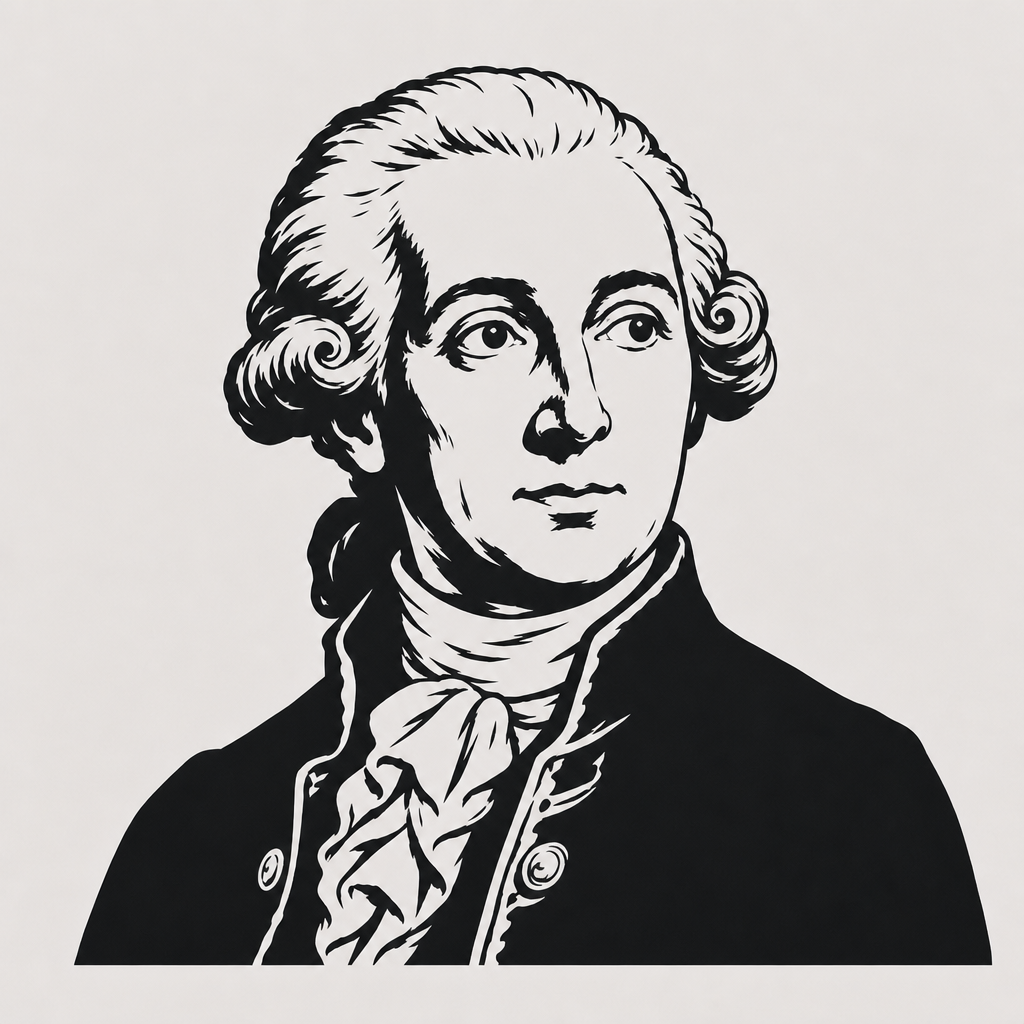
Fourth in Line
On the afternoon of May 8, 1794, in the Place de la Révolution in Paris, twenty-eight men climbed the scaffold in turn. The third was a tax farmer named Jacques Paulze. The fourth, following about a minute later, was his son-in-law — a fifty-year-old academician who had renamed the air, overturned two thousand years of chemical theory, and built the most precise laboratory in Europe. His name was Antoine-Laurent Lavoisier, and the greatest chemist alive was not dying for his chemistry. He was dying for his day job.
The distinction matters, because it is the key to the whole life. Lavoisier had made himself immortal with a balance and a sealed vessel, weighing gases to a fraction of a grain and proving that in every reaction matter is merely rearranged, never lost. But the balances, the vessels, the private laboratory open to any young man who wanted to learn — all of it was paid for by his membership in the Ferme générale, the private consortium that collected the crown’s most hated taxes. The same appetite for system and precision that made him a revolutionary in science made him an efficient servant of the most reviled institution in France. In 1794 the Revolution could no longer tell the difference between the two, and did not try. It took, as his friend Joseph-Louis Lagrange is said to have remarked, only an instant to cut off that head; a hundred years might not suffice to grow its like.
The Boy Who Inherited a Fortune
Antoine Lavoisier was born in Paris on August 26, 1743, into the comfortable legal aristocracy of the robe. His father was an attorney attached to the Parlement of Paris; the family had money, and more of it arrived when Antoine’s mother died in 1748, leaving the five-year-old boy a substantial fortune. He would never in his life know financial anxiety, and that freedom shaped everything: he could afford to treat science not as a career but as a calling, and later to buy his way into the machinery of the state.
He was educated at the Collège des Quatre-Nations, the Collège Mazarin, from 1754, taking prizes in rhetoric and, in his last years there, catching the scientific fever that never left him. He attended the popular public chemistry lectures of Guillaume-François Rouelle and studied astronomy under the Abbé de Lacaille. Dutifully, he also read law, earning his degree and licentiate by 1764 and gaining admission to the bar — a profession he never practiced. Chemistry, geology, and meteorology had already won.
The turn toward earth science came through the mineralogist Jean-Étienne Guettard, with whom the young Lavoisier tramped across France between 1763 and 1767, gathering data for a geological atlas and surveying Alsace-Lorraine. He was building the habits that would define him: measure everything, trust the number over the assumption, and treat nature as a system to be mapped rather than a mystery to be admired. In 1764 he presented his first paper to the Académie royale des sciences, on the composition of gypsum. In 1766 the crown awarded him a gold medal for an essay on how best to light the streets of Paris — a characteristic marriage of the theoretical and the useful.
The world he was entering had no such thing as research funding. Science in the Ancien Régime ran on private fortunes, royal patronage, and paid sinecures. The Académie des sciences was elite and gatekeeping; it could make a career, and its rejections could make enemies. For an ambitious young man with money, the path forward was to buy influence and spend it on discovery. Lavoisier did exactly that.
Two Contracts in One Year
The year 1768 set the two trajectories that would run in parallel until they collided. At twenty-five, Lavoisier was elected a provisional member of the Académie des sciences, one of the youngest in its history. In the same twelve months he bought a share in the Ferme générale.
The Ferme was a private syndicate that advanced tax revenue to the king and then collected it — with armed agents and considerable profit — from the salt, tobacco, and goods that moved through France. It was legal, lucrative, and despised. Lavoisier’s first assignment reads like a parable of the whole life: he was set to detecting adulterated tobacco, developing a chemical test in which acid poured over ash-cut tobacco would effervesce. From the very beginning, chemistry and tax collection were fused in a single gesture. The instrument that would later weigh oxygen was first turned on smugglers.
In 1771 he married Marie-Anne Pierrette Paulze, the thirteen-year-old daughter of a fellow tax farmer, Jacques Paulze; Lavoisier was twenty-eight. The age gap was ordinary for the period and jarring by any modern standard, and it should be stated plainly rather than romanticized. What followed, however, was a genuine scientific partnership. Marie-Anne taught herself English and Latin to translate the work of chemists such as Richard Kirwan and Joseph Priestley for her husband; she kept the laboratory records, hosted the salon where the new chemistry was argued into being, and learned engraving under Jacques-Louis David so that she could draw the plates of instruments for Lavoisier’s masterwork. Some modern scholars call her the mother of modern chemistry. She was, at the least, its indispensable collaborator.
Weighing the Air
The chemistry Lavoisier inherited was a house built on sand. For two millennia matter had been explained by four elements; combustion and rusting were explained by phlogiston, a weightless substance supposedly released when things burned. The names were alchemical relics — “vitriol of Venus,” “flowers of sulfur.” Yet the pneumatic chemists across the Channel had been generating awkward new facts: Joseph Black’s “fixed air,” Henry Cavendish’s “inflammable air,” Priestley’s menagerie of gases. The old theory could not hold them.
Lavoisier’s decisive insight was almost banal in its rigor: weigh things before and after. In the autumn of 1772 he deposited sealed notes with the Académie — filed like patents on the future — recording that phosphorus and sulfur gain weight when they burn. If burning released phlogiston, the products should be lighter, not heavier. Something in the air was combining with them. Henry Guerlac later called 1772 Lavoisier’s “crucial year.” In 1774 his Opuscules physiques et chimiques showed that calcining tin and lead in sealed vessels produced no change in total weight, and that the metals gained precisely what the trapped air lost.
That same year Priestley visited Paris and described how heating the calx of mercury released a remarkable new “dephlogisticated air” in which candles blazed. Priestley had isolated the gas; the Swedish apothecary Carl Wilhelm Scheele had almost certainly done so even earlier. But neither understood what they had. Lavoisier did. In his “Easter Memoir” of 1775, revised in 1778, he identified this “purest part of the air” as the agent of combustion and, later, gave it the name we still use: oxygène, “acid-former” — a name embedding a theory of acids that would itself turn out to be wrong. This is the sharpest way to state his achievement, as the Linda Hall Library puts it: Lavoisier discovered no new element or gas. He explained them. The revolution was not in the finding but in the understanding.
From there the edifice rose quickly. With the physicist Pierre-Simon Laplace, Lavoisier built an ice calorimeter and, in the winter of 1782-83, measured the heat and “fixed air” produced by a living guinea pig, concluding that respiration is a slow form of combustion. In 1783 he published a frontal assault on phlogiston and, again with Laplace, synthesized water from inflammable air and oxygen — proof that water was not an element but a compound of hydrogen and oxygen. In 1784-85 he decomposed and re-synthesized water before an audience of some thirty invited savants, turning precision into public theater.
Then came the language. In 1787, with Guyton de Morveau, Claude-Louis Berthollet, and Antoine-François Fourcroy, Lavoisier published a new chemical nomenclature: oxides, sulfates, the -ic and -ous endings — the vocabulary chemistry still speaks. And in 1789 he gathered the whole program into the Traité élémentaire de chimie, the first modern chemistry textbook. It defined an element operationally as a substance not yet decomposed, listed thirty-three provisional “elements” (still including light and caloric, so he kept one foot in the old world), and enshrined the principle that in any operation of art or nature, the total quantity of matter is conserved. The famous slogan “nothing is lost, nothing is created” is a later paraphrase; the Traité’s own careful language is the thing that endured. Lavoisier had, as he privately admitted wanting, brought about a revolution in chemistry.
The Wall Around Paris
He was, at the same time, one of the most effective and most hated tax farmers in France — and the two facts are not separable. It is tempting to cast him as an innocent investor devoured by a mob, but the honest record cuts against that comfort. Lavoisier was energetic and good at the work.
The single decision that most damaged him was the customs wall. In 1779 he proposed enclosing Paris in a barrier so that no goods could enter untaxed. Built at colossal expense and finished in 1791, the wall made an abstraction visible in stone, and Parisians loathed it. A mocking epigram captured the mood: to increase its cash and shorten the citizens’ horizon, the Farm had judged it necessary to put Paris in prison. Meanwhile Lavoisier stacked office upon office — academician, tax farmer, gunpowder administrator, member of the discount bank — and in 1791 the radical journalist Jean-Paul Marat, whose own scientific work on fire the Académie had dismissed a decade earlier with Lavoisier among the examiners, denounced him in L’Ami du peuple as a charlatan and a leech on the public.
The paradox is that Lavoisier genuinely thought of himself as a reformer. In 1775 he had been appointed to the Gunpowder Administration and moved into a house and superb laboratory at the Royal Arsenal, where he made French gunpowder the best in Europe — the powder that helped win American independence. He trained a young apprentice there, Éleuthère Irénée du Pont, who would carry the craft to America and found the company that still bears his name. On a royal commission in 1784 Lavoisier sat beside Benjamin Franklin and Dr. Joseph-Ignace Guillotin to debunk the mesmerists. He reported to the Crown that the tax system left the peasants of the Sologne too poor to improve their farms — an indictment of the very machine he served. He championed the metric system as an instrument of equality. He could weigh a gas to a fraction of a grain and completely misjudge how the wall and the titles looked to a starving city. It was, in one modern historian’s phrase, a tin ear for consequences.
The Fourth Cart
The Revolution that Lavoisier had welcomed as a liberal reformer turned on him by degrees, then all at once. In 1789 both the Third Estate and the nobility rejected his candidacies for the Estates-General, for the same reason: he was a tax farmer. In March 1791 the Ferme générale was abolished. In April he published an open letter resigning his paid posts — too late to erase twenty-three years of collection from public memory. In 1792 he was forced out of the Gunpowder Administration and the Arsenal. On August 8, 1793, the Académie des sciences itself was suppressed. On September 10 the police searched his house.
On November 24, 1793, the Convention ordered the arrest of all former Farmers General, hoping to recover huge sums for the bankrupt state. Lavoisier hid for several days — including, by some accounts, in the abandoned rooms of the suppressed Académie in the Louvre, the founder of modern chemistry with nowhere left to exist but the empty shell of French science. Then he surrendered, together with his father-in-law Jacques Paulze, at the end of November (sources give the 28th or the 30th). In December he was struck from the metric commission “for political reasons,” alongside Laplace and others.
Convinced that the Ferme’s contracts had been lawful, Lavoisier drafted a meticulous forty-two-page defense. He was preparing the wrong case. By the time he came before the Revolutionary Tribunal on May 8, 1794 (19 floréal, Year II), with Jean-Baptiste Coffinhal presiding, the charge had been upgraded from fraud to counterrevolutionary conspiracy. His court-appointed lawyer failed to appear. All the accused in custody were condemned together and guillotined that same afternoon. His protégé Fourcroy is said to have made a lone, dangerous appeal to Robespierre and been met with silence — a memory he carried for the rest of his life, having, as he put it, to hide his tears in his heart so as not to betray his feeling against tyranny.
Two famous stories attach to that day, and both should be handled with care. The line supposedly spoken by the judge — “The Republic has no need of scientists” — cannot be traced to the trial record. Its earliest attested version appears seven months later, in a December 1794 report by Henri Grégoire, in different words (“we no longer need chemists”) and attributed to a different judge. Scholars from James Guillaume in 1900 to Jean-Clément Martin have treated the polished sentence as legend, though the nineteenth-century biographer Édouard Grimaux thought some such words plausible. The second story — that Lavoisier arranged to blink after decapitation as a final experiment on consciousness — is a modern fabrication, unknown to any contemporary source and traced by William B. Jensen to a 1990s television documentary. What is documented is grim enough: Paulze died third, Lavoisier fourth, about a minute apart. His body was stripped and thrown into a common grave.
What the Ledger Closed
Within two years the Revolution reversed itself. Lavoisier was formally exonerated, and his confiscated belongings were returned to Marie-Anne with a note addressed to the widow of Lavoisier, “who was falsely convicted.” On August 1, 1796, the Lycée des Arts held a solemn memorial and Fourcroy delivered the éloge. The martyr of science had been created — a story sharpened after Thermidor precisely because it indicted the Terror.
That martyr narrative is true in its outline and misleading in its neatness. Lavoisier was not a hapless bystander; he was an architect and defender of an extractive system, publicly hated for years before the guillotine ever entered the picture. But neither did he “have it coming”: the specific charges against him were largely trumped up, the tobacco he was accused of adulterating he had in fact policed, and the man the Revolution killed had spent his life making things — powder, maps, a fairer system of weights, the science of chemistry itself. Both corrections have to stay in frame at once.
The deepest legacy is the one that hides in plain sight. The language of chemistry — oxide, sulfate, sulfuric acid — is his. So is its bookkeeping, the conservation of mass that every student now takes for granted. So is the textbook genre and the first modern list of elements. It is taught today mostly without his name attached, which is the profoundest kind of monument. Marie-Anne survived, published his Mémoires de chimie in 1805, endured a brief and unhappy marriage to Count Rumford, and died in 1836; her reputation has risen steadily since. Lavoisier’s name is among the seventy-two inscribed on the Eiffel Tower, and the six-volume state edition of his works, digitized by the CNRS, remains the place to check what he actually wrote.
Lagrange’s arithmetic still stands as the fairest epitaph, and its cruelty is that it is literally true. The head came off in an instant. The mind that had weighed the world into a new science would not be reproduced in a hundred years — and the same nation that grew it could not, in the spring of 1794, tell it apart from a tax collector’s.
Sources & Further Reading
- Science History Institute — “Antoine-Laurent Lavoisier,” Scientific Biographies (sciencehistory.org)
- Voelkel, James R. — “The Trials of Lavoisier,” Distillations, Science History Institute (sciencehistory.org)
- Panopticon Lavoisier / Les Œuvres de Lavoisier, CNRS–CRHST and the Comité Lavoisier of the Académie des sciences (lavoisier.cnrs.fr) — the digital edition of the collected works, including the Traité élémentaire de chimie (1789)
- Linda Hall Library — “Scientist of the Day: Antoine Lavoisier” (lindahall.org)
- Jensen, William B. — “Did Lavoisier Blink?”, Journal of Chemical Education 81, no. 5 (2004): 629
- Grimaux, Édouard — Lavoisier, 1743–1794 (Paris, 1888)
- Poirier, Jean-Pierre — Lavoisier: Chemist, Biologist, Economist (University of Pennsylvania Press, 1996)
- Bell, Madison Smartt — Lavoisier in the Year One: The Birth of a New Science in an Age of Revolution (W. W. Norton, 2005)
- Guerlac, Henry — Lavoisier — The Crucial Year (Cornell University Press, 1961)