Richard Leakey
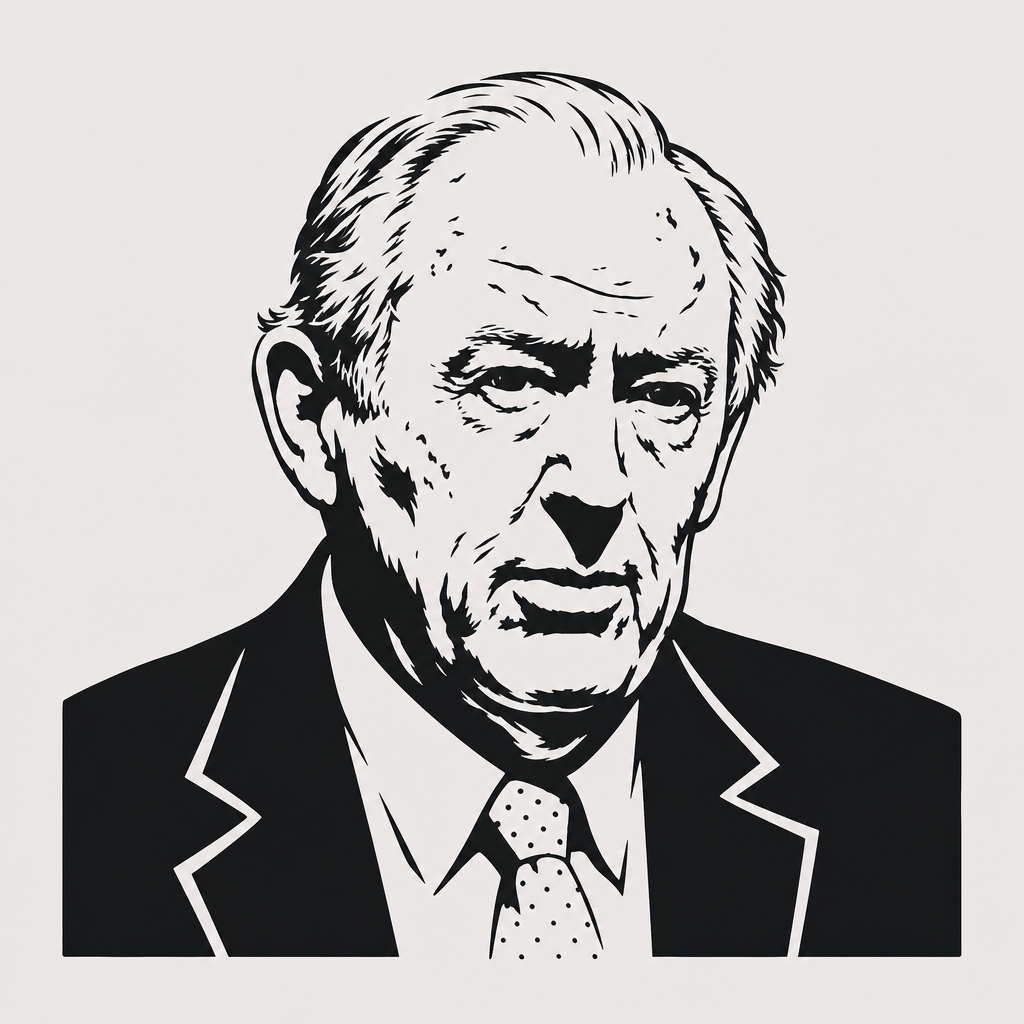
The Fire in Nairobi National Park
In July 1989, Richard Leakey did something no economist would advise. He built a pyre of about twelve tons of elephant tusks — ivory worth millions on the world market — soaked it in fuel, and had Kenya’s president set it alight.
The tusks had been confiscated from poachers. The sensible move was to sell them and fund conservation with the proceeds. Leakey argued the opposite. As long as governments treated seized ivory as an asset, ivory would keep its value, and poachers would keep killing elephants to supply it. The only way to make poaching pointless was to make ivory worthless. So he burned it, in public, in front of the world’s cameras, and let the smoke carry the message.
It was a characteristic act: theatrical, defiant, and effective. Within months the argument had helped push through an international ban on the ivory trade. Kenya’s collapsing elephant herds began to recover. And a man who had spent two decades famous for digging up the bones of the human past became, almost overnight, the world’s best-known defender of a living species.
That pivot — from the deep past to the burning present — is the key to Richard Leakey. He was born into the most celebrated name in the study of human origins, refused it, seized it anyway, and then kept walking away from every career he mastered the moment a bigger fight appeared. Fossils, museums, elephants, corruption: each in turn. Each cost him something. By the end, the fights had taken both his legs, a kidney, part of his liver, and very nearly his life. He seemed to regard that as a fair price. “Pressure,” he once said, “probably suits me.”
The Son Who Quit the Family Business
Richard Erskine Frere Leakey was born in Nairobi on December 19, 1944, the second of three sons of Louis and Mary Leakey. There was no more famous partnership in the search for human ancestors. Louis was the flamboyant theorist who insisted humanity had evolved in Africa when most of science looked to Asia; Mary was the meticulous excavator whose finds at Olduvai Gorge proved him right. To be their child was to grow up in the shadow of a discovery that had rewritten the human family tree.
Richard found his first fossil — the jaw of an extinct giant pig, by his own account — at the age of six. But proximity bred resistance. He wanted to be anything but a Leakey doing what Leakeys did. Around sixteen he dropped out of school, and he never earned a university degree. Instead he started a business trapping animals and supplying skeletons to institutions, borrowed money for a Land Rover, and took Africans and tourists into the bush. He earned a pilot’s license in 1962 and ran photographic safaris. Flying would become central to his fieldwork and, decades later, nearly kill him.
The point of the detour was independence. He was determined to be self-made, to owe his standing to no one, least of all his parents. The irony is that the escape led him straight back. In the mid-1960s, drawn by the certainty that the ground held more than had been found, he returned to the family trade — but as his own man, running his own expeditions, answering to no famous surname but building one.
The world he re-entered was newly independent Kenya. Leakey was a white Kenyan, born under British colonial rule but insistent that he was African, not a visitor. That claim would define his life. It let him become a senior official of the Kenyan state at a time when few white Africans held such power, and it also made him a target when his politics turned against those in charge. He staked his safety on being Kenyan. Repeatedly, he dared people to say he was not.
The Sediments by the Lake
In 1967 Leakey led the Kenyan contingent of an international expedition to Ethiopia’s Omo River valley. The team recovered two skulls, Omo I and Omo II, among the earliest known remains of our own species, Homo sapiens. But the moment that mattered most came not on the ground but in the air. Flying home, Leakey looked down at the eastern shore of Lake Turkana — then called Lake Rudolf — and saw sediments where his map had promised only volcanic rock. Sediments meant the chance of fossils.
He gambled his reputation on that glimpse. He redirected funding toward the new site, and in 1968, at just twenty-five, he became director of the National Museums of Kenya, giving him an institutional base of his own. The region around Koobi Fora, on Turkana’s eastern shore, proved to be one of the richest hominin fossil grounds on Earth. Over the following years his teams recovered hundreds of specimens representing scores of individuals.
The finds were not his alone, and the honest version of the story says so. Leakey directed, raised money, argued, and publicized. But the fossils were mostly spotted by a crew of Kenyan field workers who became known, half in jest, as the “Hominid Gang,” led by the extraordinary Kamoya Kimeu — self-taught, sharp-eyed, and eventually one of the most respected fossil finders in the world.
In 1972 a team member named Bernard Ngeneo found the specimen catalogued as KNM-ER 1470: a large-brained early Homo skull, shattered into hundreds of fragments and painstakingly reassembled. To Leakey, 1470 was evidence that the Homo line was far more ancient than his rivals believed. Its exact age proved slippery — early reports placed it startlingly far back, before the figure was revised to roughly 1.9 million years, and the specimen is now often assigned to Homo rudolfensis. But at the time it made Leakey world-famous. In 1977 Time magazine put him on its cover, and his book Origins carried his ideas to a mass audience. The self-taught son had made himself a scientific authority.
Turkana Boy and a Rival Named Lucy
The most spectacular find came in 1984. On the bank of a dried riverbed near Nariokotome, Kamoya Kimeu spotted a small fragment of skull. It led to the nearly complete skeleton of a Homo erectus adolescent who had died about 1.6 million years earlier — the most complete early human skeleton ever found. The world called him “Turkana Boy.” Working with the anatomist Alan Walker, Leakey’s team used the skeleton to reconstruct, bone by bone, how our ancestors stood, walked, and grew. It remains one of the defining specimens in the study of human evolution.
By then Leakey was locked in the rivalry that would follow him for life. Donald Johanson had found “Lucy,” a 3.2-million-year-old skeleton from Ethiopia, and argued that her species, Australopithecus afarensis, was the common ancestor from which the Homo line later branched. Leakey held that Homo was far older, with roots that would exclude Lucy’s kind as our direct forebears. It was a real scientific disagreement about the shape of the family tree, but it curdled into something personal. In 1981 the two men clashed in a televised debate on Cronkite’s Universe, and the frost between them lasted decades. Only in 2011 did they share a stage again at the American Museum of Natural History and, in effect, bury the hatchet.
The rivalry flattered a public appetite for feuding geniuses, and it sometimes obscured the science. But it also revealed something about Leakey: he did not shrink from conflict, and he did not mind being disliked if he thought he was right. That temperament would soon carry him out of the fossil beds entirely.
His body, meanwhile, was already failing him. In 1969 he had been diagnosed with terminal kidney disease. In 1979 his brother Philip donated a kidney to keep him alive. Leakey worked through it all, as if illness were simply another obstacle to be out-argued.
The Elephant Wars
In 1989 Kenya’s elephants were being slaughtered on an industrial scale, and the tourism economy that depended on them was in danger. President Daniel arap Moi turned to Leakey and put him in charge of the country’s wildlife, in the body that became the Kenya Wildlife Service. Leakey had no training in wildlife management. He had energy, fearlessness, and a genius for the decisive gesture — and he used all three.
The ivory bonfire was the symbol. The substance was a war. Leakey rebuilt the ranger force, secured funding and weapons, and authorized rangers to shoot poachers on sight. Poaching plummeted. Elephant and rhino populations began to recover. To much of the world, Leakey was now a conservation hero, and in 1994 the National Geographic Society awarded him its Hubbard Medal.
But the “shoot-to-kill” policy deserves an honest reckoning rather than applause. It saved animals by authorizing lethal force against people, many of them poor Kenyans drawn into poaching by desperation and by the demand of distant, wealthier buyers. The elephants recovered; the moral arithmetic — protecting wildlife and tourist revenue by killing the men at the bottom of the trade — was never as clean as the triumphant version suggests. Leakey rarely agonized over it in public. He believed the herds would have vanished without hard measures, and he was probably right that softer ones had failed. Both things can be true: the policy worked, and it exacted a human cost that the celebration tends to erase.
The wildlife job also dropped Leakey into the machinery of the Kenyan state, and there the real danger waited. He clashed with powerful interests over land, money, and control of the wildlife service. In 1993 the small plane he was piloting crashed. Both his legs were amputated below the knee. Leakey always suspected sabotage by his political enemies and never proved it. He returned to work on prosthetic legs, seemingly undeterred. In 1994 he resigned from the wildlife service, citing government interference.
Taking On the State
A man that stubborn does not retire quietly. In 1995 Leakey helped found Safina, an opposition party challenging Moi’s long-entrenched one-party rule. He had spent his life insisting he was Kenyan; now he tested that claim against a government that was happy to treat him as an interfering foreigner.
The response was ugly. Leakey was surveilled and harassed. On one notorious occasion he and other opposition figures were set upon and whipped by government-aligned thugs. He kept going. In 1997 he won a seat in parliament. And then, in one of the stranger turns of his career, the same government he had fought recruited him back. Under intense pressure from international donors to curb corruption, Moi in 1999 made Leakey head of Kenya’s civil service — cabinet secretary — leading an anti-corruption “dream team” of technocrats meant to clean up the state.
It was an almost impossible job, and it did not last. Leakey pushed against entrenched patronage networks with the same bluntness he had brought to everything else, and by 2001 he was gone. Critics questioned how much a single donor-backed reformer could really change; admirers saw a rare official willing to name corruption to the faces of those profiting from it. Both readings hold. What is not in doubt is that he tried, from inside a system designed to resist exactly that.
Through these years his health kept collapsing and he kept rebuilding it. A second kidney transplant followed the first, and later he received a liver transplant as well. He lived, for decades, on borrowed organs and prosthetic legs, and treated his own body much as he treated a stubborn government: as a problem to be managed rather than a reason to stop.
What Outlives Him
In his last two decades Leakey turned back toward the science, but institutionally now, as a builder. He joined Stony Brook University in New York, founded the conservation group WildlifeDirect in 2004, and in 2005 co-founded the Turkana Basin Institute, a permanent research base in the remote landscape where his fossils had come from. He served as its chair until his death, and briefly returned to lead the Kenya Wildlife Service again from 2015 to 2018. He also, characteristically, took up something new, farming near Nairobi and producing wine.
He died near Nairobi on January 2, 2022, at seventy-seven. President Uhuru Kenyatta announced the news. The obituaries called him a fossil hunter and a conservationist, and he was both, but the labels undersell the strangeness of the life. Few people are famous in one field; Leakey was consequential in three or four, and abandoned each at its peak.
His legacy is genuinely large and genuinely mixed. The Turkana fossils remain foundational to the human origins story, and the institute he built ensures the work continues. Kenya’s elephants survived a catastrophe partly because he fought for them without flinching. He showed that a scientist could also be a public actor — museum director, wildlife czar, member of parliament, anti-corruption reformer — and pay the physical price for it.
But a fair account has to widen the frame he often kept narrow. The fossils that made his name were mostly spotted by Kenyan field workers whose skill the “great man” story tends to swallow; Kamoya Kimeu found Turkana Boy, Bernard Ngeneo found 1470, and the Hominid Gang found much of the rest. The science that carried the Leakey name into the twenty-first century was increasingly the work of his wife, Meave Leakey, and their daughter Louise, both accomplished paleoanthropologists in their own right. And the conservation triumph came bundled with a shoot-to-kill policy that saved elephants at a human cost he preferred not to dwell on.
Richard Leakey was not a saint, and he would have been bored by the suggestion. He was something more useful and more difficult: a self-taught, self-made man who could not stop picking fights that mattered, who kept trading comfort for consequence, and who left behind fossils, elephants, an institute, and an argument about how much one restless person can change before the changing wears him out.
Sources
- National Geographic - “Richard Leakey, trailblazing conservationist and fossil hunter, dies at 77” (https://www.nationalgeographic.com/science/article/richard-leakey-trailblazing-conservationist-and-fossil-hunter-dies-at-77)
- The Leakey Foundation - “Richard Leakey, renowned paleoanthropologist and conservationist dies at age 77” (https://leakeyfoundation.org/richard-leakey-renowned-paleoanthropologist-and-conservationist-dies-at-age-77/)
- Turkana Basin Institute - “Richard Leakey, Chair of Turkana Basin Institute, Passes on at 77” (https://www.turkanabasin.org/2022/01/richard-leakey-chair-of-turkana-basin-institute-passes-on-at-77/)
- NPR - “Richard Leakey, world-renowned fossil-hunter and conservationist, dies at 77” (https://www.npr.org/2022/01/03/1069888035/famed-fossil-hunter-and-conservationist-richard-leakey-dies-at-77)
- Encyclopaedia Britannica - “Richard Leakey” (https://www.britannica.com/biography/Richard-Leakey)
- Scientific American - “30 Years After Televised Spat, Rival Anthropologists Agree to Bury the Hand-Ax” (https://blogs.scientificamerican.com/observations/30-years-after-televised-spat-rival-anthropologists-agree-to-bury-the-hand-ax/)