Wangari Maathai
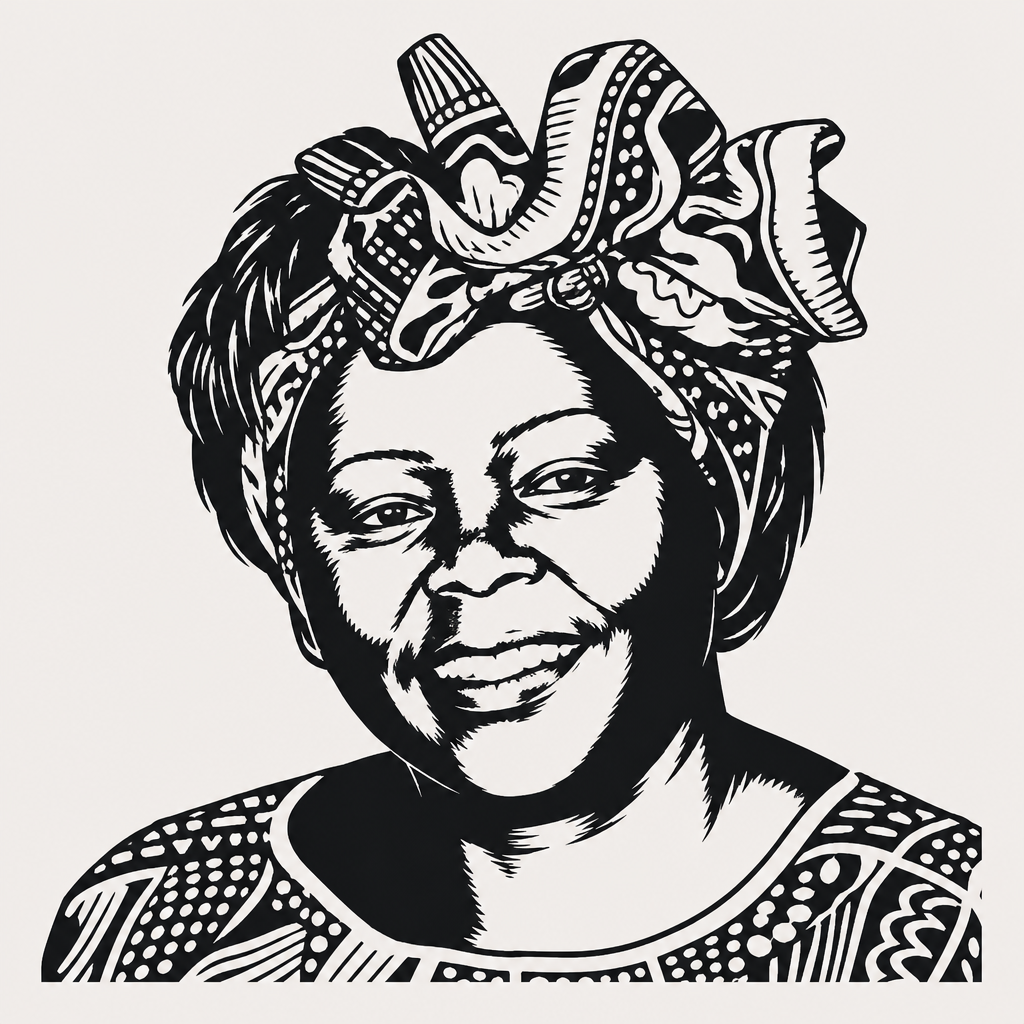
A Tree for an Answer
On October 8, 2004, the Norwegian Nobel Committee announced that the Peace Prize would go, for the first time in its history, to an African woman. Reporters scrambled to find her. Wangari Maathai was not in a capital city or a conference hall. She was in Nyeri, in the central highlands of Kenya, near the villages where she had grown up. Her response to the grandest honor on earth was not a press conference. She knelt in the red soil and planted a tree, facing Mount Kenya.
It was the most fluent sentence she knew how to speak. For nearly thirty years, Maathai had been answering everything with trees. Rural women told her their streams were drying and their children were hungry: plant trees. A dictatorship jailed its critics and gave away public forests to political cronies: plant trees, and refuse to move. A husband’s lawyers, a president’s insults, a policeman’s club: plant trees.
The world press called her the tree lady, and the phrase always sounded gentler than the life. The government of Kenya had understood her far better than her admirers abroad did. It had denounced her in parliament, put her on an assassination list, beaten her unconscious, and jailed her repeatedly — over seedlings. That was because President Daniel arap Moi’s regime grasped the thing that made Maathai dangerous: in a country where land was power and power was patronage, teaching poor women to plant trees, ask questions, and say no was not gardening. It was politics of the most subversive kind.
The Nobel Committee eventually agreed. Its citation honored “her contribution to sustainable development, democracy and peace,” and its press release compressed her life’s argument into one line: “Peace on earth depends on our ability to secure our living environment.”
The Girl from the Highlands
Wangari Muta was born on April 1, 1940, in Ihithe, a village in the Nyeri District of Kenya’s central highlands, into a Kikuyu farming family. Kenya was then a British colony, and the highlands were being remade around her: forests cleared for commercial plantations, native trees replaced by fast-growing exotics, streams beginning to falter. Decades later, in her Nobel lecture, she would trace her vocation to exactly this — a childhood spent watching forests disappear and with them “the capacity of the forests to conserve water.”
Her family did something unusual for the time and place: they sent a daughter to school. She was educated at Catholic mission schools, finished at the top of her class, and went on to Loreto High School in Limuru. Then came the stroke of historical luck that changed everything. In 1960, on the eve of Kenyan independence, she was selected for the airlift program that carried hundreds of promising East African students to American colleges — the same “Kennedy Airlift” generation that included Barack Obama’s father.
The scholarship took her to Mount St. Scholastica College, a small Benedictine school in Atchison, Kansas, where she earned a degree in biological sciences in 1964. She was studying in America through the years of the civil rights movement, and she later wrote that those years taught her lessons no laboratory could: what free expression sounded like, and what citizens could demand of a government. A master’s degree at the University of Pittsburgh followed in 1966, then doctoral study in Germany and at the University of Nairobi. In 1971 the University of Nairobi awarded her a Ph.D. in veterinary anatomy.
No woman in East or Central Africa had ever earned a doctorate before.
The firsts kept coming. In 1976 she became chair of the university’s Department of Veterinary Anatomy; in 1977 she was made an associate professor. In both cases she was the first woman in the region to hold the position — the Nobel Foundation would later describe her simply as the first female professor in Kenya. On paper, her life was a perfect ascent: village girl to professor, colonial subject to elite of a new nation. But the ascent was about to teach her what her country did to women who climbed.
Too Strong-Minded for a Woman
In 1969 she had married Mwangi Mathai, an ambitious businessman and politician. A decade later the marriage collapsed in the most public way possible. Mwangi filed for divorce, and the proceedings became national theater; he was reported to have complained that his wife was too strong-minded for a woman and that he could not control her. When Maathai criticized the judge who ruled against her, she was jailed for contempt of court.
Then came a final, petty humiliation: she was pressed to give up her married name. She refused to be erased and refused to comply, in the same gesture — she kept the name and added an extra “a.” Mathai became Maathai. For the rest of her life, her own signature carried the mark of the fight.
The episode mattered because of what it revealed and what it forged. Kenya’s establishment had shown her that credentials would not protect a woman who talked back — not a professor, not a department chair, not a national figure. And she had shown the establishment something in return: pressure did not bend her. It would be the pattern of the next twenty-five years, rehearsed first in a divorce court.
By then, her attention had already begun shifting from the anatomy laboratory to the countryside. Through the National Council of Women of Kenya, which she would lead through most of the 1980s, she kept hearing the same testimony from rural women: the streams were drying up, the harvests were thinner, and firewood — the fuel that cooked every meal — required longer and longer walks. Maathai the biologist recognized the pattern. Deforestation had broken the watersheds. The women were describing environmental collapse from the inside.
Her answer was almost absurdly simple. Why not plant trees?
Seven Trees in Kamukunji Park
On World Environment Day, June 5, 1977, Maathai and the National Council of Women marched from central Nairobi to Kamukunji Park and planted seven trees. From that small ceremony grew the organization she founded that year: the Green Belt Movement.
The method was designed around the people who needed it. Rural women — many of them unable to read, none of them wealthy, all of them expert in their own land — collected seeds, raised seedlings in makeshift nurseries, and planted trees on farms, school grounds, and church compounds. The movement paid a small stipend for every seedling that survived. Trees restored soil and firewood and shade; the stipends put income into women’s hands; and the nurseries became something no one had quite planned: meeting places where women learned that they could organize, decide, and act without waiting for permission from a husband, a chief, or a government.
Maathai called the women “foresters without diplomas,” and she was explicit that the tree was only the entry point. Planting was civic education disguised as horticulture. In her Nobel lecture she described the work as planting “seeds of peace” — the tree as a symbol and the act as a training in citizenship.
The numbers grew beyond anything the seven trees of 1977 suggested. Over the following decades the Green Belt Movement mobilized hundreds of thousands of Kenyan women — more than 900,000 by the UN’s count — and planted, by the figure the Nobel Committee cited, some 30 million trees. In 1986 the movement launched a Pan African Green Belt Network, carrying the model to Tanzania, Uganda, Malawi, Lesotho, Ethiopia, Zimbabwe, and beyond.
What the movement was not was sentimental. Maathai ran it like the scientist she was: seedlings were counted, survival rates checked, payments made only for trees that lived. And she was frank about the economics underneath the ecology. Foreign experts talked about conservation as if it were a luxury of the rich; she had watched poverty and deforestation feed each other in her own hills, each making the other worse, and built her program at exactly that junction.
A tree-planting charity run by church women should have been the safest organization in Kenya. It did not stay safe, because Maathai followed the logic of the trees wherever it led — and it led directly into the foundations of the regime.
“Be a Proper Woman”
Daniel arap Moi had ruled Kenya since 1978, atop a one-party state lubricated by land. Public forests, public parks, public commons: all could be quietly carved up and handed to allies. Environmentalism that stopped at seedlings was tolerable. Environmentalism that asked who was taking the land was treason.
In October 1989, Maathai learned of plans to erect a 60-storey tower — with a giant statue of Moi — in Uhuru Park, the one great green space left to ordinary Nairobi. She wrote letters. She filed suit. She went to the newspapers. The response was a national pile-on: members of parliament denounced her on the floor, jeered the Green Belt Movement as a gang of divorcees, and President Moi suggested that she should learn to “be a proper woman.” The government evicted the movement from its offices.
She lost in court and won in the world. The spectacle of a lone woman professor standing against the tower embarrassed the project’s foreign financiers, and in January 1990 the investors pulled out. The tower was never built. Nairobians still picnic on the grass where it would have stood.
The regime stopped treating her as a nuisance and started treating her as an enemy. In January 1992 she learned her name was on a list of people marked for assassination, and she joined the movement demanding multiparty democracy. That February, mothers of political prisoners began a hunger strike in a corner of Uhuru Park — soon christened Freedom Corner — and Maathai joined them. On March 3, 1992, police broke up the protest with clubs. Maathai was beaten unconscious. Photographs of the bloodied Nobel-laureate-to-be traveled around the world; the mothers eventually won their sons’ release.
The pattern repeated for a decade. In January 1999, leading a protest against the parceling-out of Nairobi’s Karura Forest to developers, she was attacked and struck on the head while police looked on. In 2001 she was arrested twice — for collecting petition signatures, for planting trees — and released without charge both times. She later summarized the underlying economics with a line that became her signature analysis: “Poor people will cut the last tree to cook the last meal. The more you degrade the environment, the more you dig deeper into poverty.”
Environment, poverty, democracy: she insisted they were one problem. Her country’s government kept proving her right, by punishing tree-planting as sedition.
Ninety-Eight Percent
The vindication, when it came, came quickly and twice.
In December 2002, Kenyans voted the ruling party out for the first time since independence. The regime Maathai had defied for a quarter century fell at the ballot box, and she was carried into parliament with it, winning the Tetu constituency — her home ground in Nyeri — with about 98 percent of the vote. The number reads less like an election result than a verdict on her life. In January 2003 the new president, Mwai Kibaki, named her assistant minister for environment and natural resources, putting the state’s most famous prisoner of conscience partly in charge of the forests she had been beaten for defending. She served until 2005; government, with its compromises and reshuffles, never fit her as well as opposition had.
Then, on October 8, 2004, the call from Oslo — and the tree planted facing Mount Kenya.
The award was itself an argument, and a contested one. Some critics complained that an environmentalist stretched the meaning of “peace.” The Nobel Committee answered directly: wars of the future would be fought over water, land, and resources, and a woman who had spent thirty years securing “the very basis for ecologically sustainable development” — while fighting dictatorship with her body — was exactly what peace looked like. In Oslo City Hall that December, Maathai accepted the prize “on behalf of the people of Kenya and Africa,” said she hoped it would encourage women and girls “to raise their voices and take more space for leadership,” and retold the story of the drying streams of her childhood.
The prize made her a global institution. She became the first president of the African Union’s Economic, Social and Cultural Council, co-chaired the Congo Basin Forest Fund, was named a UN Messenger of Peace, and inspired the UN’s Billion Tree Campaign — launched in 2006 and eventually credited with more than 11 billion trees worldwide. Her memoir, Unbowed, appeared in 2006; the title required no explanation.
Fame did not simplify her. Around the time of the Nobel award, a Kenyan newspaper reported her as claiming that HIV had been deliberately engineered by Western scientists to harm Africans. Maathai denied saying it and issued a formal statement rejecting the conspiracy theory, though the paper stood by its story and an ambiguous magazine quote kept the controversy alive. The episode remains genuinely disputed — a reminder that she was a combative, improvising public figure, not the serene icon of the posters.
Unbowed
Wangari Maathai died of complications from ovarian cancer at a Nairobi hospital on September 25, 2011, at seventy-one. She had kept the illness private. Her instructions for her funeral were characteristic: no wooden coffin. She would not have a tree cut down to bury her.
Tributes came from presidents and secretaries-general, but the truest measure of her legacy is structural. She changed what the Nobel Peace Prize means: after 2004, the claim that environmental collapse is a security issue — once dismissed as category confusion — became the mainstream language of climate diplomacy. She changed what African environmentalism looks like: not parks fenced against the poor, but livelihoods grown by them. And she changed the arithmetic of activism. Her method’s genius was that its basic unit — one seedling, one woman, one small payment — was too small to stop. A regime could topple a tower of opposition; it could not confiscate ten million acts of planting.
She liked to tell a parable about a hummingbird that, while the other animals stand paralyzed before a forest fire, carries water one beak-full at a time, saying: I am doing the best I can. It was her self-portrait, but it undersold her. The hummingbird acts alone. Maathai’s real discovery was that the best-I-can of one determined woman, multiplied by hundreds of thousands of hands, becomes a forest — and that a forest, in the right hands, can bring down a strongman.
The trees are still growing. Tens of millions of them, on farms and school grounds and church compounds across East Africa, planted by women who learned from her that they did not need permission.
Sources
- Nobel Prize - “Wangari Maathai - Facts” and “Biographical” (https://www.nobelprize.org/prizes/peace/2004/maathai/facts/)
- Norwegian Nobel Committee - Nobel Peace Prize 2004 press release, Oslo, October 8, 2004 (https://www.nobelprize.org/prizes/peace/2004/press-release/)
- Wangari Maathai - Nobel Lecture, Oslo, December 10, 2004 (https://www.nobelprize.org/prizes/peace/2004/maathai/lecture/)
- The Green Belt Movement - “Wangari Maathai” official biography (https://www.greenbeltmovement.org/wangari-maathai/)
- UN Africa Renewal - “Wangari Maathai, the woman of trees, dies” (https://africarenewal.un.org/en/magazine/wangari-maathai-woman-trees-dies)
- Wangari Maathai, Unbowed: A Memoir (Alfred A. Knopf, 2006)