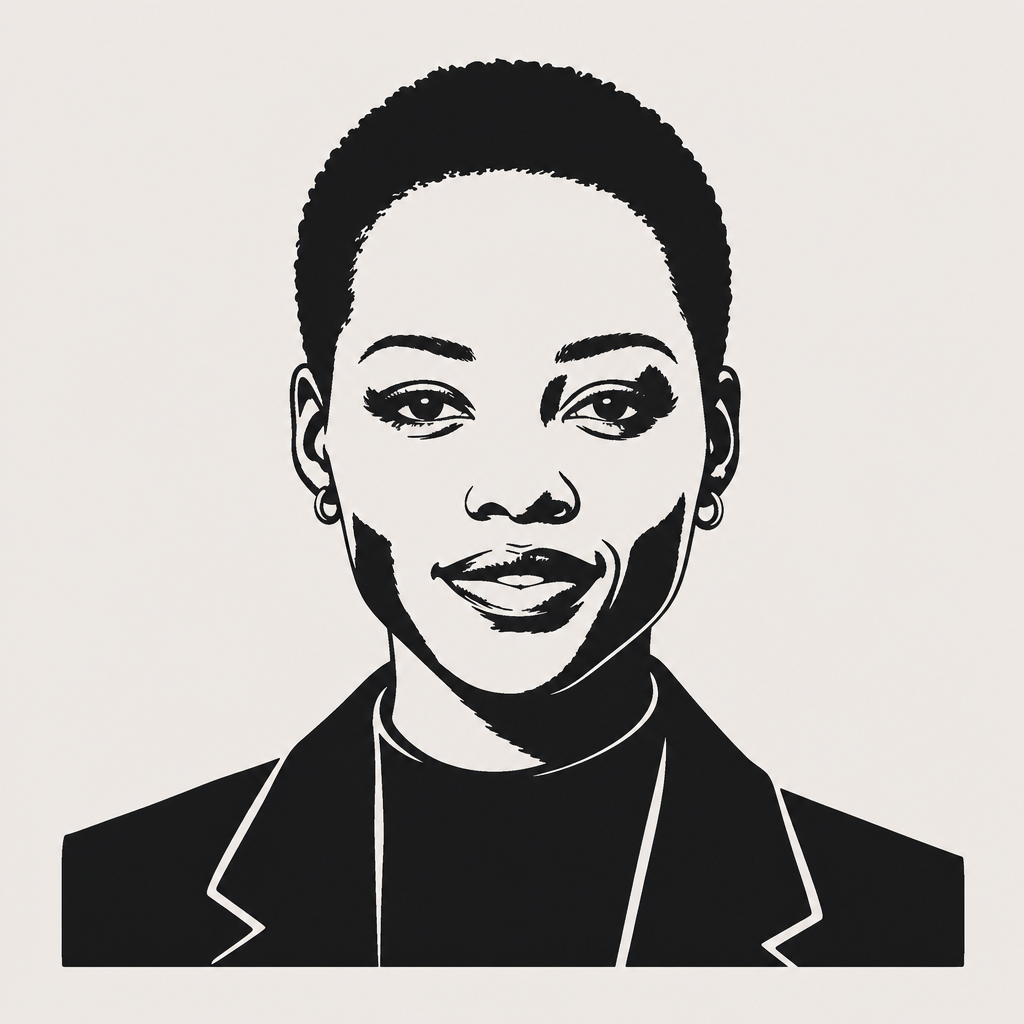
Lupita Nyong'o
The Letter About the Cream
A few days before the 2014 Academy Awards, Lupita Nyong’o stood at a podium in Beverly Hills and read a stranger’s letter out loud.
“Dear Lupita,” it began, “I think you’re really lucky to be this Black but yet this successful in Hollywood overnight. I was just about to buy Dencia’s Whitenicious cream to lighten my skin when you appeared on the world map and saved me.”
The room was full of Black women in Hollywood — actors, producers, executives — gathered at the Essence luncheon to honor her breakthrough performance. Nyong’o could have accepted the award with a gracious thank-you. Instead she told the truth. As a girl in Kenya, she said, she had been teased for her “night-shaded skin.” She had prayed to God, night after night, to wake up lighter. Every morning the mirror delivered the same disappointment. What began to change her, she said, was seeing the Sudanese model Alek Wek celebrated on international runways: proof that someone who looked like her could be called beautiful in public.
Three days later, Nyong’o walked onto the stage of the Dolby Theatre in a pale blue gown and accepted the Oscar for Best Supporting Actress. She was thirty-one years old, one year out of drama school, and it was her first feature film. She became the first Kenyan actress and the first Mexican actress ever to win an acting Academy Award. “No matter where you’re from,” she told the watching world, “your dreams are valid.”
The fairy-tale version of her story ends there. The real story — about exile, colorism, discipline, and a recurring decision to break silences that other people find comfortable — was just getting started.
Born on the Run
Lupita Amondi Nyong’o was born on March 1, 1983, in Mexico City, and the reason is political.
Her father, Peter Anyang’ Nyong’o, was a Kenyan political scientist and democracy activist during the most dangerous years of Daniel arap Moi’s one-party rule. Academics who challenged the regime were harassed, detained, or worse. In 1980, Lupita’s uncle Charles disappeared after being thrown from a ferry — a loss the family understood as a warning. Her father took a post as a visiting lecturer at El Colegio de México, and the family went into exile. When their second child was born in Mexico City, they followed local custom and gave her a Mexican name: Lupita, the affectionate diminutive of Guadalupe.
She would grow up to hold Kenyan, Mexican, and eventually American citizenship, and to describe herself simply as Kenyan-Mexican. But she was raised in Kenya. The family returned home before she turned one, choosing to contribute to the country’s democratization despite the risks; her father would be arrested and harassed again, and would eventually become a senator, a cabinet minister, and the governor of Kisumu County. Lupita grew up in Nairobi, the second of six children in a Luo family where public courage was treated less as heroism than as a duty.
She was a performer early. At fourteen she made her professional stage debut as Juliet in a Phoenix Players production of Romeo and Juliet in Nairobi. At sixteen, her parents sent her to Taxco, Mexico, for seven months to learn Spanish — a deliberate effort to keep her connected to the country of her birth. She has spoken of feeling in-between everywhere: too foreign for one home, too foreign for the other. That in-betweenness, painful in adolescence, would become raw material.
So would the mirror. The Kenya of her childhood, like much of the world, ran on an unspoken hierarchy of skin tone. Lighter was prettier; darker was teased. The bleaching creams whose advertisements promised transformation were not abstractions to her — they were products on shelves, and the letter she would one day read aloud in Beverly Hills could have been written by her younger self.
The Runner on the Set
Nyong’o’s path to acting ran through the unglamorous side of filmmaking first.
She left Kenya for Hampshire College in Massachusetts, where she studied film and theater, graduating in 2007. Back home, she took crew jobs on international productions shooting in Kenya — most consequentially as a production runner on The Constant Gardener in 2005, where watching Ralph Fiennes work, and talking with him about the acting life, helped push her toward the profession she had been circling. She worked in production on The Namesake as well, learning the machinery of movies from the bottom.
She also began making her own work. Her documentary In My Genes, which she wrote, directed, and produced, followed the lives of Kenyans with albinism — people mistreated for the color of their skin in the opposite direction. It was her first sustained artistic statement, and its subject was already her subject: what it costs to be visibly different. She acted in Shuga, a pan-African television drama about young people and HIV that reached millions across the continent.
Then she made the decision that separates her story from most overnight-fame narratives: she went back to school. She was admitted to the Yale School of Drama’s MFA program, one of the most rigorous conservatories in the English-speaking world, and spent three years on classical technique, voice, and stagecraft, winning the Herschel Williams Prize for outstanding acting. She was not discovered; she was trained.
While still a student, she auditioned on tape for a British director named Steve McQueen, who was searching through more than a thousand actresses for someone to play a role that would demand everything.
Patsey
12 Years a Slave is based on the 1853 memoir of Solomon Northup, a free Black man kidnapped into slavery in Louisiana. Among the people Northup wrote about was Patsey, an enslaved young woman on Edwin Epps’s cotton plantation — the fastest picker in the field, and for that reason and others the obsessive target of Epps’s violence and his wife’s jealousy.
Nyong’o got the part days before graduating from Yale. It was her first feature film role of any kind.
Her Patsey is the moral center of McQueen’s film: a woman worked past endurance, brutalized by the man who claims to own her, begging Northup in one unbearable scene to end her life because she cannot. Critics reached for superlatives; audiences left theaters shaken. The performance won her the Screen Actors Guild Award and the Academy Award for Best Supporting Actress, along with BAFTA and Golden Globe nominations — one of the rare Oscars ever won for a debut film performance.
Nyong’o never let the triumph float free of its source. “It doesn’t escape me for one moment,” she said on Oscar night, “that so much joy in my life is thanks to so much pain in someone else’s.” The line was not false modesty. It was an acknowledgment that her stardom had been built on the testimony of a real enslaved woman whose suffering was not a role.
The months around the Oscar made her a global phenomenon of a very particular kind. People named her the world’s most beautiful person. Lancôme made her its first Black ambassador. Magazine covers followed by the dozen. For a dark-skinned African woman to occupy that space was, as she knew better than anyone, not a personal compliment but a cultural event — the industry that had taught girls to buy bleaching cream was suddenly holding her up as its standard. She took the platform and kept talking about exactly that contradiction.
Anywhere but the Expected Lane
Hollywood has a long history of awarding Black actresses and then stranding them. Nyong’o seemed determined to make herself impossible to strand — partly by refusing to be typecast at all.
Her first post-Oscar choices baffled people expecting prestige dramas. She played Maz Kanata, a thousand-year-old alien pirate queen in Star Wars: The Force Awakens (2015), acting entirely through motion capture — no face, no skin, pure performance. She went to the stage, starring Off-Broadway and then on Broadway in Danai Gurira’s Eclipsed, playing a young captive of a rebel officer during the Liberian civil war. The 2016 Broadway production made history as the first Broadway play with an all-Black, all-female cast and creative team, and it earned Nyong’o a Tony nomination for Best Actress in a Play. In Mira Nair’s Queen of Katwe (2016) she played the fierce, exhausted mother of a Ugandan chess prodigy — a rare Hollywood film set in Africa with no white savior in sight.
Then, in October 2017, she broke a different kind of silence.
As the Harvey Weinstein revelations detonated across the industry, Nyong’o published an op-ed in The New York Times describing her own encounters with the producer, beginning in 2011 when she was still a Yale student. She wrote of a “massage” demanded in his bedroom, of maneuvering out of escalating situations, of declining his advances and fearing for her career, and of shelving the experience “far in the recesses of my mind, joining in the conspiracy of silence that has allowed this predator to prowl for so many years.” She wrote, she said, so that women coming after her would know they were not alone — and so the silence would not reassemble itself.
Weinstein, notably, disputed her account specifically — she was reportedly the only one of dozens of accusers he singled out for direct denial, a fact many observers read as its own kind of statement about whose word he thought he could challenge. Her allegations were never the subject of a court case; Weinstein was later convicted of sex crimes against other women. Nyong’o’s op-ed remains one of the defining first-person documents of the #MeToo reckoning.
Wakanda and the Woman in the Mirror
In 2018, Nyong’o appeared in a film that changed the economics of representation. As Nakia — spy, humanitarian, and the conscience pushing the king of Wakanda to open his country to the world — she was part of the ensemble that made Ryan Coogler’s Black Panther a planetary event. The film grossed more than $1.3 billion and demolished the industry assumption that Black-led, Africa-centered stories could not carry a global blockbuster. For Nyong’o, who had learned to act in Nairobi, Wakanda was not an abstraction; it was a version of the continent’s dignity projected at maximum scale.
A year later she delivered what many critics consider her finest screen work. In Jordan Peele’s horror film Us (2019), she played both Adelaide Wilson, a mother defending her family, and Red, Adelaide’s rasping, scissors-wielding double from a mirror world beneath America. The dual performance — one woman as both the protected self and the discarded self — won her an NAACP Image Award and loud complaints when the Oscars overlooked it. It was also, unmistakably, a Lupita Nyong’o theme: the double in the mirror, the self the world refuses to see.
That same year she addressed the mirror directly, for children. Her picture book Sulwe — the name means “star” in Luo, her first language — tells of a Kenyan girl “the color of midnight,” darker than everyone in her family, who tries everything to lighten herself before learning her own worth. It was the letter about the cream, transformed into a bedtime story. Sulwe debuted at number one on the New York Times bestseller list, won an NAACP Image Award, and earned its illustrator, Vashti Harrison, a Coretta Scott King Illustrator Honor.
Nyong’o kept working in every register at once: voicing the wolf mother Raksha in The Jungle Book, narrating the nature series Serengeti (bringing her first Emmy nominations), returning as Nakia in Black Panther: Wakanda Forever (2022) after the death of her friend and co-star Chadwick Boseman.
Breaking Silences
The mid-2020s made clear that Nyong’o’s Oscar had been a beginning rather than a peak — and that disclosure had become her signature act.
In February 2024 she presided over the international jury of the Berlin Film Festival, the first Black and first African jury president in the Berlinale’s seven-decade history. That summer she carried the horror prequel A Quiet Place: Day One almost wordlessly, playing a terminally ill poet crossing a devastated New York with a cat — a role for which she underwent exposure therapy to overcome a lifelong fear of cats, then adopted one. Weeks later she was the voice of Roz, the shipwrecked robot learning to mother a gosling in The Wild Robot, one of the year’s most beloved animated films. She launched Mind Your Own, a podcast telling stories of the African diaspora and of belonging — the in-betweenness of her childhood, reframed as a subject worth ten episodes. And in August 2024 she became a United States citizen, adding a third passport to the Kenyan and Mexican ones.
Then she broke her biggest silence yet. In 2025, Nyong’o revealed that in 2014 — the very year of the Oscar, the magazine covers, the “most beautiful” title — she had been diagnosed with thirty uterine fibroids and had undergone surgery. For a decade she had said nothing, absorbing the pain and the message, common to so many women, that this was simply womanhood. “Silence serves no one,” she declared, appearing on Capitol Hill with Representative Yvette Clarke to support a package of uterine-health bills, announcing a $200,000 research grant with the Foundation for Women’s Health, and helping launch a campaign to make fibroids — which disproportionately affect Black women — a research priority rather than a private shame. On her forty-third birthday, in March 2026, she posted the fuller accounting: seventy-seven fibroids across her lifetime, twenty-five surgically removed.
The same summer she testified in Washington, she was in Central Park playing Viola in Twelfth Night, reopening the renovated Delacorte Theater — washed ashore in a rubber dinghy, slipping into Swahili for parts of her soliloquies, and reunited at the play’s end with a Sebastian played by her actual brother, Junior Nyong’o. Shakespeare’s story of a shipwrecked twin surviving in a strange land by transformation might as well have been commissioned for her. Next comes Christopher Nolan’s The Odyssey (2026), where her casting among Homer’s queens stirred online debate about who gets to inhabit the classics — a debate her whole career has been quietly winning.
Lupita Nyong’o is in mid-story, and verdicts on living subjects should stay humble. But the shape of her first four decades is clear. A child born in exile, taught by the world to pray away her own face, trained herself into one of the most versatile actors of her generation — then used every increment of fame to widen the frame: for dark-skinned girls, for harassed women, for patients in pain, for a continent tired of being a backdrop. Her dreams were valid. So, she keeps insisting, are everyone else’s.
Sources
- Lupita Nyong’o, “Lupita Nyong’o: Speaking Out About Harvey Weinstein,” The New York Times, October 19, 2017 (https://www.nytimes.com/2017/10/19/opinion/lupita-nyongo-harvey-weinstein.html)
- “Transcript: Lupita Nyong’o’s emotional Oscars acceptance speech,” The Washington Post, March 2, 2014 (https://www.washingtonpost.com/news/arts-and-entertainment/wp/2014/03/02/transcript-lupita-nyongos-emotional-oscars-acceptance-speech/)
- “Lupita Nyong’o Speech on Black Women in Hollywood 2014 — Transcript,” Rev.com / Essence (https://www.rev.com/transcripts/lupita-nyongo-speech-on-black-women-in-hollywood-2014-transcript)
- Britannica, “Lupita Nyong’o” (https://www.britannica.com/biography/Lupita-Nyongo)
- Yale Office of International Students & Scholars, “Lupita Nyong’o (Kenya and Mexico)” (https://oiss.yale.edu/lupita-nyongo-kenya-and-mexico)
- CNN, “Lupita Nyong’o advocates for uterine health legislation after revealing fibroids diagnosis,” July 15, 2025 (https://www.cnn.com/2025/07/15/entertainment/lupita-nyongo-uterine-fibroids-legislation)