Auguste Rodin
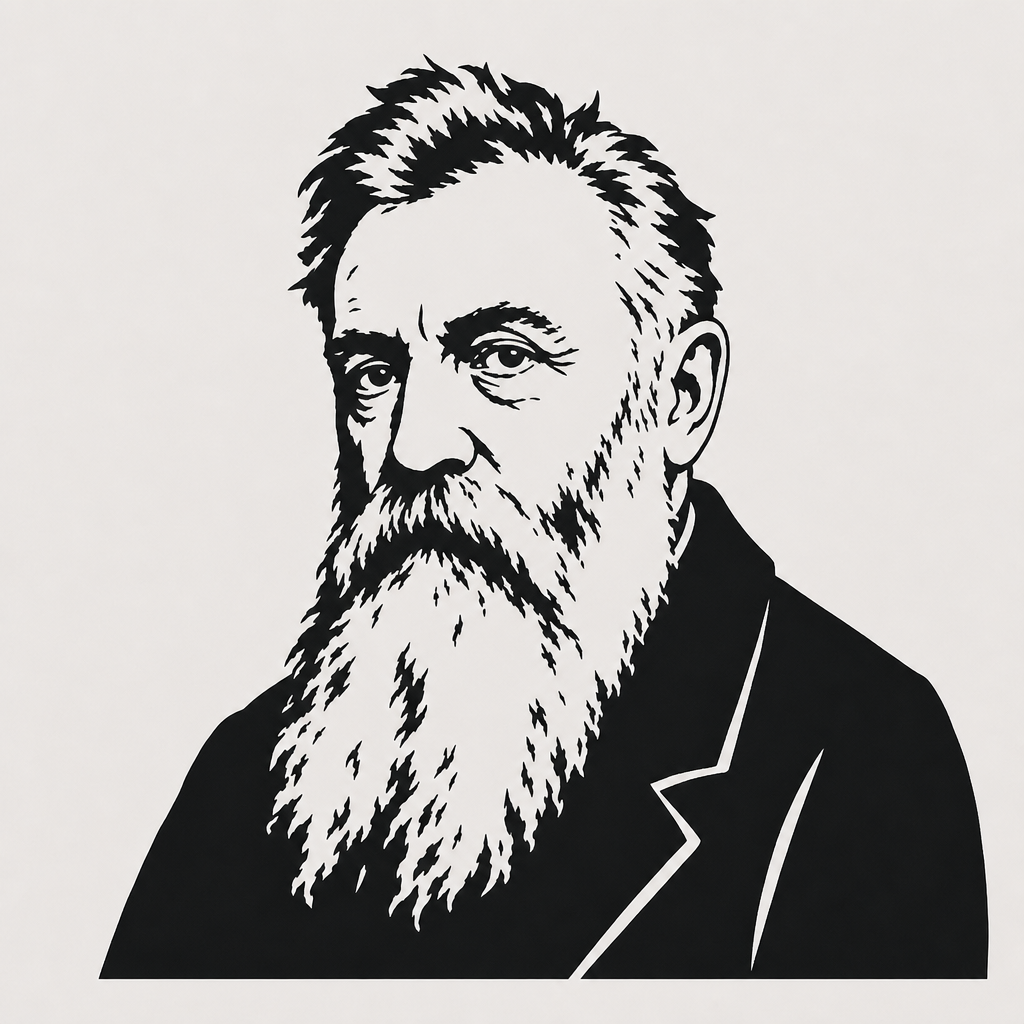
The Body That Was Too Alive
In the spring of 1877, a life-size bronze of a naked young man went on view at the Paris Salon, and the whispering began almost at once. The figure was too convincing. The muscles held tension the way a living body holds it; the surface seemed to breathe. Sculptors did not make figures this alive from clay and imagination, the rumor went. This one must have been cheated into existence — plaster poured over a real man’s body and cast directly, a trick called surmoulage. The statue was called The Age of Bronze, and its maker was a thirty-six-year-old artisan almost no one had heard of.
The accusation was serious enough to threaten his career before it began. So Auguste Rodin fought back with the only weapons he had: letters to the newspapers, the testimony of Belgian colleagues who had watched him work, and photographs of his model — a young soldier named Auguste Neyt — laid beside images of the statue to show, limb by limb, where the sculpture departed from the flesh. He demanded an official inquiry. Eventually a committee of sculptors examined the case and cleared him, and the French state, half in apology, bought the bronze.
No serious scholar has believed the charge since. But the irony would shadow Rodin’s entire life. The one unforgivable thing his art could do was seem alive — and the scandal that nearly ruined him instead made his name. It was the first move in a pattern he would repeat for forty years: produce something that broke the rules of respectable sculpture, absorb the outrage, and watch it curdle into fame.
The Near-Sighted Boy Who Drew
He was born in Paris on November 12, 1840, in a working-class district of the city’s Left Bank. His father was a clerk in the police department; his mother kept the household. From childhood he was severely near-sighted — a boy who could not read the blackboard and so filled his time drawing what was close enough to see. At fourteen he entered the Petite École, a free school of drawing and mathematics, where a teacher named Horace Lecoq de Boisbaudran drilled his pupils in a strange and lasting discipline: to observe something, then draw it from memory. Rodin’s classmates included the future sculptor Jules Dalou. He won prizes. He wanted more.
Three times he applied to the École des Beaux-Arts, the state academy that was the gateway to a sculptor’s career. Three times the judges turned him away. His modeling, shaped by the fleshy exuberance of the eighteenth century, seems to have offended examiners schooled in cool Neoclassical taste. So instead of an academy, Rodin got a trade. For nearly two decades he worked as an ornamental craftsman — carving cornices and decorative figures, mass-producing beauty for other men’s buildings and other men’s signatures.
Two blows fell in these years. In 1862 his beloved older sister Maria died, and the grief-stricken Rodin briefly entered a religious order as a lay brother. The priest who received him, Pierre-Julian Eymard, recognized that the young man’s true vocation was art, not the cloister, and sent him back to it. Then, around 1864, Rodin met Rose Beuret, a young seamstress who would remain his companion for fifty-three years, mix his clay, keep damp cloths on his unfinished figures through every absence and every affair, and bear him a son he never fully acknowledged. That same year he submitted a bust of a battered old street porter — The Man with the Broken Nose, its skull cracked off when the clay froze in his cold studio — to the Salon. Rejected. A marble version was accepted only in 1875.
He took a job as chief assistant to the successful sculptor Albert-Ernest Carrier-Belleuse, a man who ran his studio like a factory, turning out decorative work under his own name with a small army of hands. When the Franco-Prussian War came in 1870, Rodin’s poor eyesight kept him out of the fighting, and he followed Carrier-Belleuse to Brussels to work on public commissions, staying six years. Then, in 1875, he made the pilgrimage every ambitious sculptor made — to Italy, to stand before Donatello and Michelangelo. The encounter with Michelangelo, he later said, freed him from the academy that had rejected him. When he returned, he made The Age of Bronze, and the scandal found him.
The Gates That Never Closed
Vindication brought opportunity. In 1880, a government official gave Rodin a commission that would swallow the rest of his life: a monumental bronze door for a planned museum of decorative arts in Paris, on the theme of Dante’s Inferno. The museum was never built. But The Gates of Hell became the workshop of his imagination — a churning field of more than two hundred writhing figures from which he would extract, enlarge, and recombine the images that made him famous.
Perched on the lintel, meant to be Dante brooding over the damned, sat a muscular figure hunched in thought. Pulled off the door, cast alone, and blown up to colossal size in 1904, he became The Thinker — a name that now means concentrated human thought the world over. A pair of embracing lovers, the adulterers Paolo and Francesca, were lifted out and carved in marble as The Kiss; Rodin, who thought it too pretty and conventional, once dismissed it as a “huge knick-knack.” He worked on the Gates for a decade, effectively abandoned the door around 1890, and never cast it in bronze in his lifetime. The first bronze Gates were poured after his death.
The Gates also reveal the paradox at the center of Rodin’s practice. He preached, and embodied, the cult of the artist’s own touch — the thumb-marks in the clay, the living surface. Yet he ran a large studio on the model he had learned from Carrier-Belleuse. Rodin modeled originals in clay; his assistants and specialist carvers translated them into marble, enlarged them with pointing machines, and oversaw the foundry casting. Many marbles signed “Rodin” were carved almost entirely by other hands after his models; he supervised and finished to varying degrees. This was ordinary nineteenth-century practice. But Rodin pushed it to an industrial scale even as he made the artist’s personal mark his gospel — and that tension is the root of every later argument about what, exactly, a genuine Rodin is.
Around 1884 the city of Calais gave him a commission that let him break another rule. The town wanted a heroic monument to the six burghers who, in 1347, had offered their lives to save the besieged city from the English king. Rodin refused to give them glory. He modeled six ordinary men, ropes already around their necks, walking toward death in isolation and dread — not a triumphant allegory but a study of ordinary human fear and courage. The committee objected that this was not how they had imagined their heroes. Rodin refused to change it. The Burghers of Calais, completed in 1889, was finally unveiled in 1895, on the raised, railed pedestal Rodin had opposed; his wish to place the figures at ground level, among the living, was honored only long after his death.
The Ferret and the Contract
Into this studio, around 1884, came a young woman of extraordinary gift. Camille Claudel was eighteen; Rodin was forty-three. The École des Beaux-Arts was closed to women, so a talented sculptress could rise only through a male master’s atelier — and Claudel entered Rodin’s as a pupil and paid assistant, entrusted with some of the hardest work, the hands and feet of the Burghers. She became his collaborator, his model, and his lover. The Musée Rodin itself now acknowledges that some heads exhibited under Rodin’s signature were in fact modeled by Claudel. “I’ve been making sculptures for seven years,” she wrote, “and I am Monsieur Rodin’s pupil.”
In 1886 the two signed an astonishing document, sometimes called their contract: Rodin pledged that Claudel would be his only pupil, swore fidelity, and — by most accounts — promised to marry her after a trip to Italy. He never made the trip, and he never left Rose Beuret. Through the early 1890s Rodin and Claudel worked and lived partly at a country house in the Touraine, and her own art flourished; her bust of Rodin was praised at the 1892 Salon. But he would not choose between the two women, and Claudel’s fury shows in savage small sculptures caricaturing the aging sculptor and his companion. She nicknamed him “the Ferret.” They separated for good around 1898.
What happened afterward is where the two competing myths pull hardest, and where care matters most. In one telling, Claudel is the tragic muse, a genius destroyed by love for a man who used her and cast her aside. In another, she is the erased collaborator whose ideas were absorbed into Rodin’s work and who was then discarded by a society with no place for an inconvenient, brilliant woman. Both readings live in the literature; both contain truth and distortion.
The documented facts are these. Claudel’s mental health deteriorated after the break. She grew reclusive and paranoid, convinced that “the Ferret” and a gang of accomplices were stealing her work and plotting to poison her; she destroyed many of her own sculptures. On March 10, 1913, eight days after her father — her chief protector — died, her family had her committed to an asylum, on a form signed by a single doctor and her brother, the poet Paul Claudel. It was her family, not Rodin, who confined her, and who kept her confined for thirty years, until her death in 1943 — despite doctors who repeatedly advised that she could be released to her family’s care. Her mother refused to take her back. She made no more sculpture and was buried in a communal grave. Modern specialists who have reviewed her medical file believe she was genuinely ill; the cruelty lay not in the initial committal but in the decades of refusal to let her leave. Rodin, for his part, quietly arranged money for her through an intermediary and asked that his future museum reserve a room for her work — a wish realized only in 1952, through her brother’s donation. It is false to say Rodin had her locked away; it is equally false to call her a sane woman imprisoned. The truth is sadder and less tidy than either myth.
The Snowman
By the 1890s Rodin was famous, prosperous, and still capable of provoking a riot. The Société des Gens de Lettres, the writers’ society once led by Émile Zola, commissioned him to make a monument to the novelist Honoré de Balzac, dead since 1850. Rodin promised it in eighteen months and took seven years. He read Balzac; he traveled to the writer’s home region; he ordered a replica of Balzac’s monkish dressing gown; he modeled the man nude, fat, and defiant before arriving at the final form — a towering figure swallowed in a cloak, head thrown back, less a portrait than an eruption of creative force.
When the plaster went on show in May 1898, Paris laughed. Critics called it a sack of coal, a snowman, a seal, a shapeless menhir. The writers’ society rejected it as an unfinished rough draft and refused to accept the work. A defense manifesto gathered a remarkable roll of admirers — the painter Claude Monet, the composer Claude Debussy, the future statesman Georges Clemenceau — and a subscription was raised to buy the statue for the nation. But the affair unfolded in the same weeks as the Dreyfus scandal was tearing France apart, and the subscription took on a political coloring that Rodin, cautious and by most accounts no partisan of Dreyfus, wanted no part of. He refused the money, repaid his commission, and hauled the plaster home to his garden. He never saw it cast in bronze; the first cast came in 1939. And he accepted no further public monuments.
He was, in his own reported words, convinced the Balzac was the resultant of his whole life — a judgment posterity has ratified more emphatically than he could have hoped. The critic Kenneth Clark would later call it perhaps the greatest piece of sculpture since Michelangelo, and it is now routinely described as the point where modern sculpture begins. What Paris jeered as a failure of craft was in fact the arrival of an art that valued expressive force over descriptive finish — the same instinct that had made his early work seem too alive.
Two years later, Rodin gambled again and won. Rather than trust the official Exposition Universelle of 1900 to show him well, he built his own pavilion at its gates and filled it with some hundred and fifty works, the fragmentary Gates among them. The gamble secured his world fame. Collectors, portrait clients, and disciples flowed in. The young poet Rainer Maria Rilke came to write about him and served for a time as his secretary, absorbing and later preaching Rodin’s gospel of relentless work; the two quarreled, then reconciled. Busts of the famous, drawings of dancers, honors from abroad — the outsider had become an institution.
Original Posthumous
Rodin’s final act fused triumph and desolation into a single winter. Diminished by strokes, surrounded by dealers and flatterers, he arranged in 1916 to give the French state everything — his works in plaster, marble, and bronze, his archives, his collection of antiquities, and, crucially, the right to reproduce his work — in exchange for turning the mansion he loved, the Hôtel Biron, into the Musée Rodin. Parliament argued over accepting the gift of a sculptor so associated with scandal, then accepted. On January 29, 1917, he at last married Rose Beuret, his companion of fifty-three years. She died about two weeks later. Rodin himself died that November, at seventy-seven, and was buried beside her beneath a cast of The Thinker, the headstone he had chosen.
That bequest created the strangest chapter of all — one that turns the surmoulage scandal of 1877 inside out. Because Rodin willed the state not only his sculptures but the right to reproduce them from his plaster molds, the Musée Rodin has gone on casting bronzes ever since, generations after the artist’s death. French law now caps such editions at twelve casts that still legally count as originals, and the museum’s income depends on them. It is why The Burghers of Calais stands in more than a dozen cities, and why the largest Rodin collection outside Paris — in Philadelphia — is made largely of bronzes cast after he died.
Whether these are truly “original Rodins” is a genuine and unresolved debate. The museum and estate hold that they are authentic originals, produced under the artist’s own explicit testament from his own molds. Critics counter that works cast decades after death — at sizes he never approved, with patinas and surfaces he never saw and never touched — are reproductions, and that this matters especially for an artist so much of whose genius lived in the surface. Rodin is also among the most-forged of all sculptors; a forgery ring was broken up in the 1990s. The man once accused of faking a single body left behind an art that never stops being manufactured, and a question — how many Thinkers are real? — with no settled answer.
His reputation dipped after his death, when modernists found him theatrical, and was rebuilt from the 1950s onward. Today it is inescapable: The Thinker and The Kiss are global shorthand for thought and love. He is the hinge between the old sculpture of finished heroes and the modern art of the fragment, the partial figure, the expressive surface — the master in whose shade, as the escaping Brancusi put it, nothing could grow. And the recovery of Camille Claudel since the 1980s has permanently changed how his story is told. She is a subject now, not a footnote. Any honest account of the man accused of making life too well must also account for the lives his own left in shadow.
Sources & Further Reading
- Musée Rodin, Paris — collection pages and “Rodin and his artists: Camille Claudel” (musee-rodin.fr)
- Musée Rodin — “The Musée Rodin, the artist’s heir” (text of the bequest) and the 1840–2015 life timeline (musee-rodin.fr)
- Rodin Museum, Philadelphia (Philadelphia Museum of Art) — museum history and collection (rodinmuseum.org)
- Rilke, Rainer Maria — Auguste Rodin (1903), Project Gutenberg #45605
- Butler, Ruth — Rodin: The Shape of Genius (Yale University Press, 1993)
- Ayral-Clause, Odile — Camille Claudel: A Life (Abrams, 2002)
- Le Normand-Romain, Antoinette — The Bronzes of Rodin (Éditions RMN / Musée Rodin, 2007)
- Corbett, Rachel — You Must Change Your Life: The Story of Rainer Maria Rilke and Auguste Rodin (Norton, 2016)