Charles-Maurice de Talleyrand
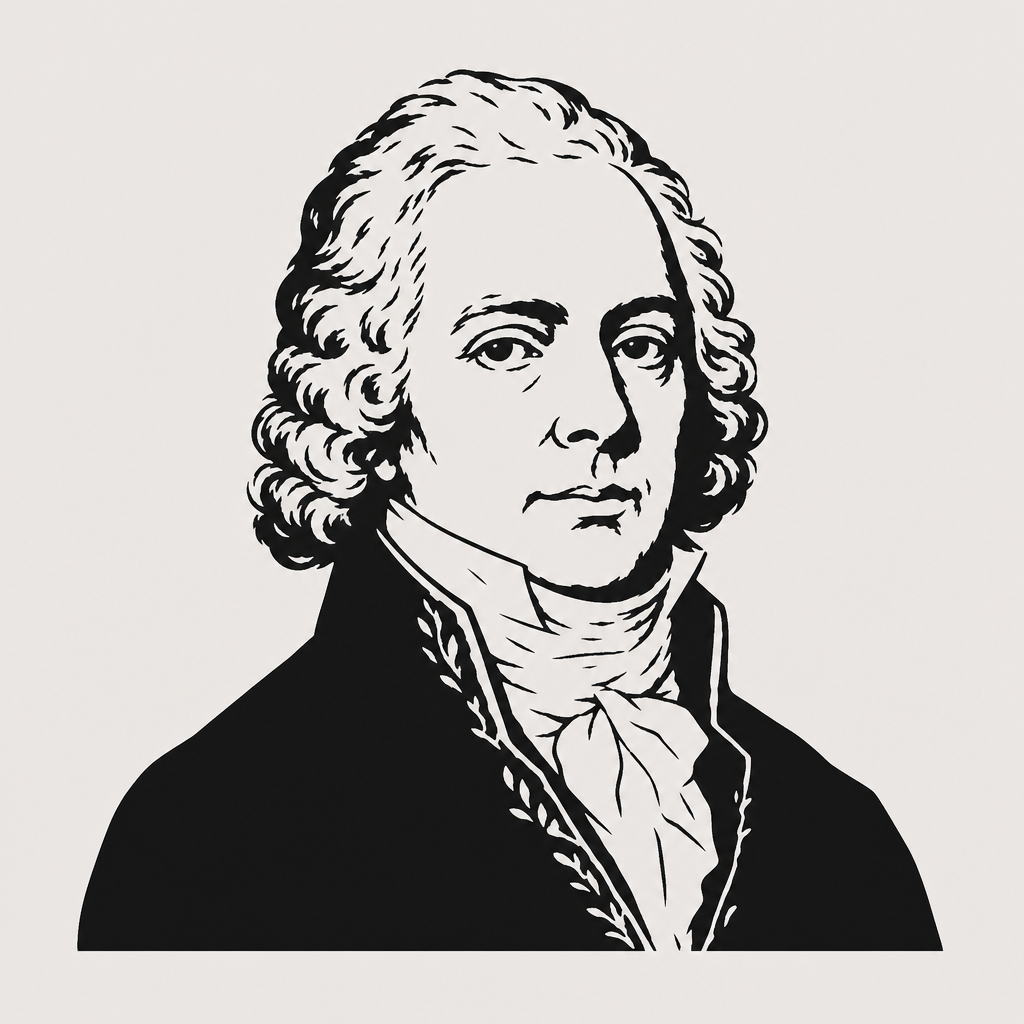
The Man at the Mantelpiece
On the morning of January 28, 1809, the most powerful man in Europe stood in a drawing room of the Tuileries and screamed at a cripple. Napoleon had rushed back from Spain on hearing that two of his own great officers of state — his foreign minister of a decade, Talleyrand, and his police minister, Fouché — had been seen arm in arm, plotting who might succeed him if he fell. Before the assembled court the Emperor let loose. Talleyrand was a thief, a coward, a man without honor who believed in nothing, who would sell his own father. He had, Napoleon raged, betrayed everyone. And then the phrase that history kept: the Emperor is said to have told him he was “shit in a silk stocking.”
Through all of it, Talleyrand did not move. He leaned against the mantelpiece, his club foot taking the weight, his heavy-lidded face registering nothing at all. When the storm finally blew itself out and he limped from the room, he is supposed to have murmured to the courtiers around him, “What a pity that so great a man should have been so badly brought up.” Both lines come to us late and polished, retouched by memoirists writing decades afterward; the tirade itself, however, is real, witnessed by half the imperial court.
Here is what makes the scene worth telling. Napoleon was right about the treachery — Talleyrand had already begun selling the Empire to its enemies — and yet he did not dare arrest the man he had just called excrement. He merely stripped him of a ceremonial office. Within five years the figure at the mantelpiece would hand Napoleon’s throne to the Bourbons, seat the Tsar of Russia in his own house, and walk into a room full of the men who had beaten France to dictate the peace. Talleyrand’s whole life is contained in that immobility: the servant nobody could trust and nobody could quite destroy.
The Lame Devil
Charles-Maurice de Talleyrand-Périgord was born in Paris on February 2, 1754, into one of the oldest and grandest families of France — and one of the poorest of its rank, illustrious enough to hold court offices but never rich enough to match them. He walked with a limp all his life. His own memoirs, written in old age, blame a childhood accident, a fall while in a nurse’s care. Modern research tells a different story: no contemporary mentions any accident, an uncle carried the same deformity, and the historian Emmanuel de Waresquiel concludes the foot was congenital. If so, the accident was itself a small self-serving fiction, deflecting a hereditary taint onto bad luck. Either way, Paris gave him a nickname that stuck for eighty-four years: le diable boiteux, the lame devil.
The foot decided his life. A noble son who could not sit a horse could not be a soldier, and a limping heir was quietly passed over so that primogeniture — and the family name — could run to a sounder brother. The Church was the designated refuge for such sons, and into the Church the boy was pushed. He never chose it, and the resentment shows across sixty years of his conduct. He read Voltaire and Montesquieu while training for the priesthood, gambled and chased women as a fashionable young abbé of the salons, and was ordained in December 1779 at twenty-five with no vocation whatsoever.
He was, however, superbly good at the business of the Church. As Agent-General of the Clergy in the early 1780s he became, in effect, the manager of the Gallican Church’s vast wealth — its lands, its revenues, its legal defenses. He learned exactly what the Church of France owned, down to the acre. In 1788, over the personal dislike of Louis XVI, he was made Bishop of Autun. He had been a bishop for barely a year when the world he was born to began to come apart, and he proved to have a talent nobody had suspected: he could read which way it was falling.
In October 1789 the Bishop of Autun rose in the National Assembly and proposed that the property of the Church — the very wealth he had spent a decade defending — be nationalized to pay the debts of the state. It was the Revolution’s first great source of funds, and he had handed it over. He helped draft the Declaration of the Rights of Man, wrote a landmark report on public education, and argued for the political rights of Protestants and Jews. On July 14, 1790, at the Fête de la Fédération, the lame bishop celebrated open-air Mass before some three hundred thousand people on the Champ de Mars — the altar of the old religion pressed into the service of the new order. When he consecrated the first constitutional bishops in 1791, Pope Pius VI excommunicated him. He resigned his see and left the clergy without a backward glance.
Six Masters
What followed was the most extraordinary run of political survival in modern European history. Over the next twenty-five years France changed its form of government roughly every fifteen years of his adult life — monarchy, constitutional monarchy, republic, Directory, Consulate, Empire, and then the Bourbons twice over — and Talleyrand served, and left, one regime after another, each time an instant before the floor gave way. His own explanation, offered late and often, was disarmingly simple: he had never, he insisted, abandoned a government before it had first abandoned itself.
His enemies called it treason. When the monarchy fell in 1792 he was in London on quasi-official missions to keep Britain out of the war; he slipped out of Paris with a passport from Danton as the September massacres began, and months later the Convention issued a warrant for his arrest after incriminating papers turned up in the king’s iron chest. Expelled from Britain under Pitt’s Alien Act, he sailed for the United States, where he spent two years in Philadelphia as a bank agent and land speculator, took an oath of allegiance before the city’s mayor, and formed a genuine admiration for Alexander Hamilton. He returned to France in 1796, struck from the émigré list after lobbying orchestrated by his lover and ally Germaine de Staël, and in July 1797 became foreign minister of the Directory. His hostile rival Barras claimed he greeted the news by vowing to make “an immense fortune”; whether or not he said it, he did it.
He did it first, and disastrously, on the Americans. In 1797 President Adams sent three envoys to settle differences with France; Talleyrand’s intermediaries — the agents the published dispatches called W, X, Y, and Z — informed them that before any talks could begin there must be a loan to France and a substantial private bribe to the minister himself. To an old-regime diplomat, such douceurs were simply the grease of the trade. To the young American republic they were an outrage. Publication of the dispatches ignited the naval Quasi-War of 1798–1800, the one moment his venality nearly caused a real one. It was settled only by the Convention of 1800, and it fixed his reputation in America forever as the most corrupt man in Europe.
Everywhere French power stood behind him, though, the same behavior paid. He helped engineer Bonaparte’s coup of 18 Brumaire in 1799 — while keeping an escape route ready in case it failed — and was reappointed foreign minister. He brokered the Peace of Lunéville with Austria and the Peace of Amiens with Britain, and the Concordat that lifted his own excommunication. In 1802 Napoleon forced him to marry his longtime mistress, Catherine Grand, a divorced former courtesan — the one respectability the ruler of France could impose on him. From the reorganization of the German states in 1801–03 he and his associates reportedly cleared something on the order of ten million francs in payments from princes eager to keep or gain territory; the true lifetime figure is unknowable and every estimate is a guess. He bought the vast Château de Valençay, kept Antonin Carême, the greatest chef in Europe, and made the dinner table an instrument of statecraft.
Not everything he touched was profit. In 1804 he was complicit in the kidnapping and execution of the Duc d’Enghien, a Bourbon prince seized on foreign soil and shot on thin evidence; how deeply he was involved remains disputed, the file partly destroyed, possibly by his own hand, but royalists never forgave “the murderer of the Duc d’Enghien.” (The famous verdict on that crime — that it was “worse than a crime, it was a mistake” — was coined by someone else, not by him.) And from about 1805 a genuine conviction took hold beneath the greed: that France had reached its natural limits, that Napoleon’s endless wars would destroy the gains of the Revolution, and that only a stable European balance could preserve them. In 1807 he resigned the foreign ministry rather than keep signing punitive treaties. It is the closest thing to a principle in his life — and it turned him, in his own mind, from the Emperor’s servant into France’s.
Selling the Emperor, Saving France
At the Congress of Erfurt in the autumn of 1808 he crossed the line no defense can quite erase. Officially he was there as Napoleon’s aide, helping to overawe Tsar Alexander I into a firmer alliance. Secretly — by his own account, which is the main source and must be read as such — he took the Tsar aside and counseled him to resist: the French people, he is supposed to have said, were civilized and their sovereign was not; it was for Alexander to save Europe. From 1808 onward he accepted payments from Austria and Russia in exchange for the Emperor’s secrets. This is the hard core of the case against him, and it cannot be laundered: to take foreign money for betraying your own government’s negotiating positions is a different and darker act than pocketing gratuities for treaties you would have signed anyway. It was this that Napoleon half-glimpsed at the mantelpiece in January 1809 — and, astonishingly, failed to punish.
The wager came due in the spring of 1814. As the allied armies closed on Paris and Napoleon’s marshals fell back, Talleyrand contrived to remain in the capital. When Tsar Alexander entered the city on March 31, he lodged not in a palace but in Talleyrand’s own house on the rue Saint-Florentin, where his host spent the night persuading him that neither a regency nor a new general but only the restored Bourbons could give France — and Europe — stability. On April 1 the Senate, at Talleyrand’s prompting, established a provisional government under his presidency; on April 2 it deposed the Emperor. For the returning princes he supplied the reassuring line for the newspapers: nothing had changed in France, there was simply one more Frenchman. Two months later the First Treaty of Paris left defeated France with its 1792 borders, no indemnity, and its looted art intact — an astonishing leniency that was substantially his work as the restored king’s foreign minister.
Then came the masterpiece. At the Congress of Vienna, which opened in the autumn of 1814 to redraw the map of Europe, Talleyrand arrived as the envoy of the beaten aggressor, formally excluded from the inner committee of the four victorious powers. He talked his way into the room by making himself the champion of a principle — legitimacy, the rights of established thrones and of the smaller states the great powers meant to carve up. When Prussia and Russia moved to swallow Saxony and Poland, he split the alliance that had crushed France: on January 3, 1815, France, Austria, and Britain signed a secret defensive treaty against Russia and Prussia. The defeated power now held the balance of Europe. Saxony was largely saved; France was a great power again barely nine months after total defeat. It is the payoff that retroactively appears to justify — or to launder — every betrayal that came before.
Napoleon’s escape and the Hundred Days interrupted the triumph but did not undo it; Talleyrand stayed in Vienna throughout. After Waterloo he served briefly as foreign minister and first president of the council — prime minister — under Louis XVIII, then resigned rather than put his name to the harsher Second Treaty of Paris. He was nearly sixty-two, and most men would have been finished.
The Last Negotiation
He was not finished. He spent fifteen years in gilded opposition — whist, salons, the writing of self-justifying memoirs he ordered sealed for thirty years after his death — and then, in 1830, helped topple another king. When the July Revolution put Louis-Philippe on the throne, the new monarch sent the seventy-six-year-old Talleyrand to London as ambassador. There he crowned the whole improbable career: he was a principal architect of Belgian independence and neutrality, helped place Leopold of Saxe-Coburg on the new Belgian throne, and in 1834 sealed the Quadruple Alliance of the western constitutional powers. Then, at last, he went home to Valençay to die.
The end was itself a negotiation. The excommunicated ex-bishop had one loyalty left to settle, and on May 16, 1838, in his final hours, he signed a formal retraction of his revolutionary “errors” and a letter of submission to Pope Gregory XVI — the timing, by every account, calculated to the last possible moment. When the priest came to administer extreme unction, Talleyrand is said, in the account left by the Abbé Dupanloup, to have insisted the holy oil be applied to the backs of his hands rather than the palms, because those were the hands of a bishop. He died on May 17. Louis-Philippe, king of the French, had called on him that morning. He had exited every allegiance of his life in turn — and re-entered the very first one at the door of death, on his own terms, correcting the liturgy as he went.
The Two Verdicts
His name became a common noun. To call a man “a Talleyrand” can mean a diplomat of genius or a conscienceless turncoat, and both usages survive because the argument behind them was never settled. The prosecution is formidable: he swore loyalty to and then abandoned or sold the Church, the monarchy, the Directory he helped overthrow, and the Emperor who made him a prince, and he grew rich at nearly every turn. George Sand thought him “a man born for great vices and small actions.” The Duke of Wellington, who watched him work, confessed he could never discover on what grounds Talleyrand’s great reputation rested.
The defense is equally serious, and it is not merely his own. From about 1805 he did hold to a single, consistent policy — peace, natural frontiers, a Europe in balance — and he betrayed, on this reading, only rulers who had first betrayed the true interest of France. The philosopher Simone Weil later judged that he had served “not every regime, but France behind every regime.” The evidence for the defense is the lenient treaty of 1814 and the miracle of Vienna, and the fact that the Concert of Europe he helped build kept the continent from general war for four decades. The Library of Congress puts the open question plainly: was he a cynical opportunist, a wily defender of French interests, or a cosmopolitan European bent on keeping the peace? Historians genuinely disagree, and it is not the biographer’s job to pretend otherwise.
Perhaps the fairest word came from the man who had every reason to hate him. During the retreat from Russia in 1812, brooding to Caulaincourt about the minister who was already betraying him, Napoleon called Talleyrand a man of intrigue and great immorality — and, in the same breath, the most capable of all his ministers. Both halves of that sentence are true. The lame devil built no monuments and led no armies; his art was survival, and he practiced it at the expense of everyone who ever employed him. But twice, when France lay beaten, the survivor’s instinct and the patriot’s calculation pointed the same way, and a defeated nation kept its borders and regained its place because a man nobody could trust happened, that once, to be worth trusting. History is under no obligation to resolve him. It never has.
Sources & Further Reading
- Fondation Napoléon — biography, “Talleyrand-Périgord, Charles-Maurice de,” napoleon.org (ministerial dates; the 1814 sequence; Napoleon’s 1812 verdict)
- Office of the Historian, U.S. Department of State — “The XYZ Affair and the Quasi-War with France, 1798–1800,” history.state.gov
- Château de Valençay — “Le Prince de Talleyrand,” chateau-valencay.fr (career timeline, Valençay years, death and burial)
- Library of Congress, 4 Corners of the World blog — Taru Spiegel, “Talleyrand: A Diplomat Par Excellence” (2019), blogs.loc.gov
- Talleyrand, Memoirs of the Prince de Talleyrand, ed. duc de Broglie (1891) — Internet Archive (primary, with heavy caveats)
- Cooper, Duff — Talleyrand (1932)
- Waresquiel, Emmanuel de — Talleyrand: le prince immobile (Fayard, 2003) — the standard modern life; the congenital-limp finding
- Harris, Robin — Talleyrand: Betrayer and Saviour of France (John Murray, 2007)
- Ferrero, Guglielmo — The Reconstruction of Europe: Talleyrand and the Congress of Vienna, 1814–1815 (1941)