Alan Turing
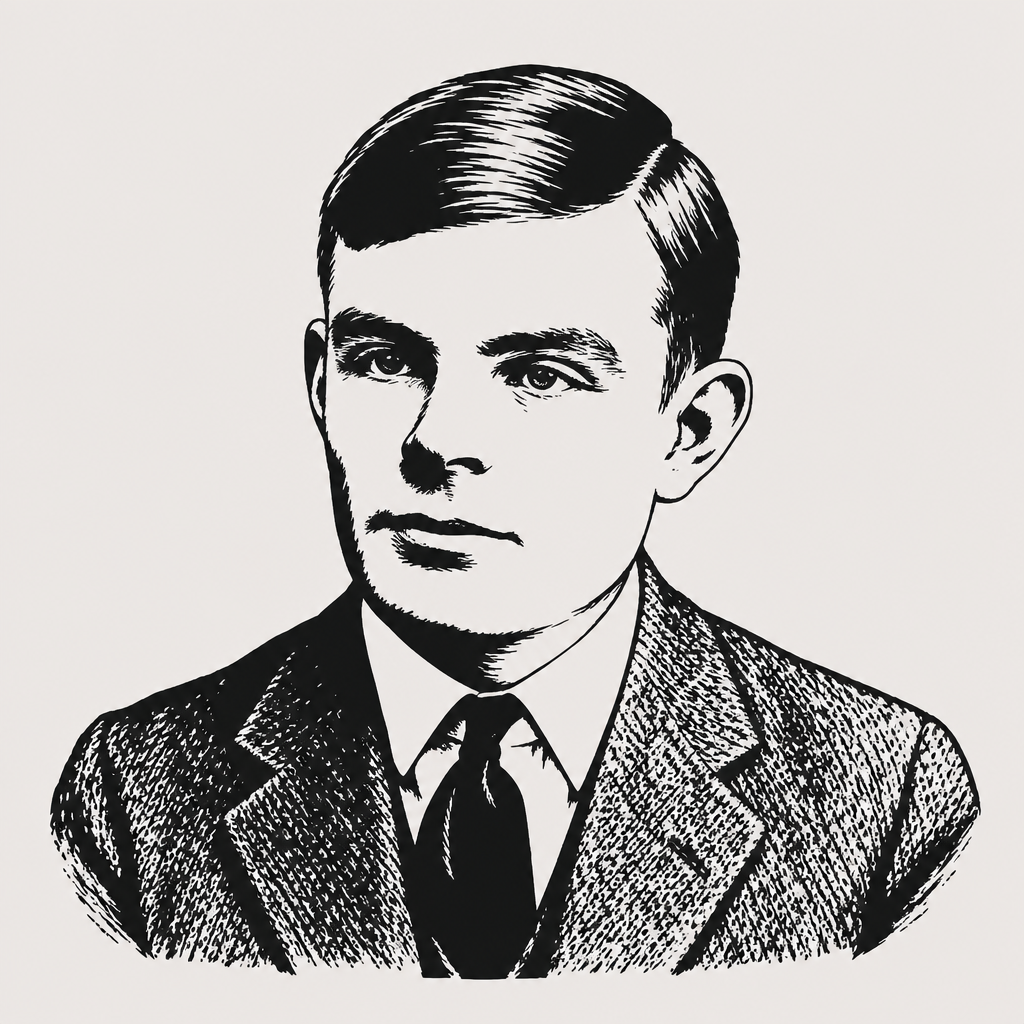
The Verdict at Wilmslow
On June 10, 1954, a coroner in the small Cheshire town of Wilmslow considered the death of a 41-year-old mathematician. The facts before him were few. Alan Turing had been found in bed by his housekeeper two evenings earlier, dead of cyanide poisoning. There was a jar of potassium cyanide in the house, and a half-eaten apple on the bedside table — an apple no one ever thought to test. There was no note. The coroner ruled suicide, “while the balance of his mind was disturbed,” and the newspapers gave the story a few inches. The obituaries praised a gifted Cambridge mathematician and Fellow of the Royal Society, dead too young.
Not one of them could say what he had actually done, because almost nothing true about Alan Turing was legal to print. That he had led the attack on Nazi Germany’s naval codes — the work Churchill’s own intelligence chiefs credited with helping to win the Atlantic war — was a state secret, and remained one for another twenty years. That he was homosexual was no secret at all by then: the state had prosecuted him for it two years earlier, taken his security clearance, and sentenced him to a year of hormone injections designed to extinguish his desire. The war hero was unmentionable; the “criminal” was a matter of public record.
Sixty-seven years later, the Bank of England put his face on the £50 note, wreathed in ticker tape of binary — his birthday, encoded — beside a line he gave a newspaper in 1949 about the computers to come: “This is only a foretaste of what is to come, and only the shadow of what is going to be.” The distance between the inquest and the banknote is the story of Alan Turing: a man who spent his life making hidden things readable, while everything that mattered about him was forced to stay hidden.
The Boy on the Bicycle
Alan Mathison Turing was born in London on June 23, 1912, the second son of a colonial civil servant. His parents spent most of his childhood in India, where his father served, and by the custom of their class the boys stayed behind, boarded out with a retired army couple on the English south coast. Alan grew up largely without his parents, odd, untidy, and stubbornly self-directed — a boy who did long division for pleasure and, by one family story, dug up a garden looking for buried treasure using a map he had drawn himself.
In May 1926, aged thirteen, he was due to start at Sherborne School in Dorset on the same day Britain’s General Strike stopped every train in the country. Turing rode his bicycle the sixty-odd miles from Southampton alone, staying overnight at an inn, and arrived on time — a feat improbable enough that the local paper reported it. Sherborne barely knew what to do with him. He was hopeless at Latin, indifferent to games as they were played, and consumed by mathematics and chemistry; his headmaster warned that a boy interested only in science was “wasting his time at a public school.”
What changed him was another student. Christopher Morcom, a year ahead, was everything Turing was not — polished, precise, admired — and shared his hunger for science. Turing later said plainly that he had “worshipped” him. In February 1930, Morcom died suddenly of bovine tuberculosis, contracted years earlier from infected milk. Turing, devastated, wrote a stream of letters to Morcom’s mother wrestling with whether a mind — a spirit, he called it — could survive the failure of its body. It was grief, but it was also the first appearance of the question that would organize his entire scientific life: what is the relationship between thought and the machinery that carries it?
The machinery of his own career now engaged. A scholarship took him to King’s College, Cambridge, in 1931 — a tolerant, brilliant world where, unusually for the age, neither his awkwardness nor his sexuality made him an outcast. He graduated with distinction in 1934 and at twenty-two was elected a Fellow of King’s. In 1935 he attended Max Newman’s lectures on the foundations of mathematics, and met the problem that made him: David Hilbert’s Entscheidungsproblem, the “decision problem,” which asked whether there could exist a definite method for settling, in principle, any mathematical question.
Turing’s answer, worked out on long runs and delivered in the 1936 paper “On Computable Numbers,” was no — and the way he proved it mattered more than the result. To say what a “definite method” was, he imagined a machine: a strip of tape, a head that reads and writes symbols one at a time, a fixed table of rules. Anything a human calculator could do by rote, one of these machines could do. Then came the leap. He showed that a single machine could read the rule-table of any other machine from its tape and imitate it — one machine that could be every machine. The “universal machine” was an abstraction invented to kill a Hilbert problem; it was also, a decade early, the complete conceptual design of the modern computer, with hardware, software, and data revealed as one substance. The American logician Alonzo Church reached the same verdict on Hilbert’s problem by other means a few weeks ahead of him, and Turing went to Princeton to complete a doctorate under Church. But it was Turing’s version — the machine you could almost hear clicking — that the future used.
The Prof’s War
Turing returned to Cambridge in 1938 and was quietly recruited by the Government Code and Cypher School. On September 4, 1939, the day after Britain declared war, he reported to its wartime station: a Victorian estate north of London called Bletchley Park.
The German armed forces encrypted their radio traffic with the Enigma machine, whose settings changed daily and whose possible configurations ran to astronomical numbers. The Poles had got there first — mathematicians of the Polish Cipher Bureau had broken pre-war Enigma and, in July 1939, handed Britain and France their reconstructions and methods, an inheritance without which Bletchley might have started years behind. But the Germans kept hardening the system, and the Polish techniques were dying. Turing’s response was the Bombe: an electromechanical machine that took a guessed fragment of plaintext — a “crib,” such as a daily weather report — and raced through Enigma’s possibilities, discarding contradictions at electric speed until only plausible settings survived. With a crucial refinement by his colleague Gordon Welchman, more than two hundred Bombes were eventually built, and from early 1940 until the end of the war the Allies read thousands of German messages a day.
Turing — “the Prof,” in Bletchley’s affectionate shorthand — took on the hardest version of the problem: naval Enigma, which guarded the U-boat packs strangling Britain’s Atlantic convoys, and which most of the establishment considered unbreakable. As head of Hut 8 he devised Banburismus, a pencil-and-cardboard procedure for weighing the evidence in intercepted messages that was, in modern terms, sequential Bayesian inference years before statisticians named it. Helped by captured key material seized from German weather ships and the sinking U-110, Hut 8 broke into the U-boat traffic in 1941, and convoy routing changed within weeks. When bureaucratic starvation slowed the work that autumn, Turing and three colleagues went over every head in the chain of command and wrote directly to Churchill. The Prime Minister minuted his chief of staff the same day: “ACTION THIS DAY. Make sure they have all they want on extreme priority.” They got it.
Bletchley also indulged the eccentric it depended on. Turing chained his tea mug to a radiator, cycled in a gas mask during hay fever season, and sometimes ran the forty miles to London meetings — he was a near-Olympic-class distance runner, and in 1947 would run a marathon in 2 hours 46 minutes, fifth in the national championship. In 1941 he briefly became engaged to Joan Clarke, one of Hut 8’s own cryptanalysts; he told her honestly about his “tendencies,” and it was he, not she, who ended it. In 1942 he devised the entry point into the German high command’s Lorenz teleprinter cipher — the attack that Newman’s section later industrialized on Colossus, the world’s first large-scale electronic digital machine — then crossed the Atlantic as the top-level liaison on codebreaking and speech encryption. He was appointed OBE in 1946 for services he could not name. Harry Hinsley, the official historian of British intelligence, later estimated that Ultra — the intelligence Bletchley produced — shortened the war in Europe by two or more years. However one weighs such counterfactuals, few individuals contributed more to it than Turing, and no one was allowed to know.
Building the Brain
Turing left the war with a unique possession: he alone had both the theory of the universal machine and hands-on knowledge of large-scale electronics. In 1945 the National Physical Laboratory hired him to design an electronic computer, and his 1946 report on the ACE — Automatic Computing Engine — was the first complete design for a stored-program computer ever written, down to circuit diagrams, cost estimates, subroutine libraries, and speculation about machines used from a distance. Then bureaucracy did what bureaucracy does. The NPL, doubting its own project, built a diluted fraction of the design; by the time the Pilot ACE ran in May 1950 — becoming, briefly, the fastest computer in the world — Turing had resigned in frustration and moved to Manchester, where Max Newman’s laboratory had run the world’s first stored program in June 1948 on a machine nicknamed the Baby. Turing became the lab’s deputy director, wrote the programming manual for its commercial successor, the Ferranti Mark 1, and settled into the role he liked best: using the machine.
What he used it for made him a founder twice more. In 1950 he published “Computing Machinery and Intelligence” in the philosophy journal Mind — a paper that opens with the sentence “I propose to consider the question, ‘Can machines think?’” and then, judging the question hopelessly vague, replaces it with a game. If an interrogator, conversing by teleprinter with a hidden human and a hidden machine, cannot reliably tell which is which, on what grounds do we deny the machine thought? The “imitation game” — the Turing test — came wrapped in witty demolitions of every objection Turing could anticipate, from theology to extrasensory perception, and a prediction that by the century’s end machines would converse well enough that “the use of words” would have changed. Artificial intelligence, as a debate, begins there.
Then he turned to a question he had carried since childhood, when a book had told him the human body was a machine: how does a growing organism get its form? In “The Chemical Basis of Morphogenesis” (1952) he showed that two ordinary chemicals, reacting and diffusing through tissue at different rates, could break perfect symmetry on their own and settle into standing waves — spots, stripes, whorls. He ran the numbers on the Ferranti Mark 1, making him among the first humans to do computational biology, and wondered whether his equations explained the zebra and the sunflower. Biologists took decades to catch up; “Turing patterns” are now textbook developmental biology. He was elected a Fellow of the Royal Society in 1951, still only 38, with the founding documents of computer science, artificial intelligence, and mathematical biology behind him.
The Burglary on Adlington Road
In January 1952, Turing’s house in Wilmslow was burgled. He reported it to the police, and — with the unguarded honesty that everyone who knew him described — explained how he knew the likely culprit: an acquaintance of Arnold Murray, the unemployed nineteen-year-old with whom he was having an affair. Gross indecency between men remained a crime under the same Victorian statute that had convicted Oscar Wilde in 1895, and the detectives turned from the burglary to the confession. Britain in 1952 was in the grip of a Cold War panic that recast homosexual men as security risks — two Foreign Office men, Burgess and Maclean, had just defected to Moscow — and prosecutions were surging. Turing did not pretend to be ashamed, which may have been the most incomprehensible thing about him. On March 31, 1952, he was convicted.
He was offered a choice: prison, or probation conditional on “organo-therapy” — a year of synthetic estrogen intended to eliminate his libido, what a later age would call chemical castration. He chose the treatment, telling a friend with bleak wit that it was surely rational to prefer it. It rendered him impotent; his security clearance was revoked; the postwar codebreaking agency GCHQ, which had kept him as a consultant, was closed to him; the country he had defended monitored his movements and his foreign visitors. Through it all he kept working — deep in morphogenesis, sketching a new theory of quantum mechanics, joking in letters. Which is part of why the evening of June 7, 1954, remains genuinely unresolved. The inquest’s suicide verdict was reached in a day, on thin evidence, and the apple was never tested; his mother insisted to her death that he had been careless with the cyanide he used for home electroplating experiments, and some modern scholars agree the accident theory cannot be excluded. His biographer Andrew Hodges reads it as suicide staged gently enough to let his mother believe otherwise. No reading is comfortable. The state’s cruelty is documented either way; what it cost him inside, he characteristically declined to say.
Seventy Years of Catching Up
The secrecy outlived him by decades. Colleagues who knew what he had done at Bletchley could not tell even his mother, whose 1959 memoir of her son barely gestures at the war. When computing’s highest honor was created in 1966, it was named the Turing Award for his mathematics; the world had no idea it was also naming a war hero. Only in the mid-1970s, when the Ultra secret finally broke, did the pieces assemble — and only with Andrew Hodges’ 1983 biography, written by a mathematician who was also a gay-liberation activist, did Britain meet the whole man at once: the logician, the codebreaker, and the convicted “criminal” were the same person, and the middle fact explained why the country had let the last one happen.
The catching-up became a national ritual. In 2009, after an online petition, Prime Minister Gordon Brown formally apologized for his “appalling” treatment: “we’re sorry, you deserved so much better.” On Christmas Eve 2013 the Queen granted a rare royal pardon; in 2017 the informally named Alan Turing law extended pardons to some 49,000 other men convicted under the same statutes — a tacit admission that Turing’s fame had been doing the moral work for all of them. Hollywood supplied a myth in 2014 with The Imitation Game; a BBC audience vote in 2019 named him the greatest person of the twentieth century; in 2021 came the banknote, with its binary birthday.
He needs none of it to be present. Every phone, laptop, and server on Earth is a universal Turing machine — one machine imitating all machines, exactly as a 23-year-old imagined in 1936 to settle a question in logic. Every debate about whether the chatbots have finally crossed the line he drew in 1950 is conducted in his terms, usually under his name. He asked the twentieth century’s two best questions — can a machine think? how does a body build itself? — and gave both of them their first serious answers, in between saving his country in perfect silence. The verdict at Wilmslow took an afternoon. The verdict on Turing took seventy years, and it reversed.
Sources
- Andrew Hodges, Alan Turing: The Enigma (1983; centenary edition, Princeton University Press, 2012)
- Andrew Hodges, “Alan Turing,” Stanford Encyclopedia of Philosophy (2002, rev. 2013) (https://plato.stanford.edu/entries/turing/)
- The Turing Digital Archive, King’s College, Cambridge (https://turingarchive.kings.cam.ac.uk/)
- Bletchley Park Trust, “10 Things to Know About Alan Turing” (https://www.bletchleypark.org.uk/our-story/10-things-to-know-about-alan-turing/)
- A. M. Turing, “Computing Machinery and Intelligence,” Mind 59, no. 236 (1950): 433–460 (https://academic.oup.com/mind/article/LIX/236/433/986238)
- GOV.UK, “Royal pardon for WW2 code-breaker Dr Alan Turing,” 24 December 2013 (https://www.gov.uk/government/news/royal-pardon-for-ww2-code-breaker-dr-alan-turing)
- Bank of England, “The polymer £50 note” (https://www.bankofengland.co.uk/banknotes/polymer-50-pound-note)