Vincent van Gogh
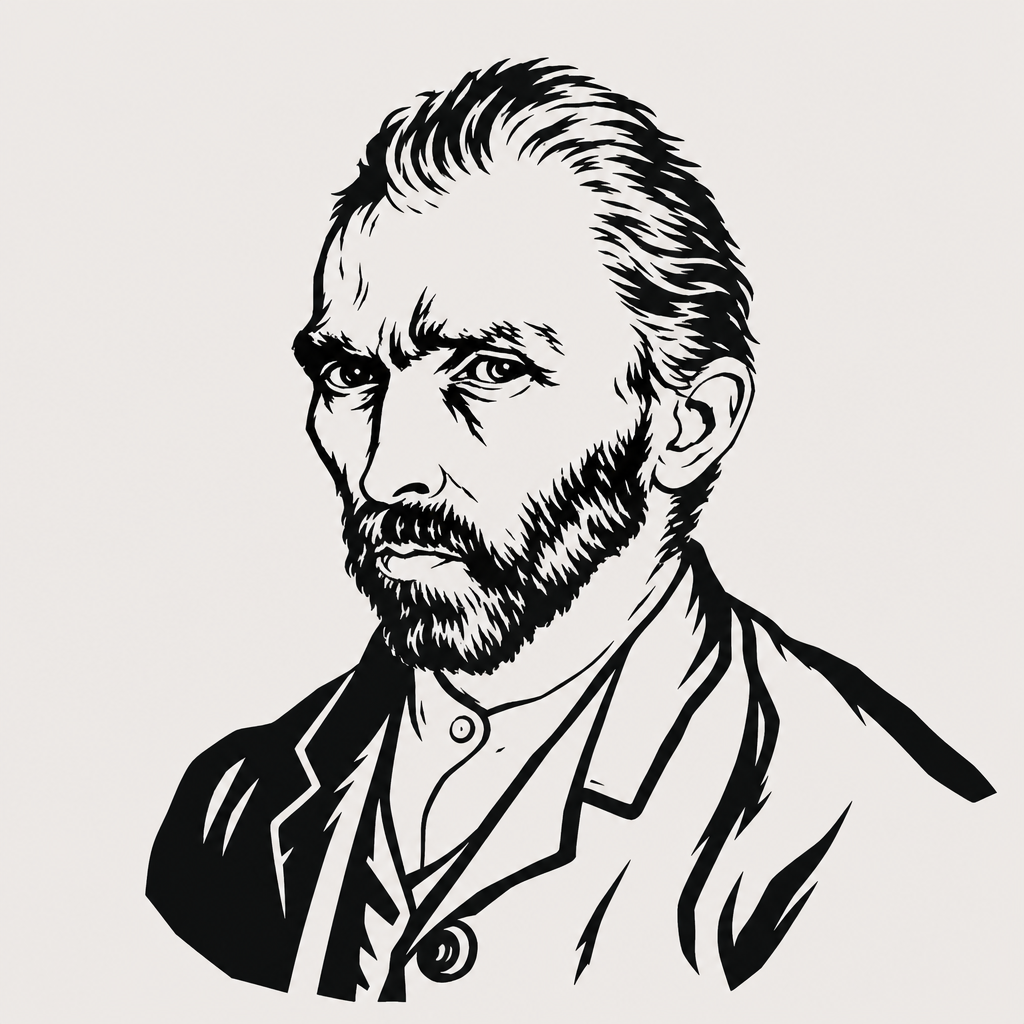
Four Hundred Francs
In the early weeks of 1890, a letter reached the asylum of Saint-Paul-de-Mausole in the south of France, addressed to a red-bearded Dutch patient who had turned a spare cell into a painting studio. It carried unusual news. In Brussels, at an exhibition of the avant-garde group Les XX, a painter named Anna Boch had bought his canvas The Red Vineyard for 400 francs.
It was the only painting Vincent van Gogh is known by name to have sold in his life.
He had been painting for barely ten years. In that decade he had produced roughly 2,100 works — around 860 of them oil paintings — while living almost entirely on money sent by his younger brother Theo, an art dealer in Paris. He had been dismissed as a clumsy amateur, a madman, a charity case. Now, at last, came a sale, and in the same month a young critic named Albert Aurier published the first serious article ever written about him, hailing the intensity of his color and calling him an isolated genius. Vincent’s response was characteristic: he worried the praise was overdone, and wrote that it ought to have gone to other painters.
Six months later he was dead at thirty-seven.
The story everyone knows — the ear, the asylum, the tortured genius painting masterpieces in a fever of madness — is not exactly false. But it hides a better story, one his own letters tell in remarkable detail: a man who failed at everything he tried until he was twenty-seven, then taught himself to paint through sheer systematic labor, sustained by one person’s stubborn faith. And then a second story, stranger still: how a dead, unsellable painter became the most beloved artist in the world — not by accident, but largely through the determination of a woman history nearly forgot.
A Talent for Failure
Vincent Willem van Gogh was born on March 30, 1853, in Groot-Zundert, a village in the southern Netherlands, the eldest surviving child of a Dutch Reformed minister and his wife. The family was respectable, pious, and connected: three of Vincent’s uncles were art dealers. So when the boy turned sixteen, his future looked settled. An uncle placed him with the international art firm Goupil & Cie in The Hague, and for a few years Vincent was, by every account, good at the job. Transferred to London in 1873, he earned more than his father. In 1872 he had begun writing letters to his younger brother Theo — the start of a correspondence that would run to 903 surviving letters and become one of the most revealing documents any artist has left behind.
Then something curdled. Rejected in love, increasingly consumed by religion, Vincent grew openly contemptuous of selling pictures as merchandise. Goupil dismissed him in 1876. He tried teaching in England. He tried studying for the ministry in Amsterdam and failed the entrance exam. He tried missionary school and washed out of that too. In 1879 he finally got a posting as a lay evangelist in the Borinage, a bleak coal-mining district in Belgium — and promptly gave away his clothes and comfortable lodgings to live in a hut like the miners he served. The church authorities, unimpressed by this excess of zeal, let him go.
He was twenty-six, unemployed, and by his family’s lights an embarrassment. His father talked of having him committed to an asylum at Geel. Vincent drifted around the Borinage, so poor he slept in barns. At one point he walked some eighty kilometers to Courrières in northern France to seek out Jules Breton, a painter he admired — and, arriving at Breton’s imposing new studio, lost his nerve and walked home without knocking.
Out of this lowest point came the turn. Theo, now rising at Goupil in Paris, suggested that Vincent take his endless sketching seriously. In 1880 Vincent agreed, with the totality he brought to everything. He was twenty-seven, and he had found the vocation that would hold the rest of his life together: not a replacement for his failed religious calling, but a continuation of it by other means. He wanted, he would later write, to make art that consoled — to paint ordinary people and things with something of the eternal in them.
Teaching His Hand to See
The myth of Van Gogh is instinct and frenzy. The reality, documented page after page in the letters, is method. He worked through drawing manuals and plaster-cast exercises. He built himself a perspective frame. He studied color theory and could lecture Theo by mail on how a complementary blue makes an orange vibrate. He drew for two years before he seriously touched oil paint, mostly in The Hague, where his cousin-in-law Anton Mauve — an established painter — gave him his first real lessons until the two men quarreled. Part of the quarrel was Sien Hoornik, a pregnant seamstress who had worked as a prostitute. Vincent took her in with her children and talked of marriage; his scandalized family and mentors pulled away, and after a year and a half poverty pulled the household apart.
He landed back with his parents, now in the village of Nuenen, and painted relentlessly: weavers at their looms, peasant heads, cottages under heavy skies, nearly two hundred canvases in two years, all in the dark earth palette of Dutch tradition. The period peaked in May 1885 with The Potato Eaters, a deliberately rough, deliberately unglamorous scene of a peasant family sharing their evening meal under a single lamp. Vincent considered it his first true picture. Theo, watching Impressionism brighten Paris, told him frankly that it was too dark to sell.
So Vincent went to see for himself. After a hungry winter in Antwerp — where he studied Rubens, discovered cheap Japanese woodblock prints, and briefly enrolled at the academy — he arrived unannounced in Paris in March 1886 and moved into Theo’s Montmartre apartment.
Paris rewired him. In two years he painted about two hundred pictures and absorbed everything: the broken color of the Impressionists, the dot-by-dot science of Seurat and Signac, the flat bold planes of the Japanese prints he collected and copied. Through Theo and the paint-seller Père Tanguy he met Toulouse-Lautrec, Émile Bernard, and a forceful ex-stockbroker turned painter named Paul Gauguin. The somber Dutchman’s canvases filled with light; his self-portraits — he painted dozens, unable to afford models — track the change face by face.
But two years of city life, absinthe, and sharing a flat with Vincent wore both brothers down. In February 1888 Vincent boarded a train south to Arles, in Provence, chasing clearer light, cheaper living, and a dream: a “Studio of the South,” a brotherhood of painters working together, with Theo as their dealer and Vincent as founder.
What followed was one of the most explosive creative outbursts in the history of art. In roughly fifteen months at Arles he produced about two hundred paintings and more than a hundred drawings: orchards in blossom, harvests under yellow heat, the all-night café where, he wrote, a man could ruin himself or go mad, his own spare bedroom, the café terrace under a starry sky, and sunflowers — the blazing series he painted to decorate the little Yellow House he had rented on the Place Lamartine, preparing it for the guest who would make the Studio of the South real.
The Yellow House
Gauguin arrived on October 23, 1888, his travel paid by Theo. For nine weeks the two painters worked side by side, and the arrangement failed slowly, then quickly. They painted the same subjects and argued about everything — memory versus observation, their heroes, their futures. Gauguin was domineering and restless; Vincent was intense, sleepless, and terrified of being abandoned along with his dream.
On the night of December 23, 1888, after a quarrel, Gauguin left the house. What happened next has been mythologized for over a century, but the essentials are grim and simple: Vincent, in some kind of acute breakdown, took a razor and severed his left ear — nearly all of it, as a sketch later drawn by his physician Félix Rey shows, not the “lobe” of legend. He wrapped it in paper, carried it to a brothel nearby, and handed it to a frightened young woman named Gabrielle, telling her to keep it carefully. Then he went home and slept. Police found him unconscious the next morning. Gauguin wired Theo and left for Paris; the two painters corresponded afterward but never met again.
What was wrong with Vincent? His doctors at the time said a form of epilepsy; later writers have argued for bipolar disorder, absinthe poisoning, and half a dozen other diagnoses. No label commands agreement, and the letters make retrospective certainty impossible. What is clear is the pattern: sudden attacks of confusion, terror, and delirium, separated by long stretches of complete lucidity. In those stretches he understood his situation with painful clarity. After neighbors in Arles petitioned to have the “madman” confined, he did it himself: in May 1889 he entered the asylum of Saint-Paul-de-Mausole at Saint-Rémy-de-Provence as a voluntary patient.
He stayed a year, and painted about a hundred and fifty canvases. The asylum’s walled garden, its irises, the olive groves and cypresses and wheat fields beyond — and, in June 1889, working partly from the view through his window and partly from imagination, a night sky boiling with stars over a sleeping village. He mentioned The Starry Night to Theo almost in passing, unsure it was any good.
The attacks kept returning; in one he swallowed paint. Between them, his reputation was quietly igniting — Aurier’s article, the Brussels sale, invitations to exhibit. In May 1890 he moved north to Auvers-sur-Oise, a village near Paris, to be closer to Theo and under the loose care of Dr. Paul Gachet, a melancholy physician and art collector whose portrait he soon painted. In seventy days at Auvers he produced roughly seventy paintings — churches, gardens, portraits, and windswept wheat fields under troubled skies.
On July 27, 1890, he went out after lunch and returned to his inn at nightfall, doubled over. He had a bullet in his chest. He said he had shot himself in the fields; no gun was ever found, and a 2011 biography’s theory that a local teenager shot him by accident still sparks debate, though the Van Gogh Museum’s experts and most scholars remain convinced it was suicide. Theo rushed from Paris and was at his bedside when Vincent died in the early hours of July 29, aged thirty-seven. Theo, shattered and already ill, survived his brother by only six months. He was thirty-three. In 1914 his remains were moved to Auvers, where the two brothers lie side by side under matching slabs of ivy.
The Widow’s Campaign
At his death, Vincent van Gogh was an obscure painter with one documented sale, a few admiring critics, and several hundred unsold canvases stacked in Theo’s apartment. That he did not stay obscure is largely the work of one person: Theo’s young widow, Johanna van Gogh-Bonger.
Jo was twenty-eight when Theo died, left with a baby son — named Vincent — and an inheritance most dealers considered nearly worthless. She spent the next three decades proving them wrong. She lent and sold paintings strategically, placing them in exhibitions across Europe, feeding the growing appetite among young artists who saw in Van Gogh’s color and slashing brushwork a door out of Impressionism. The Fauves and the German Expressionists walked through that door; modern art’s core conviction — that color and paint-handling can carry emotion directly — descends from him. And in 1914 Jo published the brothers’ correspondence, revealing not a raving madman but a thoughtful, ferociously well-read man who could describe what he was doing and why in prose good enough to stand beside the paintings. The letters fused life and work into one of the most compelling stories in Western culture. The story did the rest.
It also got simplified. The “mad genius” legend inverted the truth of the working method the letters document; his illness interrupted the paintings rather than producing them. The starving-artist cliché obscures the fact that he was, in effect, funded by a patron — Theo’s allowance was a deliberate investment in a shared enterprise, and Vincent insisted the paintings belonged to them both. Even the famous ear was misreported for a century until the researcher Bernadette Murphy tracked down Dr. Rey’s sketch.
A hundred years after Anna Boch paid 400 francs for The Red Vineyard, his Portrait of Dr. Gachet sold for $82.5 million, then the highest price ever paid for a painting. The gap between those numbers is usually told as irony. It is better told as vindication — of a failed preacher who decided that ordinary things, painted honestly enough, could console people; and of the two people who believed him: the brother who paid for the paint, and the sister-in-law who made sure the world found out.
Sources & Further Reading
- Vincent van Gogh: The Letters, the complete annotated correspondence, ed. Leo Jansen, Hans Luijten, and Nienke Bakker (Van Gogh Museum & Huygens ING) — vangoghletters.org
- Van Gogh Museum, Amsterdam — “The Life of Vincent van Gogh, 1853–1890” and the museum’s FAQ pages on the ear incident and his illness — vangoghmuseum.nl
- The Metropolitan Museum of Art — “Vincent van Gogh (1853–1890),” Heilbrunn Timeline of Art History — metmuseum.org
- Bernadette Murphy, Van Gogh’s Ear: The True Story (2016) — the definitive investigation of the December 1888 crisis.
- Steven Naifeh & Gregory White Smith, Van Gogh: The Life (2011) — the major modern biography; its accidental-shooting theory of his death remains disputed.
- Hans Luijten, Jo van Gogh-Bonger: The Woman Who Made Vincent Famous (English ed. 2022) — the story of the campaign that built his legacy.