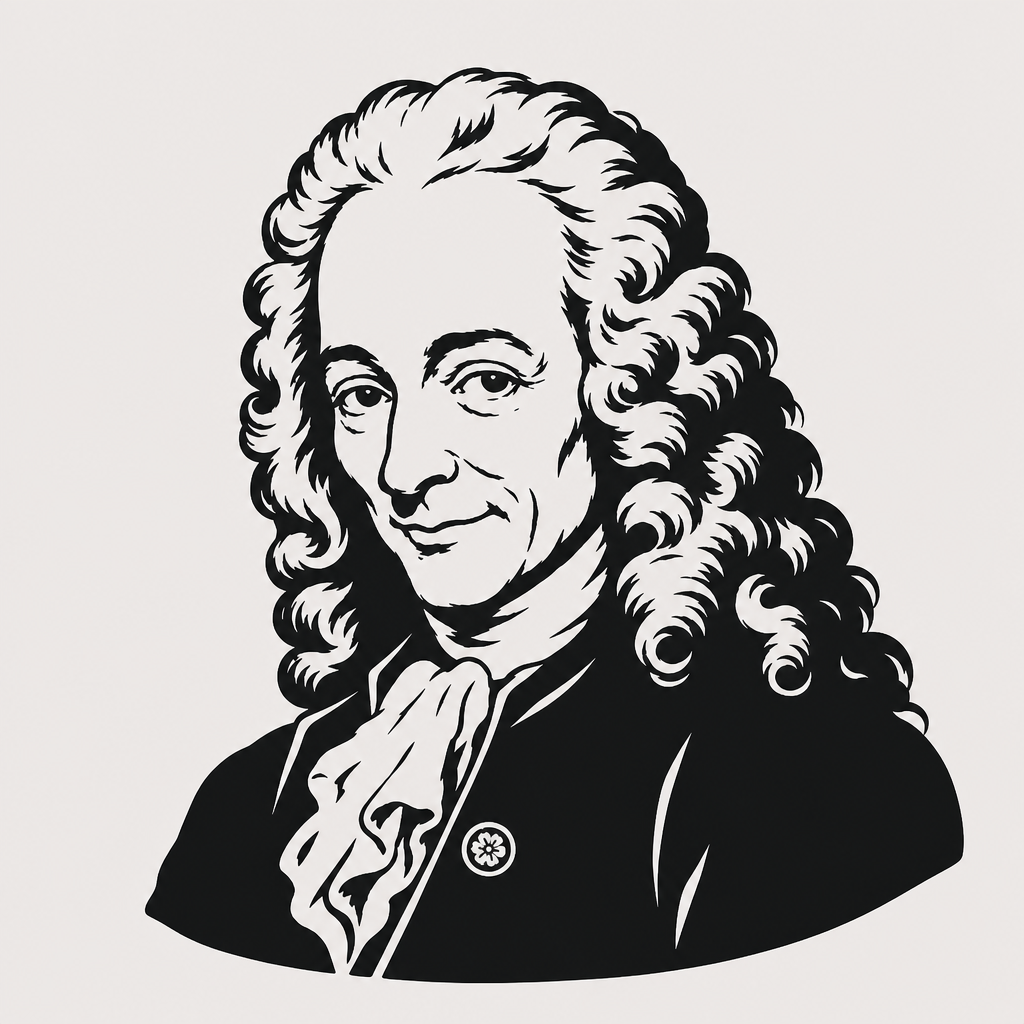
Voltaire
The Beating on the Rue
Early in 1726, one of the most celebrated young writers in France was thrashed in a Paris street by a nobleman’s servants while the nobleman looked on.
The insult had been a matter of names. The chevalier de Rohan-Chabot, of one of the grandest families in the kingdom, had sneered at the poet’s assumed title — “Monsieur de Voltaire? Monsieur Arouet? Which is it?” — and the poet, whose wit was already famous, shot back that he was the first of his name while Rohan was the last of his. A few days later Rohan’s lackeys set on him with cudgels. When Voltaire, humiliated, took fencing lessons and demanded satisfaction in a duel, the Rohan family arranged instead for him to be arrested. On 17 April 1726 he entered the Bastille without trial, on a lettre de cachet — a royal warrant that needed no charge. Two weeks later he was released on the condition that he leave the country.
No one was punished for the beating. That was the lesson, and Voltaire never forgot it: in the France of the Old Regime, a commoner with the sharpest tongue in Europe had no rights a Rohan was bound to respect. Nearly everything he built over the next fifty years — the fortune, the fame, the house perched on a national border — can be read as the slow, deliberate construction of a position from which a man like him could finally strike back.
Zozo Becomes Voltaire
He was born François-Marie Arouet in Paris on 21 November 1694, the youngest surviving child of a prosperous notary and minor treasury official. (He liked, later, to claim a February birth and an aristocratic secret father — a small, characteristic act of self-invention; the parish record is plain.) The family called him Zozo. His mother died when he was seven, and his bond with his father, who wanted a lawyer, curdled into the first of his lifelong quarrels with authority.
The Jesuits of the Collège Louis-le-Grand gave him a superb education in Latin, rhetoric, and theology, and a lasting love of the theatre. His father secured him respectable positions; the son sabotaged them, preferring verse and the salons. Sent to The Hague as an embassy secretary at eighteen, he tumbled into a scandalous romance with a Protestant refugee and was shipped home.
The wit that made him welcome also made him dangerous. In 1717, satirical verses accusing the Regent of France of incest earned him eleven months in the Bastille, where he polished his tragedy Œdipe. When it triumphed at the Comédie-Française in 1718, he was already signing himself “Arouet de Voltaire” — “Voltaire” an anagram of AROVET LI (Arouet the younger, in the Latinized spelling), with an echo of volter, to turn quickly. He had renamed himself, erasing the notary’s son. By his late twenties he was the leading poet of France, author of an epic, La Henriade, that made a hero of Henri IV precisely because Henri had ended a century of religious slaughter with tolerance.
Then came Rohan, and the Bastille a second time, and exile.
Freedom, Purchased in Cash
Voltaire crossed to England in 1726 and stayed nearly three years, and the country remade him. He learned English, read Locke and Newton, met Pope and Swift, watched Quakers worship without priests, and — by his own account — saw Isaac Newton buried with the honours of a king. Here was a society where merchants were respected, where more than one religion coexisted without massacre, where a writer could grow rich and speak freely. He came to England, his biographers say, a poet, and left it a prose writer. His Letters Concerning the English Nation (1733), praising English liberty as an implicit indictment of France, were duly condemned and burned by the Paris authorities, and a warrant went out for his arrest.
By then he had solved the problem that had shaped his whole life: money. In 1729, over dinner, the mathematician La Condamine explained to him that the French government had bungled the design of a lottery so badly that its prize pool was worth more than the cost of every ticket combined. Voltaire organized a syndicate to buy up the tickets, again and again, entirely legally — to the fury of the finance ministry and, when it went to court, the ruling that no law had been broken. His share ran on the order of hundreds of thousands of livres. He invested it shrewdly — annuities, army-supply contracts, loans to princes — until he was one of the richest commoners in Europe. It may have been the most consequential thing he ever did. A writer who cannot be starved cannot be silenced, and Voltaire, alone among the great writers of his age, never again needed a patron or a censor’s goodwill.
Fleeing the warrant over the English letters, he took refuge at Cirey, the country château of Émilie, marquise du Châtelet — mathematician, physicist, future translator of Newton’s Principia into French, married, and twelve years his junior. For fifteen years she was his lover and intellectual equal. They assembled a library of some 21,000 volumes, ran physics experiments, and combed the Bible for contradictions. His Elements of the Philosophy of Newton (1738) helped win France away from Descartes. He was made royal historiographer and, after several rejections, elected to the Académie française in 1746. When Émilie died in 1749, days after giving birth, the only settled home of his middle years ended with her.
Grief-stricken, he accepted the standing invitation of Frederick the Great and moved to Potsdam in 1750. The philosopher-king and the philosopher had adored each other by letter for a decade; in person, within three years, it collapsed — a squalid bond-speculation lawsuit, a savage satire Voltaire aimed at the president of Frederick’s academy, and finally the king’s agents detaining Voltaire and his niece for weeks at Frankfurt over a book of Frederick’s own poems. The two never met again. Astonishingly, the correspondence resumed and ran, warm and barbed, until Voltaire’s death.
The Patriarch of Ferney
Banned from Paris by Louis XV, and unwelcome in Calvinist Geneva, which frowned on his beloved theatre, Voltaire in 1759 bought an estate called Ferney, just inside France but minutes from the Swiss border. “I find myself,” he wrote, “between France and Switzerland, without depending on either.” From this fortress of independence — a frontier at his back to run for if the authorities of either country came — he waged the campaign of his last two decades.
That same winter he published Candide, the tale of a young optimist battered by earthquake, war, and the Inquisition until he concludes that we must simply cultivate our garden. Issued anonymously, banned at once, and read everywhere, it remains the most famous thing he wrote; its scene of a mutilated enslaved man in Suriname — “It is at this price that you eat sugar in Europe” — is one of the century’s sharpest indictments of colonial slavery.
At Ferney he became “the innkeeper of Europe.” He drained the swamps, paved the streets, built a school and a fountain, and planted industries — watchmaking, silk, pottery, tanning — growing the village from a couple of hundred souls to well over a thousand. He built a church inscribed DEO EREXIT VOLTAIRE, “Voltaire erected this to God” — to God alone, pointedly not to any saint. Boswell, Gibbon, Adam Smith, and Casanova made the pilgrimage. From about 1760 he ended his letters with three words that became a movement: Écrasez l’infâme — crush the infamous thing. He meant, most scholars agree, not religion as such — he believed firmly in God, and told the atheists that “if God did not exist, it would be necessary to invent him” — but the machinery of religious persecution and imposed superstition.
He soon had his case. In March 1762, Jean Calas, a Protestant cloth merchant of Toulouse, was broken on the wheel — his limbs shattered one by one before he was strangled — for supposedly murdering his son to stop him converting to Catholicism. The son had almost certainly killed himself. Voltaire, sixty-seven and skeptical at first, interviewed the shattered family, grew convinced of a judicial atrocity, and turned the full apparatus of his fame, fortune, and prose on the case: pamphlets, ghost-written briefs, letters to every court in Europe, and the Treatise on Tolerance (1763). “Ignoring such a thing,” he wrote, “is to abandon humanity.” In 1765 the King’s Council quashed the verdict and rehabilitated Calas. A private citizen with a pen had forced the French state to confess a judicial murder — the first great victory of public opinion in European history.
He did it again and again. He fought nine years for the Sirven family, condemned to death in absentia on a similar charge — “it took two hours to sentence a virtuous family to death, and it took us nine years to give them justice.” He campaigned, and failed in his own lifetime, to clear the chevalier de La Barre, a teenager tortured and beheaded in 1766 for blasphemy, with a copy of Voltaire’s own Philosophical Dictionary burned on the pyre with his body. That case frightened him — the fire could as easily have been lit for him — and hardened him. He had invented something new: the writer as a one-man engine of justice, the direct ancestor of Zola’s “J’accuse.”
Apotheosis and the Refused Grave
In February 1778, after nearly thirty years of exile from the capital, the eighty-three-year-old Voltaire returned to Paris. The city went delirious. Three hundred visitors a day came to his door, Benjamin Franklin among them. On 30 March, at the Comédie-Française, his bust was crowned with laurel on the stage before a weeping, roaring house. It was, everyone understood, an apotheosis — the living deification of a writer.
He died in Paris on 30 May 1778. What happened at the end is buried under rival propaganda: the church put out stories of a terrified recantation, his disciples of serene defiance. Only a note he wrote that February is safely documented: “I die adoring God, loving my friends, not hating my enemies, and detesting superstition.” The beloved retort — asked to renounce Satan, “This is no time to make new enemies” — is a fine story and almost certainly a later invention. Denied Christian burial in Paris, his family propped his corpse upright in a carriage and rushed it to a country abbey in Champagne, where a sympathetic nephew buried it hours ahead of the bishop’s ban. The city that had crowned him eleven weeks earlier would not give him a grave.
The Revolution gave him a better one. On 11 July 1791, the corpse smuggled out of Paris returned in a vast procession — by some estimates a million people in the streets — to be enshrined in the Panthéon as the first great man of the new Republic. His old enemy Rousseau followed three years later; the two rivals lie facing each other in the crypt.
The Two Ledgers
Voltaire is a double myth, and honesty requires holding both files open at once.
The first is the saint of tolerance, and it is real: the champion of Calas, the patron of free thought, the writer whose Treatise on Tolerance climbed the French bestseller lists again after the Charlie Hebdo murders of 2015. The single most famous sentence attributed to him belongs to this myth — “I disapprove of what you say, but I will defend to the death your right to say it.” He never wrote it. It was composed in 1906 by his English biographer Evelyn Beatrice Hall to summarize his attitude; she confirmed as much in 1939, calling it “my own expression” that should not have been placed in quotation marks. It is a fair paraphrase — he did fight to circulate books he personally scorned — but it is Hall’s line, not Voltaire’s, and any account that opens with it as his has failed on the first page.
The second ledger is uglier, and it has grown heavier with recent scholarship. Voltaire wrote repeatedly and viciously about Jews; roughly a quarter of the articles in his Philosophical Dictionary treat them with contempt. Scholars argue over motive — Peter Gay read the attacks as a flanking assault on Christianity, others as anti-biblical polemic, others still as personal grievance over ruinous debts — but the texts themselves are not in dispute, and when the Jewish writer Isaac de Pinto protested in 1762, Voltaire conceded he had been wrong to blame a whole people for the faults of some, then never revised the passages. He was also a polygenist who wrote of Africans as a separate and inferior order of humanity. Here the record must be stated with care. He held investments in the Compagnie des Indes, which trafficked in enslaved people, so his fortune was in a general way likely touched by the trade — but the notorious letter in which “Voltaire” thanks a slave-ship merchant for his profits is regarded by historians as a probable forgery, with no reliable source attesting to it. Indirect complicity is likely; the direct, damning document is not real. And against the racist passages stands the anti-slavery cry of Candide. The columns do not cancel; both belong on the page.
That unresolved argument is not academic. In 2020, amid a global reckoning over monuments, a statue of Voltaire in Paris was repeatedly splashed with paint over his links to slavery-era finance; the state quietly removed it, judged it too fragile to return, and only replaced it with a copy in 2024. France is still arguing over whether the first man in its Panthéon deserves the pedestal.
Perhaps that is the fittest monument to him. Voltaire spent his life insisting that no authority, sacred or royal, stood above questioning — and now the questioning has come for him too. He would have hated it, answered it at exhausting length, and understood it completely.
Sources & Further Reading
- Voltaire Foundation, University of Oxford — “About Voltaire,” biographical essay by Nicholas Cronk (voltaire.ox.ac.uk/about-voltaire/)
- Château de Voltaire à Ferney, Centre des monuments nationaux — history of the château and “Voltaire, les dates clés” (chateau-ferney-voltaire.fr)
- Panthéon, Centre des monuments nationaux — “The crypt” (paris-pantheon.fr)
- Musée protestant, Fondation pasteur Eugène Bersier — “The Calas affair” and “The Sirven affair” (museeprotestant.org)
- Quote Investigator — “I Disapprove of What You Say, But I Will Defend to the Death Your Right to Say It” (quoteinvestigator.com/2015/06/01/defend-say/)
- Pearson, Roger — Voltaire Almighty: A Life in Pursuit of Freedom (Bloomsbury, 2005)
- Cronk, Nicholas — Voltaire: A Very Short Introduction (Oxford University Press, 2017)
- Davidson, Ian — Voltaire: A Life (Profile Books, 2010)