Oprah Winfrey
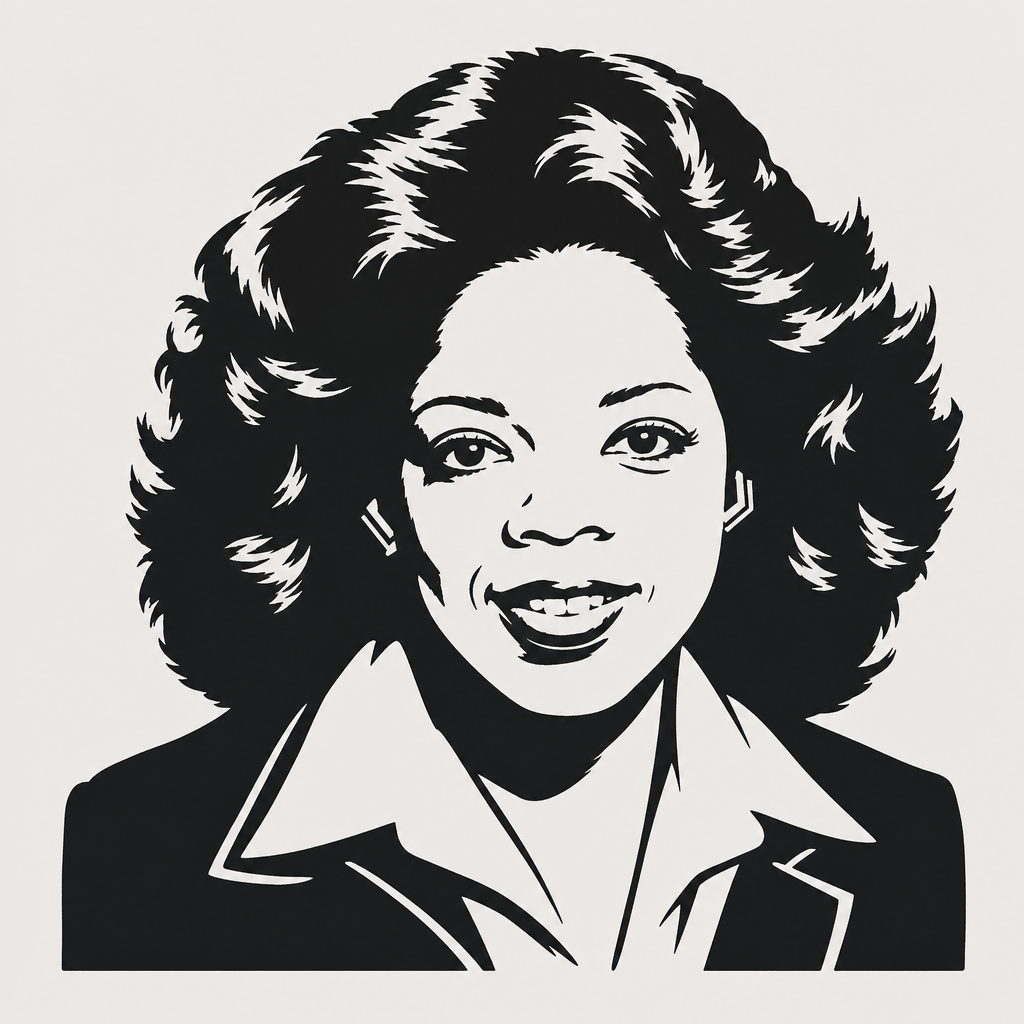
The Hour That Fit
Oprah Winfrey did not become Oprah by doing what television news asked her to do.
In Baltimore in the late 1970s, she was young, ambitious, and miserable. She had been hired as a news anchor, a prestigious job for a Black woman in local television, but the role fit badly. News directors wanted composure, polish, distance. Winfrey cried too easily. She felt too much for the people she interviewed. She tried to sound like the broadcasters she admired and later said she had been pretending to be someone else.
Then the station moved her to a local morning talk show.
It was supposed to be a demotion, maybe a place to park her before firing her. Instead, it was the door. Winfrey later remembered coming off that first show with the sensation that this was what she should have been doing all along. It felt, she said, like breathing.
That discovery changed American media. Winfrey’s gift was not detachment. It was presence. She could sit across from a stranger and make millions of people feel that they were also in the room. She could turn pain into speech, speech into recognition, recognition into ratings, and ratings into ownership. By the time The Oprah Winfrey Show ended in 2011, after twenty-five years in national syndication, the style she helped create was everywhere: the celebrity confession, the survivor testimony, the book-club recommendation, the self-help breakthrough, the audience as congregation, the host as both interviewer and witness.
Oprah became one of the most powerful media figures in the world because she understood something television had only partly understood before her: people did not only want to watch stories. They wanted to feel seen by them.
Learning to Speak
Oprah Gail Winfrey was born Orpah Gail Winfrey on January 29, 1954, in Kosciusko, Mississippi. The biblical name on her birth certificate was often mispronounced, and the public spelling “Oprah” stuck. Her mother, Vernita Lee, was a teenager. Her father, Vernon Winfrey, was in the armed forces and later became a barber and local political figure in Nashville.
Her first home was her grandmother Hattie Mae Lee’s farm in rural Mississippi. There was poverty, but there was also language. Her grandmother taught her to read when she was very young. In church, little Oprah recited Bible verses and poems, a child performer in a place where speech had power. The scene matters because it was not simply cute foreshadowing. Before cameras, before studios, before syndication contracts, Winfrey learned that words could gather a room.
At about six, she moved to Milwaukee to live with her mother, who worked long hours as a housemaid. Those years were unstable and, by Winfrey’s later account, traumatic. She has said she was sexually abused by male relatives and another visitor between the ages of nine and thirteen. At fourteen, she became pregnant; her son was born prematurely and died in infancy. A lesser biography would turn those facts into an easy origin story, as if suffering automatically makes a person wise. It does not. What those years did create was danger, secrecy, shame, and a longing for a different kind of life.
That different life began to take shape when she went to Nashville to live with Vernon Winfrey. Vernon was strict. He set curfews, required reading, and expected achievement. In his house, discipline was not a slogan. It was a schedule. Winfrey became an honors student, joined speech competitions, and won prizes for public speaking and dramatic recitation. She also won the Miss Black Tennessee pageant and attracted the attention of WVOL, a Black radio station in Nashville.
At seventeen, she had her first broadcasting job.
Radio gave her a microphone before television gave her a face. She studied at Tennessee State University on scholarship while continuing to work in media, and by nineteen she had moved into television news. In Nashville, then Baltimore, she seemed to be climbing the expected ladder: anchor, reporter, public professional. But Winfrey’s strengths did not match the old image of authority. She was warm where news wanted cool. She was porous where the format wanted hard edges.
For a while, that looked like failure.
The Talk Show Becomes a Mirror
Failure turned out to be accurate information. Winfrey’s move from news to talk television did not lower her ambition; it gave it a usable shape.
In Baltimore, she co-hosted People Are Talking, a local talk show where personality was not a liability. She could listen, laugh, react, and ask the question beneath the prepared question. The format rewarded what news had tried to correct. Word traveled. In 1984, Chicago’s WLS-TV brought her in to host AM Chicago, a struggling half-hour morning show.
The change was immediate. Within months, the show rose from the bottom of the ratings to the top of the local market. Winfrey was not yet the global figure she would become, but the essential chemistry was already there. She did not interview as if she were extracting information. She interviewed as if she were inviting disclosure.
In 1985, the show was renamed The Oprah Winfrey Show. The same year, another door opened. Quincy Jones saw Winfrey and helped connect her to Steven Spielberg’s film adaptation of Alice Walker’s The Color Purple. Winfrey, who had never acted in a feature film, played Sofia, a woman of force, humor, and defiance. The performance earned her an Academy Award nomination for Best Supporting Actress and gave her national visibility beyond daytime television.
Then, in September 1986, The Oprah Winfrey Show entered national syndication.
Daytime talk was already a powerful form. Phil Donahue had shown that a talk show could handle social issues, politics, and audience participation. But Winfrey pushed the genre toward intimacy. Her show could be sensational, especially in its early years, but it increasingly became a place where private life entered public language: abuse, addiction, family estrangement, weight, grief, sexuality, faith, shame, recovery. Sometimes the episodes were raw. Sometimes they were sentimental. Sometimes they were illuminating. The point is that they were watched.
The audience did not just consume Oprah. It participated in her. Viewers saw a host who spoke about her own struggles with weight, family, trauma, and longing. They saw a Black woman commanding a national stage without sanding herself down into someone else’s ideal. They saw a celebrity who seemed to be looking back at them.
That intimacy was not merely emotional. It was industrial.
Owning the Name
In 1986, Winfrey founded Harpo Productions. The name was “Oprah” spelled backward, but the reversal also suggested a deeper turn. She was not content to be the face of a program owned by others. In 1988, Harpo took ownership and production responsibility for The Oprah Winfrey Show. That move made Winfrey one of the rare performers, and rarer Black women, to control the machinery behind her own national platform.
This is the part of the Oprah story that can disappear behind the glow of personality. The smile mattered. The empathy mattered. But ownership changed the stakes. Winfrey was not simply being paid to host; she was building an institution.
Harpo produced television movies and programs. Winfrey acted, produced, and developed projects, including The Women of Brewster Place, There Are No Children Here, Before Women Had Wings, and later adaptations connected to writers she admired. She kept returning to The Color Purple, as actor, producer, and cultural steward. Her taste became part of her business.
Her influence over books was even more striking. In 1996, Oprah’s Book Club began as a segment on the show and quickly became one of the most powerful forces in American publishing. A selection could send a novel or memoir onto bestseller lists almost overnight. Toni Morrison, who had already won the Nobel Prize, reached new mass audiences through Oprah’s platform. Living writers, dead writers, literary fiction, memoir, classics: all of them could be pulled into millions of homes by a host who treated reading not as homework, but as transformation.
The book club revealed the promise and the risk of Oprah’s power. At its best, it made serious reading popular without apologizing for emotion. It told viewers that inner life mattered and that books could change a person. At its worst, or at least its most vulnerable, it showed how strongly Oprah’s endorsement could convert trust into fact.
That vulnerability became public in 2005 and 2006, after James Frey’s A Million Little Pieces was chosen for the book club. The book had been marketed as a memoir of addiction and recovery. Investigations showed that major parts were fabricated or exaggerated. At first, Winfrey defended the book’s emotional usefulness. Then she reversed course, brought Frey and his publisher onto her show, and confronted them about truth.
The episode was more than a publishing scandal. It was a crack in the Oprah method. Her show had taught people to honor testimony, to believe that telling one’s story could heal both speaker and listener. But memoir also asks for factual trust. Feeling true is not the same as being true. Winfrey’s public correction mattered because it acknowledged the difference, however belatedly.
The Gospel of Better
By the 1990s, The Oprah Winfrey Show had moved away from much of daytime television’s most lurid competition. It still relied on revelation, but the frame shifted toward self-improvement, spirituality, health, literature, and service. Oprah became not only a host, but a guide to better living.
There was real public value in that work. Winfrey used her own history of abuse to advocate for child protection. She testified in support of a national database of convicted child abusers, and the National Child Protection Act, sometimes called the “Oprah Bill,” was signed in 1993. Her show gave survivors a language before many families, churches, schools, and workplaces knew how to listen. She helped make certain forms of pain speakable.
She also built philanthropy into her public identity. Oprah’s Angel Network raised money for charitable projects. She gave scholarships and supported education. Her largest symbolic project was the Oprah Winfrey Leadership Academy for Girls in South Africa, developed after conversations with Nelson Mandela and opened in 2007. The school was praised for its ambition and criticized by some as lavish. Winfrey defended the beauty of the campus as part of the point: girls who had been denied much should not be trained to expect little.
The same period made Oprah a subject for scholars and critics. Eva Illouz examined her as a central figure in therapeutic popular culture, where suffering becomes a story of self-work. Kathryn Lofton treated Oprah as a kind of American icon whose media, spirituality, commerce, and charisma were difficult to separate. Those critiques do not cancel the achievement. They help explain it. Oprah’s empire worked because it met a real hunger: the desire to believe that wounds could be narrated into meaning, that consumption could become care, that a better self was waiting on the other side of confession.
That promise had limits. The show and its extended universe sometimes elevated experts, health claims, and self-help ideas that deserved more scrutiny than the platform gave them. Figures associated with Oprah’s media world, including Dr. Phil McGraw and Dr. Mehmet Oz, went on to build large careers of their own, often amid later criticism. The broader question is not whether Oprah personally endorsed every weak idea that traveled through her orbit. It is what happens when charisma becomes a credential.
Oprah’s genius was trust. Trust is also the thing that most needs guarding.
A Platform Larger Than Television
Winfrey ended The Oprah Winfrey Show on May 25, 2011. By then, the daily hour had become a cultural institution. The White House later described the program as more than 4,500 episodes; other summaries count more than 5,000 broadcasts depending on format and inclusion. Whatever the exact tally, the scale was enormous. For a quarter century, Oprah had been part of the rhythm of American afternoons.
Ending the show did not end the platform. Winfrey launched the Oprah Winfrey Network, moved further into producing, interviewing, publishing, and public events, and continued to shape conversations through specials and long-form interviews. She received the Jean Hersholt Humanitarian Award from the Academy of Motion Picture Arts and Sciences in 2011. In 2013, President Barack Obama awarded her the Presidential Medal of Freedom, calling attention to her rise from poverty and abuse, her historic platform, and her support for young people, especially young women.
Her political influence had already been tested. In 2008, Winfrey endorsed Barack Obama, the first presidential candidate she had publicly supported. Commentators argued over how many votes her endorsement moved, but the precise number matters less than the obvious fact: a daytime television host had become a political validator with national weight. She did not need office to exercise power.
Winfrey’s honors accumulated: Emmys, film nominations, humanitarian awards, honorary degrees, museum recognition, and a theater named for her at the Smithsonian National Museum of African American History and Culture. In 2018, accepting the Cecil B. DeMille Award at the Golden Globes, she delivered a speech shaped by the #MeToo moment and the history of Black women’s testimony. Once again, she stood at the intersection of media, trauma, race, gender, and public speech.
That intersection is her territory.
The Woman and the Method
Oprah Winfrey’s life is often told as a triumph over adversity, and it is that. A girl born into poverty in Mississippi became a billionaire media owner, a philanthropist, an actor, a producer, a publisher, and one of the most recognizable people on Earth. But the simpler version misses the machinery.
Her achievement was methodological. She found a way to make listening feel dramatic. She made ordinary people narratable. She turned her own biography into a bridge without letting it remain merely private. She understood the commercial power of sincerity and the spiritual power of being believed. Then she did the rarest thing in entertainment: she owned the thing that bore her name.
The legacy is mixed because the influence is vast. Oprah helped millions of people speak about abuse, grief, shame, reading, ambition, and self-worth. She expanded what a Black woman could represent on national television. She changed publishing. She turned philanthropy into part of a media life. She helped create the modern expectation that public figures should reveal their wounds and that audiences should be improved by watching.
She also helped build a culture in which confession can become performance, healing can become product, and emotional resonance can outrun evidence. The Oprah method is powerful enough to help and powerful enough to mislead. That is why it deserves more than either worship or dismissal.
The best way to understand Oprah is not as a saint, a guru, or a brand, though she has been treated as all three. She is a broadcaster who discovered that her truest medium was trust. From a church recitation in Mississippi to a local talk show in Baltimore, from Chicago syndication to a global media empire, she kept returning to the same basic act: sit down, ask, listen, respond, make the private visible.
Television has produced many famous faces. Oprah Winfrey changed what a face on television could do.
Sources
- Academy of Achievement - “Oprah Winfrey” and 1991 interview (https://achievement.org/achiever/oprah-winfrey/)
- White House - “Remarks by the President at Presidential Medal of Freedom Ceremony,” November 20, 2013 (https://obamawhitehouse.archives.gov/the-press-office/2013/11/20/remarks-president-presidential-medal-freedom-ceremony)
- Academy of Motion Picture Arts and Sciences - “The 2011 Governors Awards” (https://www.oscars.org/governors/ceremonies/2011)
- Eva Illouz, Oprah Winfrey and the Glamour of Misery: An Essay on Popular Culture (Columbia University Press, 2003)
- Kathryn Lofton, Oprah: The Gospel of an Icon (University of California Press, 2011)