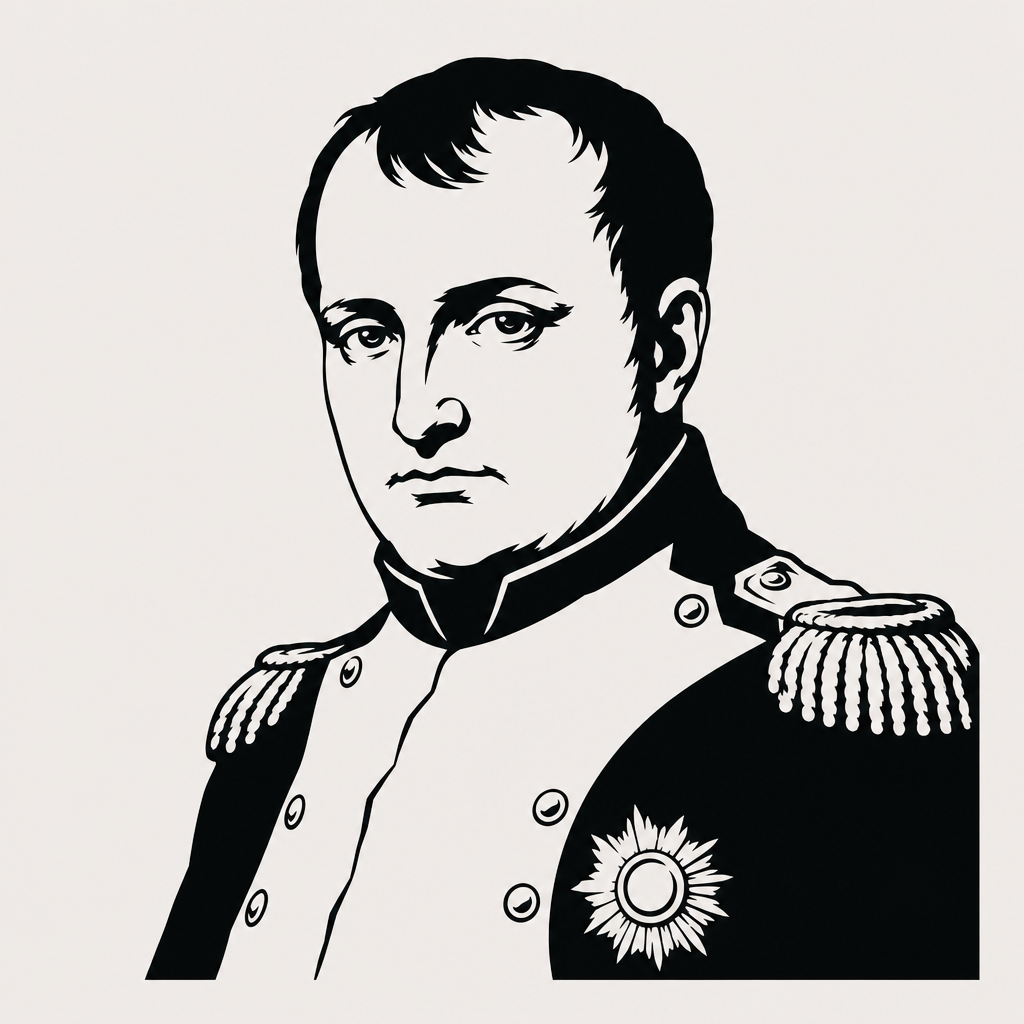
Napoleon Bonaparte
On December 2, 1804, inside Notre-Dame, a thirty-five-year-old man lifted a golden crown past a waiting Pope and set it on his own head. The gesture was worked out in advance, but the message was his alone: he owed the throne to no dynasty and no anointing. He had made himself — and, from Italy onward, he had learned to make his own legend too, through bulletins, staged paintings, and a censored press. Napoleon Bonaparte is the extreme case of talent meeting opportunity, and of a man arranging how the world would remember it.
He was born in Ajaccio in 1769, months after France crushed Corsican independence, into a family of minor nobility that spoke Corsican Italian. That nobility bought him a scholarship to a French military school, where classmates mocked his accent; his answer was relentless work. Then the Revolution of 1789 demolished the aristocratic ceiling above an artillery lieutenant, and he rose faster than anyone in modern European history — from the siege of Toulon to the conquest of Italy to First Consul by thirty.
As ruler he built institutions that outlasted him by two centuries: the Bank of France, the lycées, and above all the Civil Code, still the spine of law in dozens of countries. In the same years he restored colonial slavery, which the Revolution had abolished, and fought the war in the Caribbean that produced Haiti, the first Black republic, born by defeating him. Then the gambler could not stop — Spain, and the catastrophe of Russia in 1812 — until Waterloo ended it in 1815.
The British exiled him to Saint Helena, where, deprived of an army, he won his last campaign: the one for his memory, dictating the Mémorial that recast the despot as a liberal martyr. He died there in 1821, of the stomach cancer that killed his father, at fifty-one. He was the heir of the Revolution and the first modern dictator, the lawgiver and the man who re-enslaved the Caribbean, whose wars killed on the order of a million Frenchmen and more Europeans still. Both ledgers are real; neither cancels the other — which is exactly the argument he wanted us to keep having.