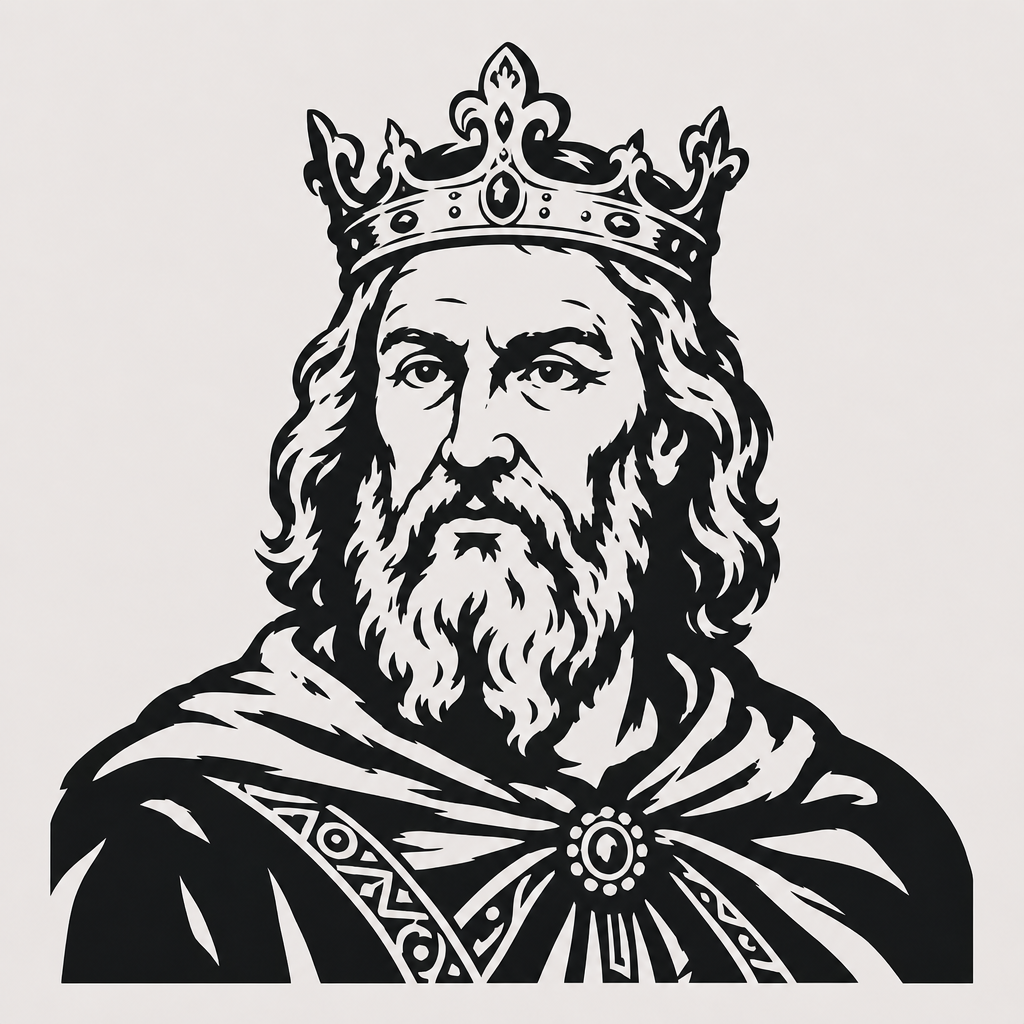
Charlemagne
On Christmas Day in the year 800, at Mass in Old St. Peter’s, Pope Leo III set a crown on the head of a Frankish king and the Roman crowd hailed him emperor — the first in Western Europe since Rome fell three centuries before. Charlemagne’s own biographer insisted he would never have entered the church had he known what the pope intended. Historians have argued about that sentence ever since; the imperial language was already circulating at his court, and the surprise may be a pose. The ambiguity is the point. An event that shaped a thousand years of European politics was one perhaps no single person fully controlled.
Born probably in 748 — the date is genuinely uncertain, and his birthplace is unknown — he was the eldest son of Pepin the Short, a mayor of the palace who had stolen a throne and had it blessed by the Church. That bargain, Frankish swords protecting Rome in exchange for legitimacy, ran through Charlemagne’s whole life. After his brother died conveniently young in 771 and his brother’s sons vanished from the record, he ruled alone.
For forty years he was almost never at peace, roughly doubling his realm. His war on the pagan Saxons was the cruelest: in 782, a source written to flatter him records 4,500 prisoners beheaded in one day at Verden — the number perhaps inflated, the atrocity beyond doubt. Yet the same man gathered Europe’s finest scholars to his palace at Aachen and revived learning across the continent, though he himself, by his biographer’s account, could not write his own name.
He died at Aachen in 814, and his empire fractured within a generation. His name never did. France and Germany both count their kings from him; Napoleon, the Church, the Nazis, and the European Union have all fought to claim him. The man was a warlord of the eighth century. The “father of Europe” is something every later age rebuilt to explain itself.