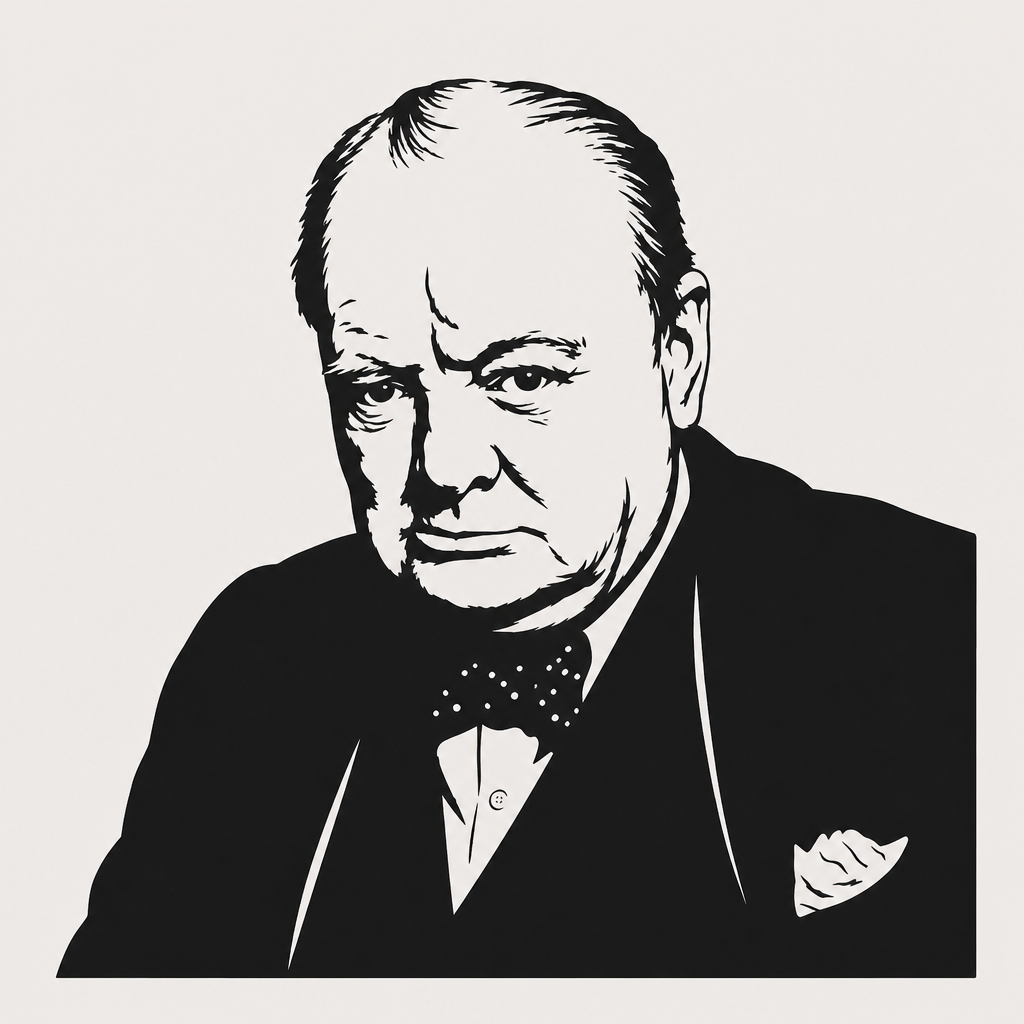
Winston Churchill
In late May 1940, with France collapsing and the British army trapped at Dunkirk, the War Cabinet weighed a reasonable-sounding question: should Britain at least explore Hitler’s terms? The Prime Minister of eighteen days fenced with Lord Halifax for three days, then went around the War Cabinet to the outer ministry and declared that if Britain’s story must end, let it end “only when each one of us lies choking in his own blood upon the ground.” The ministers cheered, the question never seriously reopened, and Britain fought on alone. Nearly everything about Winston Churchill’s first sixty-five years — the recklessness, the obstinacy, the bottomless self-belief — had looked like a catalogue of dangerous flaws. In that week they were exactly what the moment required.
Born at Blenheim Palace in 1874 to a meteoric politician father who regarded him with near-contempt, Churchill spent his life arguing with the ghost. He made himself famous young — war correspondent, prison-camp escapee in the Boer War, MP by 26 — and then spent four decades being brilliant and rarely trusted: he switched parties twice, helped found the welfare state, and drove the catastrophic Gallipoli campaign of 1915 that killed tens of thousands and nearly broke him. By the 1930s, after fighting Indian self-government and misjudging the abdication crisis, the Westminster verdict was settled: a genius without judgment. That is why his decade of warnings about German rearmament was so easy to dismiss — until Hitler proved him right.
As wartime Prime Minister he refused, and he spoke. His speeches — “blood, toil, tears and sweat,” “we shall never surrender,” “their finest hour” — made capitulation unthinkable while Britain stood alone, and told the United States that resistance was worth backing. He courted Roosevelt relentlessly, allied with Stalin overnight, absorbed defeat after defeat, and lived to stand above a roaring victory crowd in 1945 — eleven weeks before the electorate, wanting homes rather than empire, voted him out. He accepted the result completely; it was the thing he had been defending.
Any honest account holds two ledgers open. One records 1940, and it is secure. The other is imperial and has grown heavier: his documented contempt for Indians, the Bengal famine of 1943 in which millions died while London declined large-scale grain shipments, Gallipoli’s dead, and more. Churchill died in 1965, seventy years to the day after his father, and as his coffin went up the Thames the dockers dipped their cranes in salute — working London, the city that stood with him under the bombs and then, quite correctly, voted him out. History is under no obligation to make such people simple.