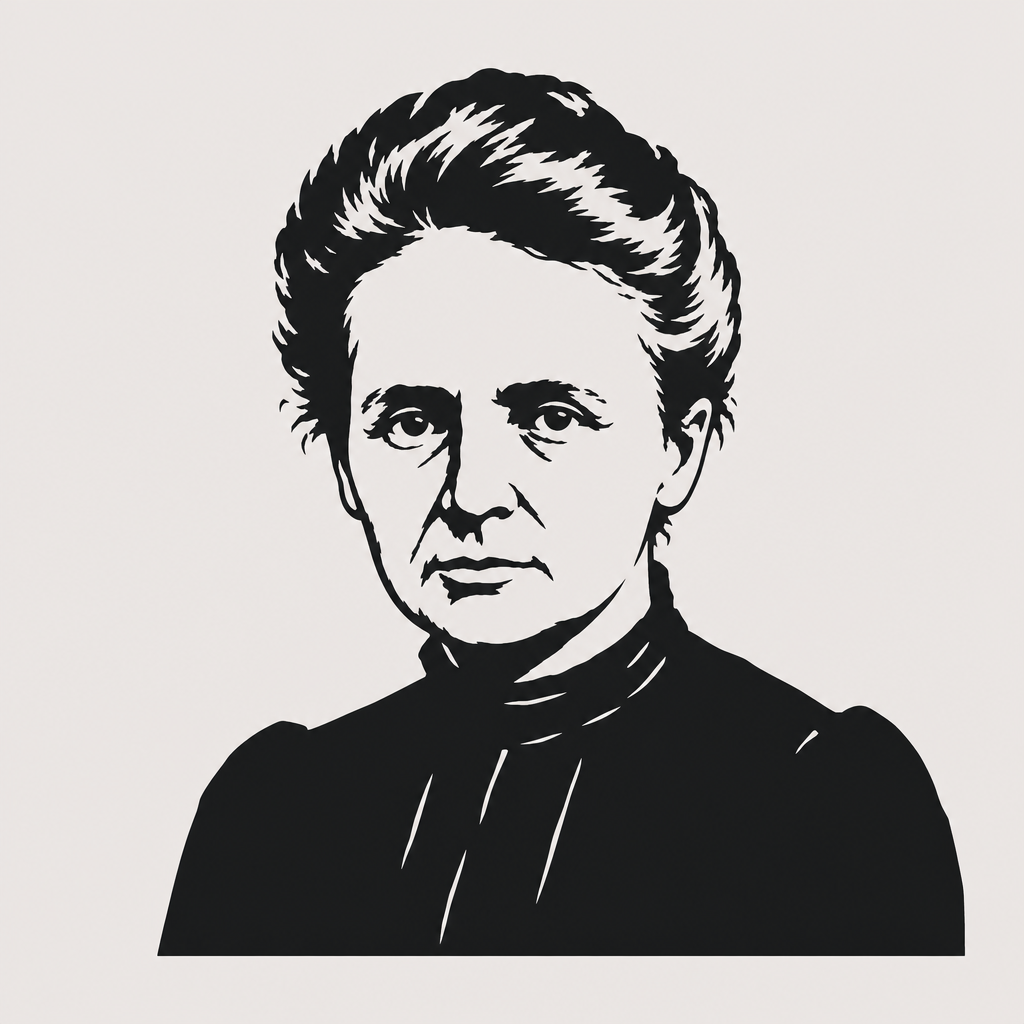
Marie Curie
In November 1911 a mob gathered outside Marie Curie’s house in a Paris suburb, terrifying her two young daughters, because the papers had recast the most famous woman scientist in the world as a foreign home-wrecker. Stolen letters, a false rumor that she was Jewish, an insinuation that she had driven her late husband to his death — the nationalist press hurled all of it. In the middle of the frenzy came a telegram from Stockholm awarding her a second Nobel Prize, and a note from the committee suggesting she stay home until her name was cleared. She went anyway, insisting there was no connection between her scientific work and the facts of her private life. It is the whole of her in one sentence.
She was born Maria Skłodowska in 1867 in a Warsaw that belonged to the Russian Empire, in a Poland erased from the map. Barred from its universities because she was a woman, she studied in an illegal underground “Flying University” and worked six years as a governess to fund her sister’s medical studies in Paris before taking her own turn. Arriving at the Sorbonne in 1891 with almost nothing, she earned two degrees, married the physicist Pierre Curie, and chose for her doctorate a phenomenon almost no one was studying: the mysterious rays given off by uranium.
Measuring those rays with rare precision, she realized an unknown element must be hiding in the mineral pitchblende. In 1898 she and Pierre announced two — polonium, named for her lost homeland, and radium — and coined the word “radioactive.” To prove radium existed she spent years in a leaky shed boiling down tons of ore by hand, refusing to patent the process. The tubes glowed on the shelves at night like faint fairy lights; they were also, unknowingly, burning her. A first Nobel came in 1903; Pierre was killed by a wagon in 1906; she took over his Sorbonne chair as the first woman to teach there and kept working.
The First World War made her an improvised commander of X-ray units at the front, where more than a million wounded men were examined. She died in 1934 of an anemia her doctor blamed on “a long accumulation of radiations” — whether from radium or her unshielded wartime X-rays, historians still debate. In 1995 she became the first woman honored in the Panthéon for her own achievements, and her notebooks remain too radioactive to handle without a waiver. Honored past death, and radioactive past death: the element that made her immortal is the one that killed her.