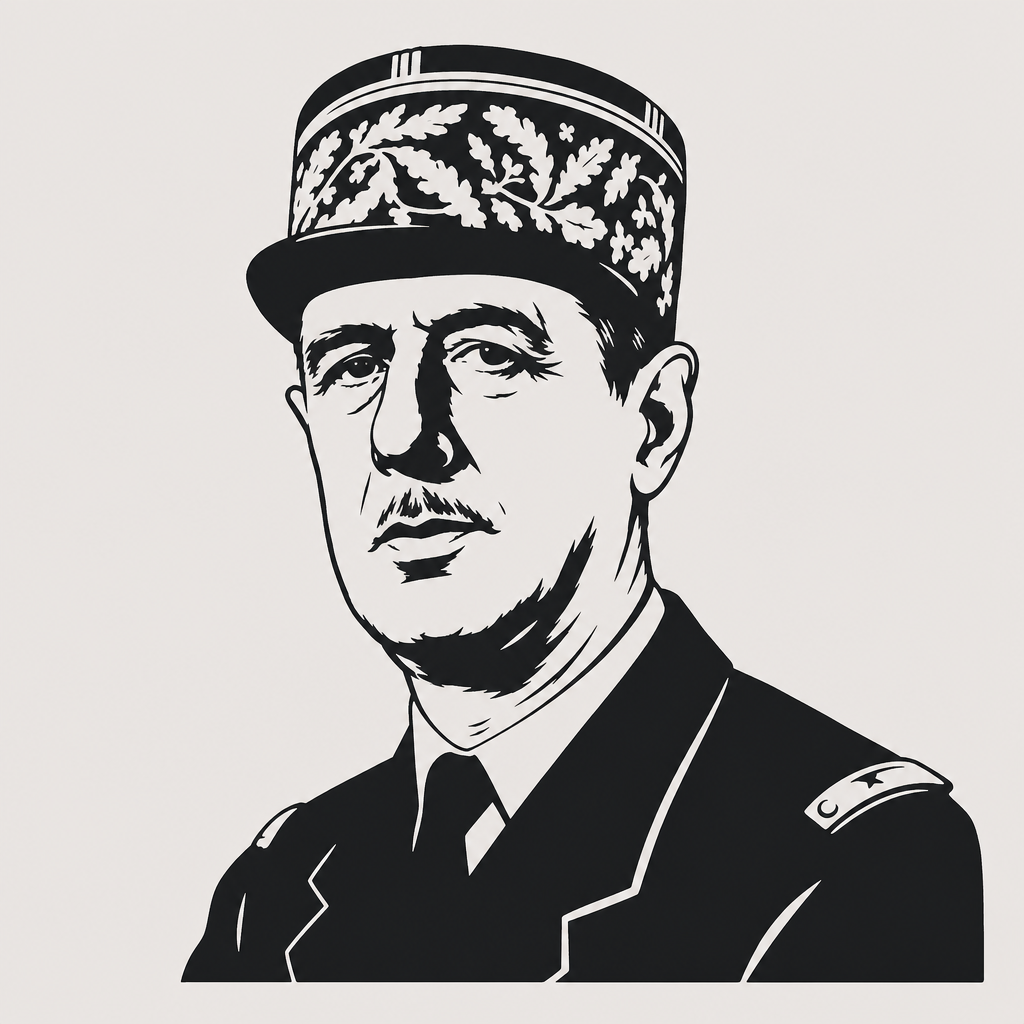
Charles de Gaulle
On the evening of June 18, 1940, a French general almost no one had heard of spoke into a BBC microphone in London and told a defeated France that it had not lost the war. He had no troops, no territory, and within weeks a death sentence in absentia from the legal government of Marshal Pétain. Almost nobody heard the broadcast — the BBC never recorded it, and most who “remembered” it later were remembering something else. Yet June 18 became the founding date of modern France. That is the puzzle of Charles de Gaulle: a man who staked everything on the claim that he, not the legal government, was the true France, and then spent thirty years making the nation ratify it.
Born in Lille in 1890 into a Catholic, patriotic family raised on the wound of lost Alsace-Lorraine, he grew up certain he was born to act at the decisive hour. The First World War cheated him of it — wounded, bayoneted, and captured at Verdun in 1916, he sat out the war behind German wire after five failed escapes, a humiliation that never left him. Between the wars he was a brilliant, insubordinate officer who wrote books urging a fast armored army France declined to build. When the country he had warned collapsed in six weeks in 1940, he refused the surrender and flew to London to build a state from nothing.
He made the claim good at the Liberation of Paris in August 1944 — “Paris liberated by itself,” he declared, a magnificent sentence that quietly erased the Allied troops who fought for the city. He resigned in 1946 expecting to be recalled, waited twelve years, and returned in 1958 amid an army insurrection over Algeria — rescue or velvet coup, historians still argue. He gave France a new constitution, a directly elected presidency, and its own atomic bomb. But the record has stains kept off the monument: the Sétif killings of 1945, the October 1961 massacre of Algerian demonstrators in Paris under his prefect, the abandoned harkis.
In April 1969, having always framed his referendums as votes on himself, he lost one he need not have called and resigned at midnight by communiqué — no speech, no return. He died the next year and was buried, by his own instruction, in a village churchyard beside his daughter Anne, under a slab bearing only his name and dates, while the world’s leaders gathered at a separate service in Notre-Dame. He was at once the man who talked a broken country into believing in itself and the storyteller whose gift kept its darkest chapters in shadow. The honest verdict is to hold both.