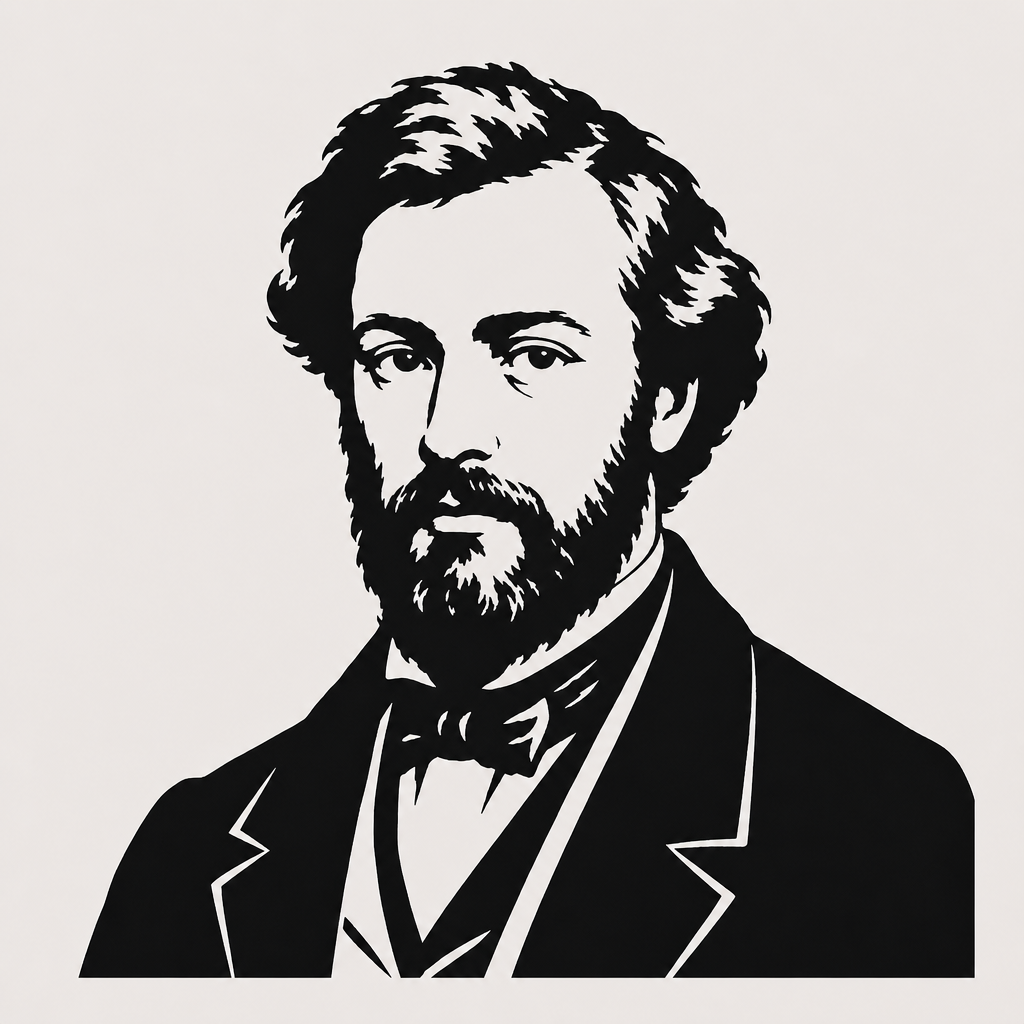
Léon Foucault
In the first days of February 1851, cards went out to the scientists of Paris with a startling promise: “You are invited to come and see the Earth turn.” Everyone since Copernicus had accepted that the planet spins, but the proof had always been astronomical, inferred from the sky; no one had ever built something you could stand in front of and watch. Under the great dome of the Panthéon, Léon Foucault hung a heavy bob on a long wire and let it swing. Its plane crept steadily clockwise, held fixed in space while the room, the city, and all of France turned beneath it. A stylus traced the slow veer in a ring of sand, and a crowd of ordinary Parisians stood and watched the ground move.
The man who arranged this had no business, by the rules of his time, doing science at all. Born in Paris in 1819, frail and dismissed as lazy at school, Foucault had one gift: a pair of extraordinary hands that built working steam engines and telegraphs as a boy. His mother steered him toward surgery; he fainted at the sight of blood and washed out of medicine. A generous professor, Alfred Donné, rescued him — first as a laboratory assistant, then by handing him the science column of a Paris daily. So a man with no degree became, at 25, the arbiter of French science for the reading public.
He never built grand theories; he settled arguments others could not close. A spinning mirror let him prove in 1850 that light travels slower in water than in air, deciding a decades-old fight over its nature. Then came the pendulum, and after it the gyroscope and the silvered-glass mirror that gave astronomy its modern telescope. London awarded him the Royal Society’s Copley Medal in 1855; his own Académie des Sciences, which had turned him away repeatedly, did not elect him until 1865, three years before his death.
He had little time left. Late in 1867 his hands went numb and a swift paralysis took hold; he died in February 1868, aged 48, of a cause never settled, probably a rapid multiple sclerosis, though some have blamed years of chemical exposure. The establishment’s verdict that he was a mere mechanic has been forgotten. The demonstration he built to overturn it still swings beneath the Panthéon, proving to anyone who cares to look that the ground is moving under our feet, and that a patient man with good hands found a way to let us see it.