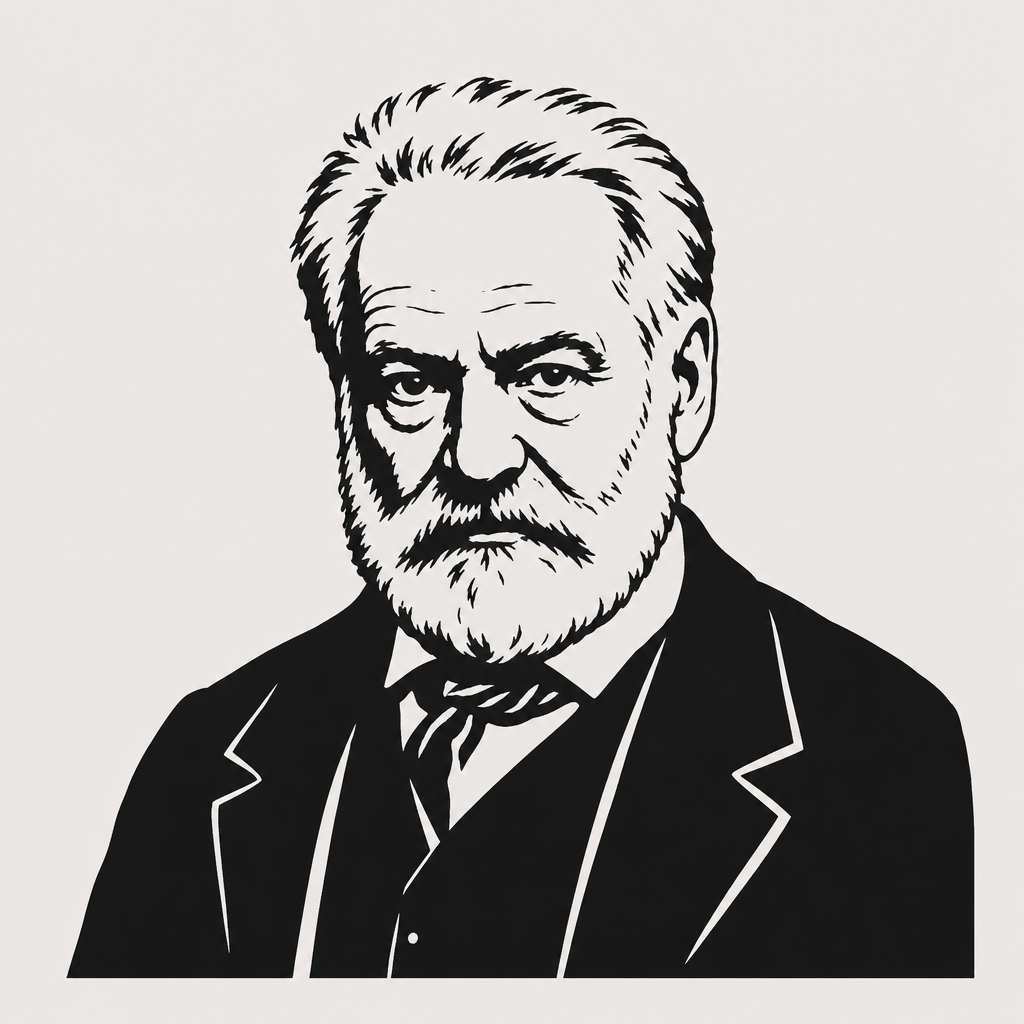
Victor Hugo
When Victor Hugo died in 1885, the French state draped the Arc de Triomphe in black and deconsecrated the Panthéon to house him. Then, at his own insistence, it carried him to his tomb in the corbillard des pauvres — the plain wagon reserved for those too poor to bury themselves — behind a crowd counted at two million or more, larger than the population of Paris. The secular saint who refused a priest and the incorrigible showman whose humility filled the streets were the same man, and the funeral put both on display at once.
He had been famous almost from childhood. Born in 1802 to a Bonapartist general and a royalist mother whose marriage was a running war, he wrote in his diary at fourteen, “I shall be Chateaubriand or nothing,” and very nearly skipped the “nothing” — pensioned by the Bourbon court, decorated at twenty-three, elected to the Académie française. Then Hernani stormed the theater for Romanticism in 1830, Notre-Dame de Paris made a cathedral immortal, and in 1843 his daughter Léopoldine drowned at nineteen; he learned of it from a newspaper in a café, and the grief eventually became his most beloved poetry.
The choice that could not be curated came in 1851, when Louis-Napoléon’s coup drove him out of France under a false passport. He spent nineteen years on the Channel Islands, refused the emperor’s amnesty — “When liberty returns, I will return” — and from a glass study on his roof finished Les Misérables (1862), the exile’s masterpiece detonated inside the Empire that banished him. When the Empire fell in 1870, he came home to a hero’s welcome and became the conscience of the Third Republic.
The monument had a shadow ledger: a wife pushed toward another man, a mistress kept in seclusion for fifty years, affairs pursued into his eighties, a daughter who ended her life in asylums, and an 1879 speech urging Europe to “take” Africa beside a lifetime of genuine abolitionism. Neither the saint nor the satyr alone is the man. In the end the nation finished the myth he had spent his life curating — and, for once, the monument and the man very nearly matched.