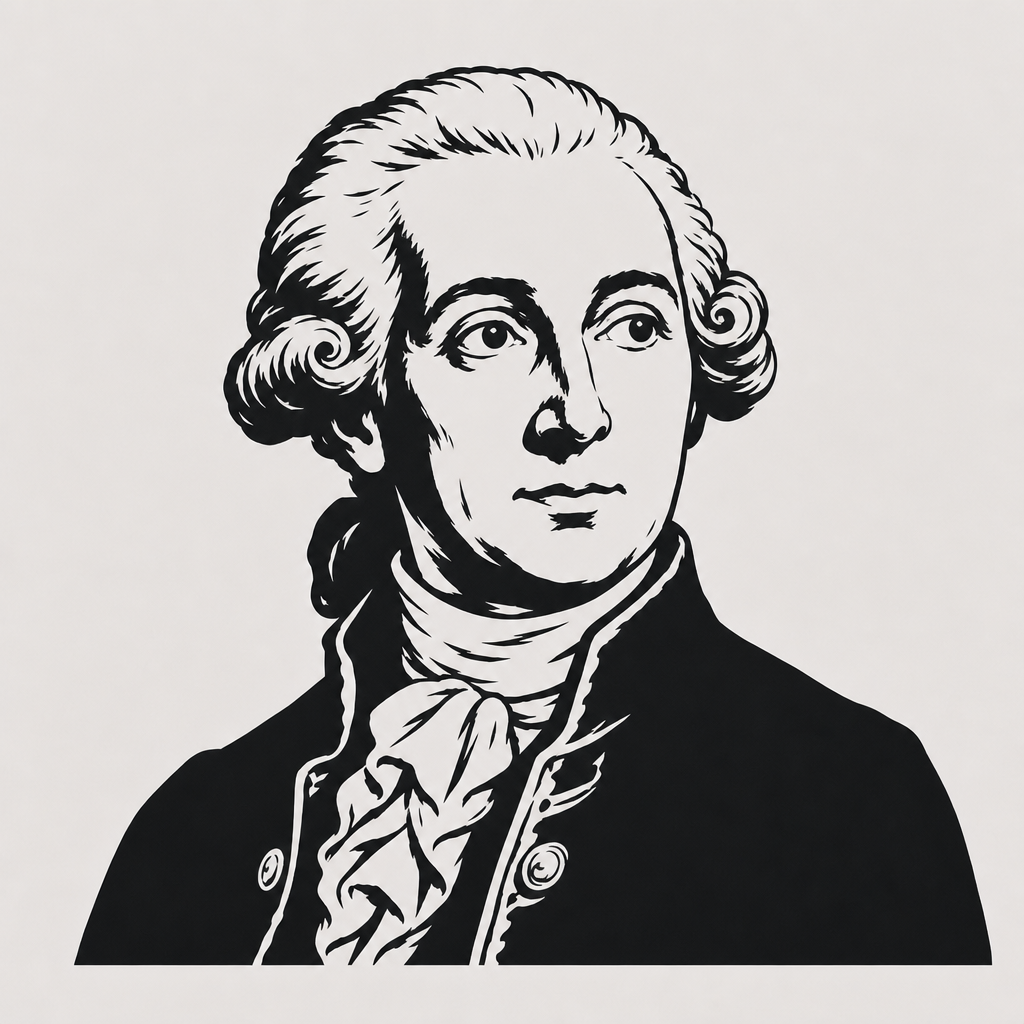
Antoine Lavoisier
On the afternoon of May 8, 1794, twenty-eight men climbed the scaffold in the Place de la Révolution. The third was a tax farmer named Jacques Paulze; the fourth, about a minute later, was his son-in-law — a fifty-year-old academician who had renamed the air, overturned two thousand years of chemical theory, and built the most precise laboratory in Europe. Antoine-Laurent Lavoisier was not dying for his chemistry. He was dying for his day job. The same appetite for system that made him a revolutionary in science had made him an efficient servant of the Ferme générale, the consortium that collected France’s most hated taxes — and in 1794 the Revolution could no longer tell the two apart.
Born in Paris in 1743 and left a fortune at five, Lavoisier could treat science as a calling rather than a career. In 1768 he did two things that would run in parallel until they collided: he was elected to the Académie des sciences at twenty-five, and he bought into the tax farm, whose first assignment for him was a chemical test to catch adulterated tobacco. His wife, Marie-Anne Paulze, married at thirteen, taught herself English to translate foreign chemists, kept the laboratory records, and engraved the plates of his masterwork — his indispensable collaborator.
His genius was almost banal in its rigor: weigh things before and after. Beginning with sealed notes deposited in 1772, he showed that burning substances gain weight by combining with something in the air, demolishing the reigning theory of phlogiston. Priestley and Scheele had isolated the gas first; Lavoisier understood it, named it oxygen, proved water was a compound, and in his 1789 Traité gave chemistry its modern vocabulary and its law of conservation of mass. But the customs wall he proposed around Paris in 1779 had made him one of the most hated men in the city, and when the Terror ordered the arrest of all tax farmers, his forty-two-page legal defense met a charge already upgraded to treason.
Within two years the Revolution exonerated him, returning his belongings to “the widow of Lavoisier, who was falsely convicted.” The famous line said to have sent him to the blade — “the Republic has no need of scientists” — cannot be traced to the trial and first surfaced months later, in other words and another mouth; the tale that his severed head blinked is a modern invention. What is real is quieter and larger: the oxides, sulfates, and conservation laws every student now learns without his name attached. As his friend Lagrange is said to have put it, it took an instant to cut off that head, and a hundred years might not grow its like.