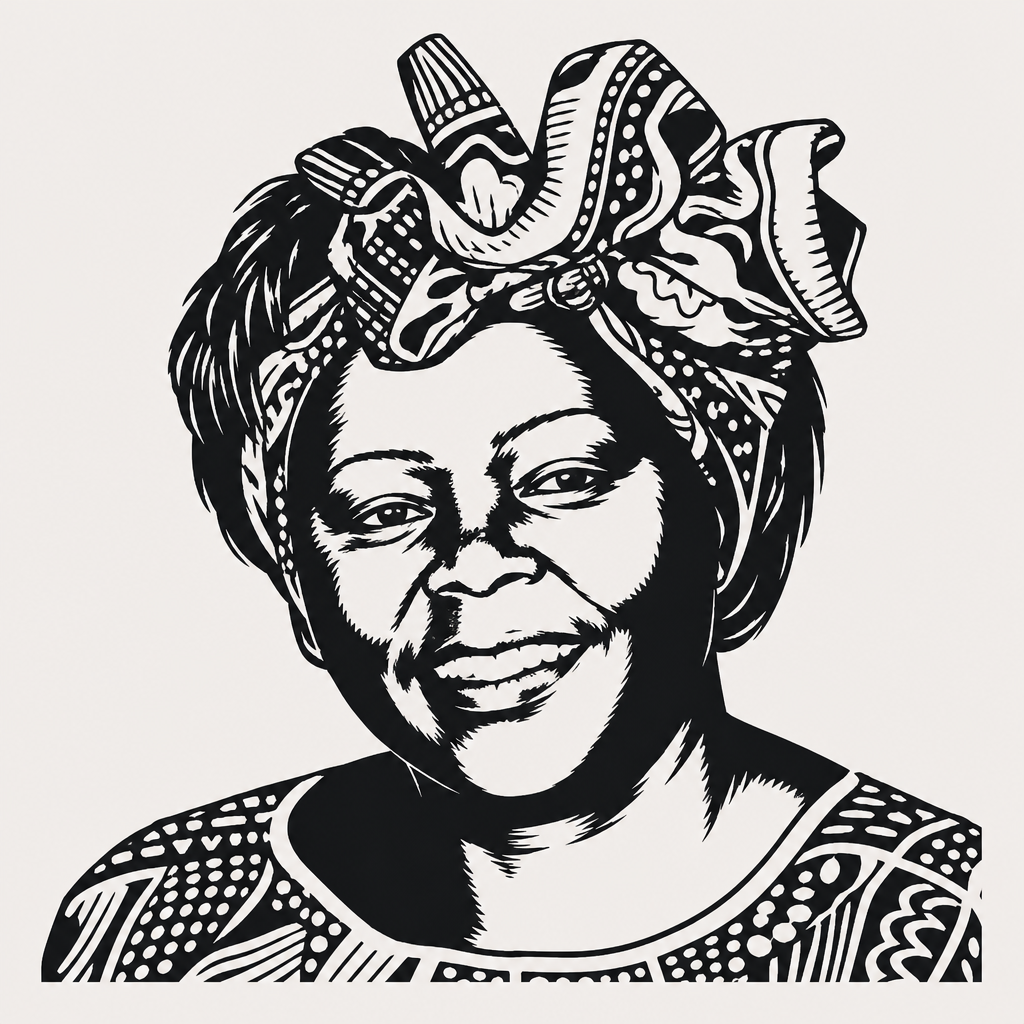
Wangari Maathai
When word reached Wangari Maathai on October 8, 2004, that she had become the first African woman to win the Nobel Peace Prize, she did not hold a press conference. She knelt in the red soil of Nyeri, Kenya, and planted a tree facing Mount Kenya. The world called her the tree lady, but Kenya’s government had understood her better: it had denounced her in parliament, put her on an assassination list, and beaten her unconscious — over seedlings. In a country where land was power, teaching poor women to plant trees and say no was not gardening. It was subversion.
Born in 1940 to a Kikuyu farming family in Kenya’s central highlands, she watched forests cleared for plantations and streams begin to dry. An airlift scholarship carried her to college in Kansas in 1960, and in 1971 she became the first woman in East or Central Africa to earn a doctorate. Kenya’s establishment showed her its limits anyway: her divorce became national theater — her husband reportedly complained she was too strong-minded for a woman — and when she criticized the judge, she was jailed. Ordered to drop her married name, she kept it and added an extra “a” instead.
In 1977 she founded the Green Belt Movement, paying rural women small stipends to raise seedlings — some 30 million trees, and nurseries that doubled as schools for citizenship. When the logic of the trees led into the regime’s land-grabbing, she followed it: she shamed the backers of a 60-storey tower out of Nairobi’s Uhuru Park in 1990, took a police beating at Freedom Corner in 1992, and bled for Karura Forest in 1999. In 2002 the regime fell at the ballot box, and her constituency sent her to parliament with about 98 percent of the vote; the Nobel followed two years later.
She died of cancer in 2011, leaving instructions that no tree be cut for her coffin. Her insight — that environmental collapse, poverty, and tyranny are one problem — has since become the common sense of climate diplomacy. She liked the parable of the hummingbird fighting a forest fire one beak-full of water at a time; her life showed what happens when that best-I-can is multiplied by hundreds of thousands of hands. It becomes a forest, and a forest can bring down a strongman.