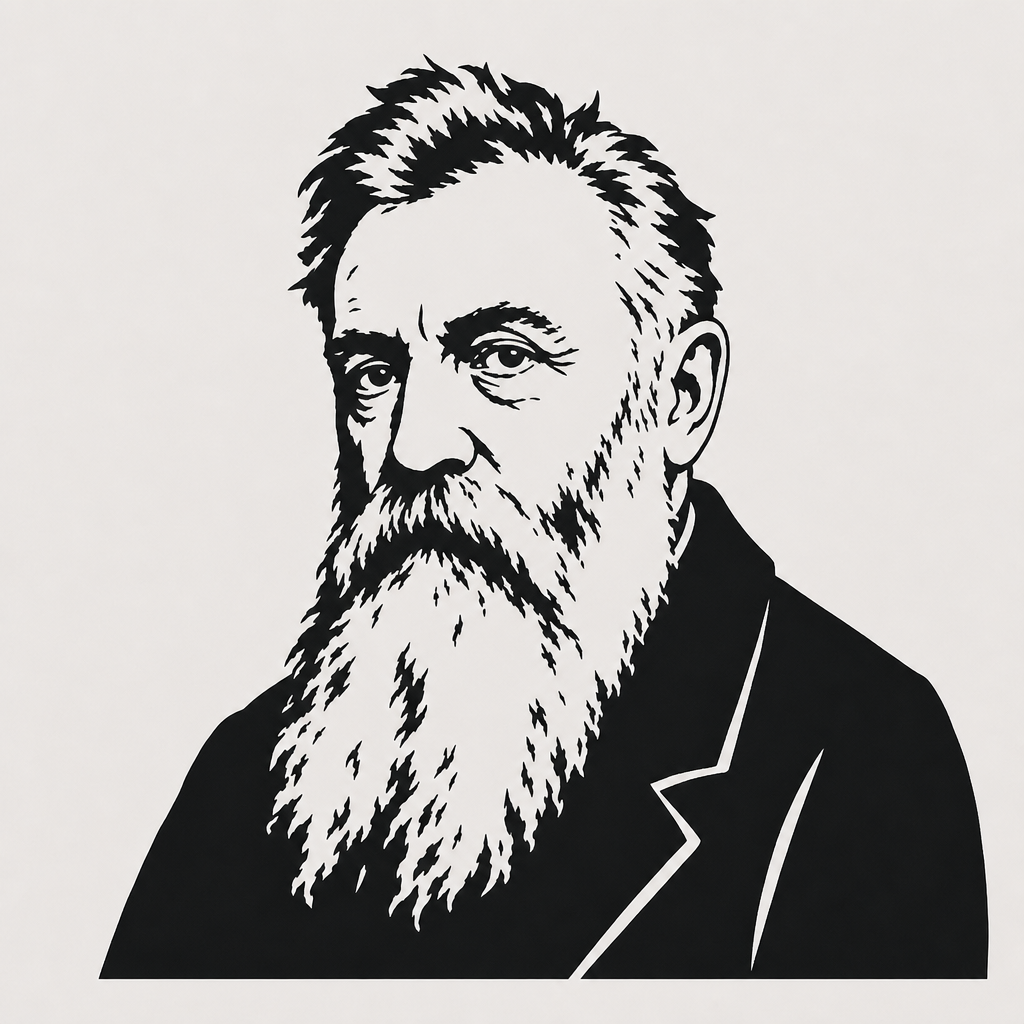
Auguste Rodin
In 1877 a life-size bronze of a naked young man appeared at the Paris Salon, and critics decided it was too alive to be sculpture — the unknown artisan behind it must have poured plaster over a real body and cast it directly. Auguste Rodin defended The Age of Bronze with letters, witnesses, and photographs of his model until a committee of sculptors cleared him and the state bought the work. No serious scholar has believed the charge since, but the irony set the pattern of his life: the one thing his art could not be forgiven for was seeming alive, and the scandal that nearly ruined him made his name instead.
He had earned the outrage the hard way. Born poor and severely near-sighted in 1840, rejected three times by the state art academy, he spent nearly two decades carving ornament under other men’s signatures before Italy and Michelangelo set him free. Then the breakthroughs came, each greeted as an offense: The Gates of Hell, the churning door that gave him The Thinker and The Kiss; the Burghers of Calais, six ordinary men modeled walking toward death instead of heroic martyrdom; and in 1898 the cloaked, defiant Balzac, jeered as a snowman and a sack of coal, which he hauled home to his garden and which the next century would call the birth of modern sculpture.
His triumphs cast long shadows. He ran his studio like a factory, with assistants carving the marbles he signed, and among his gifted hands was Camille Claudel — pupil, collaborator, and lover, who modeled work that went out under his name and who broke with him when he would not leave his lifelong companion, Rose Beuret. Claudel’s family, not Rodin, had her committed to an asylum in 1913 and kept her there for thirty years against medical advice; the truth of her ruin is sadder than either the tragic-muse legend or the exploitation myth allows.
Rodin married Rose at last in 1917; she died two weeks later, and he within the year. He left France everything, including the right to keep casting bronzes from his molds — which is why, a century on, his art is still being manufactured and why “how many Thinkers are real?” has no settled answer. The man accused of faking one body ended by making his work, quite literally, immortal.