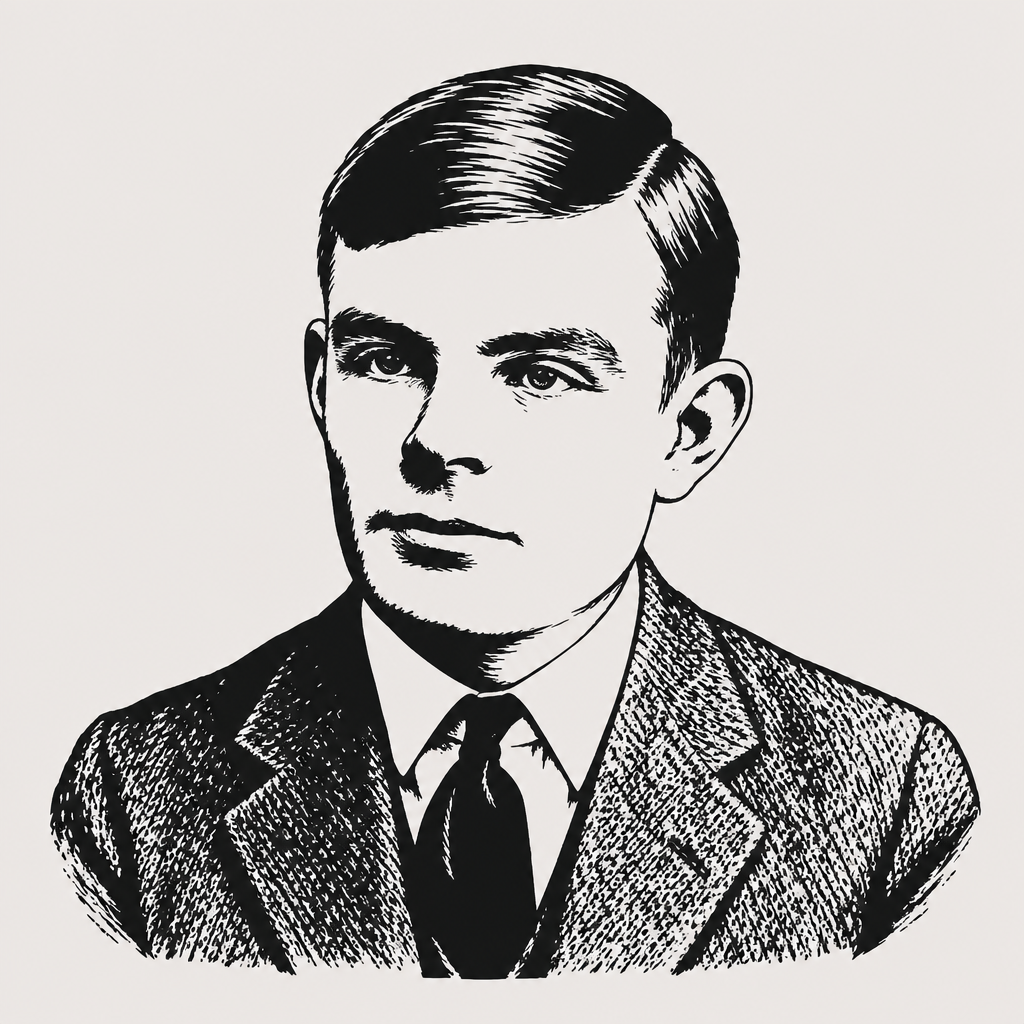
Alan Turing
In June 1954, a Cheshire coroner ruled on the death of a 41-year-old mathematician found poisoned by cyanide, a half-eaten apple at his bedside — an apple no one thought to test. The verdict was suicide; the obituaries praised a promising academic. None of them could mention that Alan Turing had led the attack on Nazi Germany’s naval codes, because that remained a state secret for another twenty years. The man who invented the idea of the computer and helped win the Atlantic war died publicly known mainly for his criminal conviction: two years earlier, Britain had prosecuted him for being gay.
Raised in foster households while his parents served in India, Turing announced himself at thirteen by cycling sixty miles alone to his first day of boarding school when the 1926 General Strike stopped the trains. The death of Christopher Morcom — his schoolmate and first love — left him with a lifelong question about minds and the machinery that carries them. At Cambridge, aged 23, he answered a famous logic problem by imagining a machine that could imitate every other machine: the 1936 “universal machine” that is, conceptually, every computer ever built.
The day after Britain declared war in 1939, Turing reported to Bletchley Park. Building on a crucial Polish head start, he designed the Bombe — the machine that unlocked Enigma traffic — and led Hut 8 against the U-boat codes most colleagues thought unbreakable; when bureaucracy starved the work, he wrote to Churchill and got “ACTION THIS DAY” scrawled across the reply. After the war he produced the first complete design for a stored-program computer, founded artificial intelligence with the 1950 question “Can machines think?” and its imitation game, and used one of the first computers to show how chemistry alone could paint the zebra’s stripes.
In 1952, after candidly telling police about his relationship with a young man while reporting a burglary, he was convicted of gross indecency and chose a year of estrogen injections — chemical castration — over prison; his clearance was revoked and the state that owed him victory watched him instead. Whether his death two years later was suicide, as the inquest ruled, or an accident with home chemistry, as his mother insisted, remains genuinely unresolved. The rest took seventy years: public apology in 2009, royal pardon in 2013, his face on the £50 note in 2021 — while every machine you own runs on the idea he wrote down at 23.