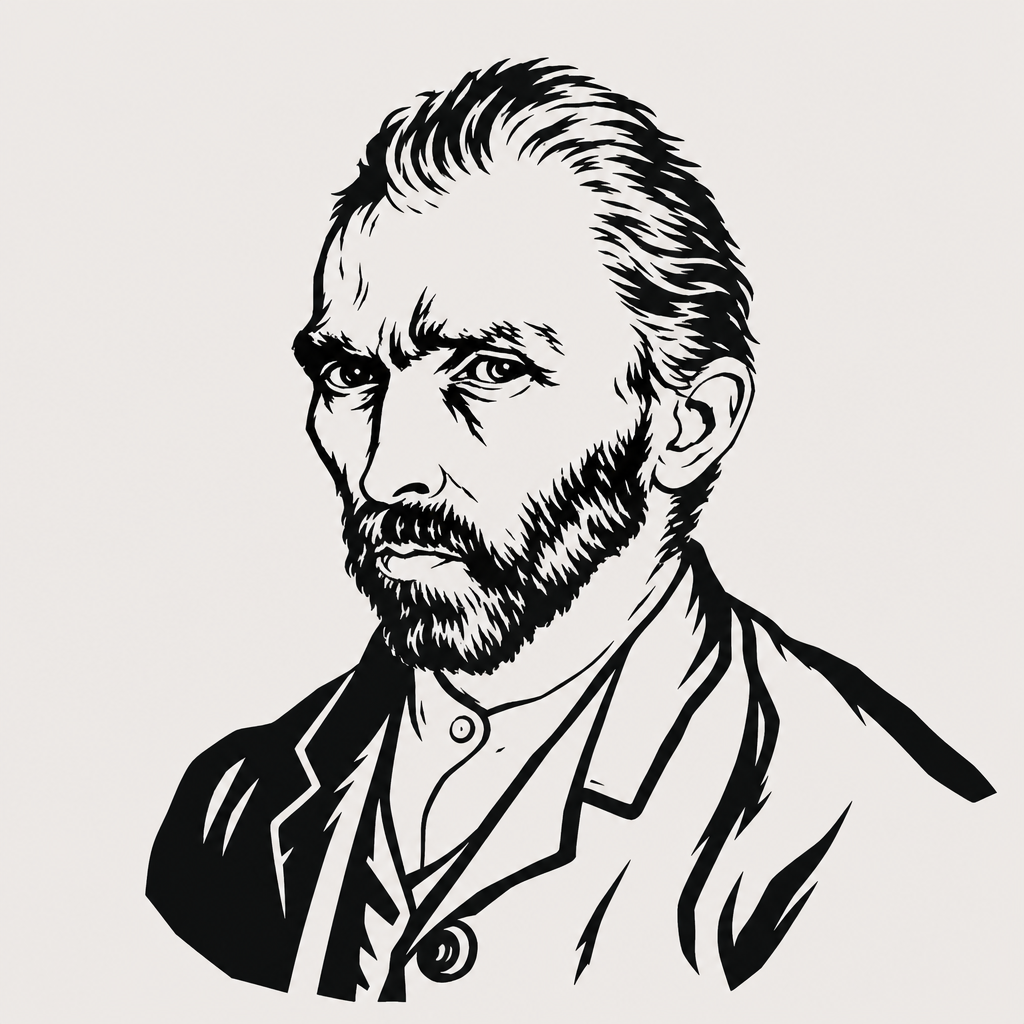
Vincent van Gogh
In early 1890, a letter reached a red-bearded Dutch patient at the asylum of Saint-Paul-de-Mausole: in Brussels, a painter named Anna Boch had bought his canvas The Red Vineyard for 400 francs. It was the only painting Vincent van Gogh is known by name to have sold in his life. He had been painting barely ten years, producing roughly 2,100 works while living on money sent by his brother Theo. Six months after the sale, he was dead at thirty-seven.
The myth is instinct and frenzy; the reality, documented in 903 surviving letters, is method. Van Gogh failed at everything until he was twenty-seven — art dealing, teaching, the ministry, a missionary posting in a Belgian coal district — before Theo suggested he take his sketching seriously. He worked through drawing manuals, built a perspective frame, studied color theory, and drew for two years before seriously touching oil paint. Paris rewired his somber Dutch palette with Impressionist light and Japanese prints, and in fifteen months at Arles he produced some two hundred paintings — orchards, sunflowers, the café terrace at night — preparing his Yellow House for a “Studio of the South” with Paul Gauguin.
That dream collapsed in December 1888 when, after a quarrel with Gauguin, Van Gogh severed his own ear in an acute breakdown. His illness — never conclusively diagnosed — came as sudden attacks separated by long stretches of complete lucidity, and it interrupted the paintings rather than producing them. As a voluntary patient at Saint-Rémy he painted about a hundred and fifty canvases, including a night sky boiling with stars that he mentioned to Theo almost in passing. In July 1890, in the wheat fields of Auvers-sur-Oise, he suffered a gunshot wound most scholars accept as self-inflicted, and died with Theo at his bedside. Theo survived him by six months; the brothers lie side by side under matching ivy.
That Van Gogh did not stay obscure is largely the work of Theo’s widow, Johanna van Gogh-Bonger, who spent three decades placing his paintings in exhibitions across Europe and published the brothers’ letters in 1914 — revealing not a raving madman but a thoughtful, ferociously well-read man. The Fauves and Expressionists walked through the door he opened. A century after that 400-franc sale, his Portrait of Dr. Gachet sold for $82.5 million — vindication of a failed preacher who believed ordinary things, painted honestly enough, could console people.