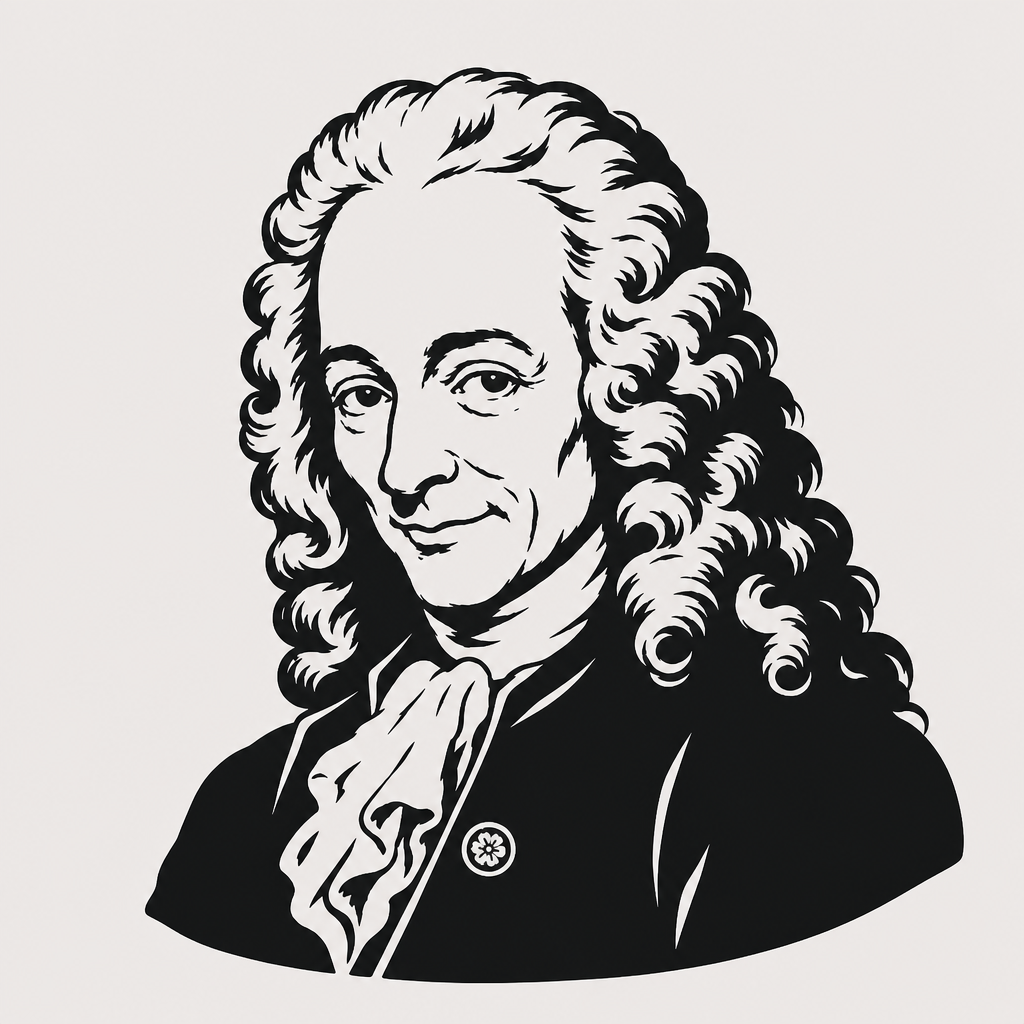
Voltaire
Early in 1726, one of the most celebrated writers in France was thrashed in a Paris street by a nobleman’s servants over an exchange of insults — and when he demanded a duel, it was he, not the aristocrat, who was thrown into the Bastille without trial and then exiled. No one was punished for the beating. That was the lesson François-Marie Arouet never forgot: a commoner with the sharpest tongue in Europe had no rights a nobleman was bound to respect. Nearly everything the man we know as Voltaire built afterward was a position from which he could finally strike back.
He had already renamed himself — “Voltaire,” an anagram that erased the notary’s son — and made himself the leading poet of France. Exile in England showed him what a free press and religious plurality could look like. Then, in 1729, he spotted a fatal flaw in a government lottery, organized a syndicate to buy it out legally, and made a fortune. It was the most consequential thing he ever did: a writer who cannot be starved cannot be silenced, and Voltaire never again needed a patron or a censor’s goodwill.
In 1759 he bought Ferney, an estate straddling the French-Swiss border — a fortress of independence with a frontier at his back. From there he published Candide and waged the campaigns that invented the public intellectual. When the Protestant merchant Jean Calas was broken on the wheel in 1762 for a murder he did not commit, Voltaire spent three years and his whole arsenal of fame and prose forcing the French state to confess the error — the first great victory of public opinion in European history, which he repeated for the Sirven family and, in vain, for the executed teenager La Barre.
Crowned on a Paris stage in 1778 and refused a grave by the same city weeks later, he was enshrined in the Panthéon by the Revolution in 1791. His memory carries two ledgers. One holds the saint of tolerance — though his single most famous “quote,” “I disapprove of what you say, but I will defend to the death your right to say it,” was actually written in 1906 by his biographer Evelyn Beatrice Hall. The other holds vicious antisemitic writings, polygenist theories of race, and a fortune likely touched by colonial slavery, even as the direct slave-trade letter attributed to him appears to be a forgery. Both files are real; neither cancels the other. The man who insisted no authority stood above questioning is now, fittingly, being questioned himself.