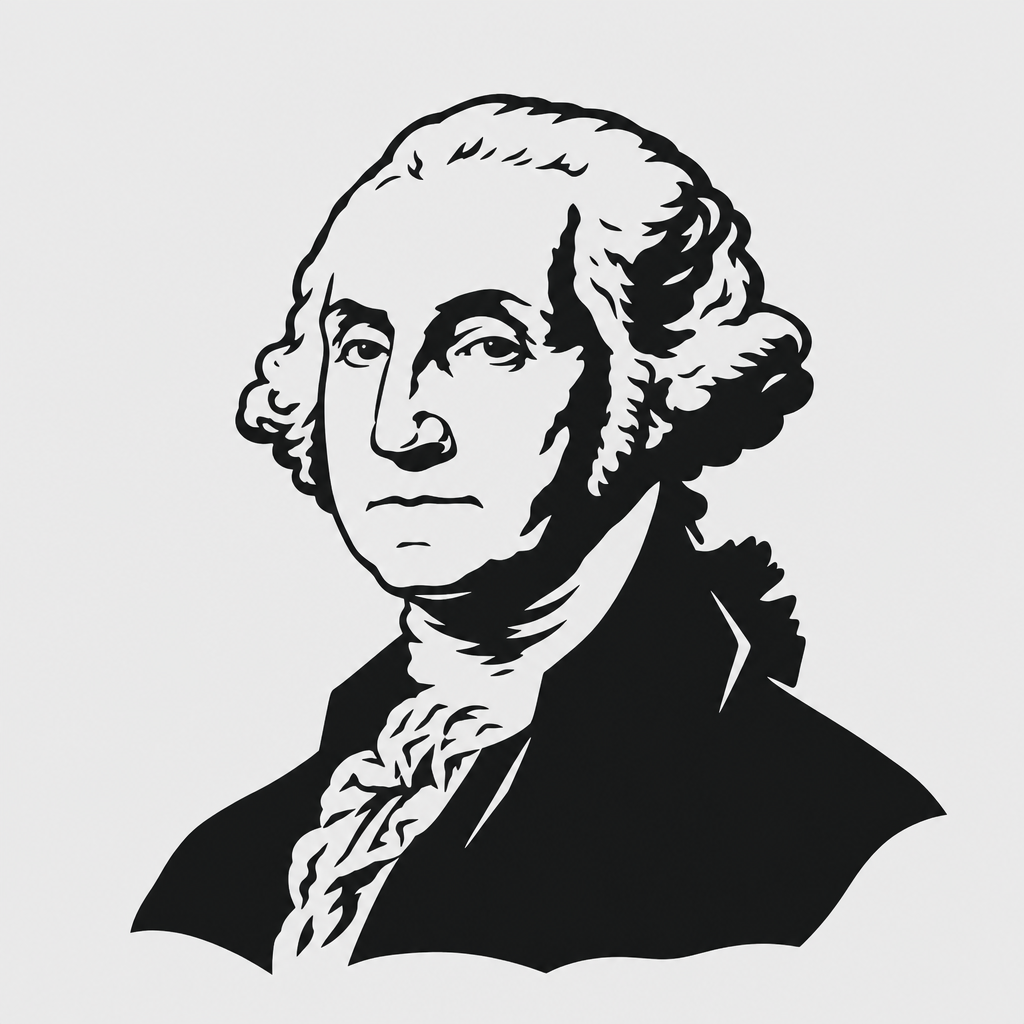
George Washington
On December 23, 1783, a victorious general stood before Congress in Annapolis and did something almost no one in his position had ever done voluntarily: he quit. George Washington had held the Continental Army together for eight and a half years; his officers had suggested more than once that he take charge of the country, and everyone in Europe assumed he would. Instead, hands trembling, he returned his commission and rode home to make Christmas dinner at Mount Vernon. Told of the plan, King George III reportedly said that if Washington did that, he would be the greatest man in the world.
Washington’s schooling stopped in his mid-teens — alone among the major founders, he never attended college. What he had was a body built for the frontier, a talent for surveying and land, and ambition: at twenty-two his frontier blunder at Jumonville Glen helped ignite a world war, and at twenty-three he emerged from Braddock’s massacre a colonial hero with four bullet holes through his coat. As commander in chief he lost more battles than he won, but he grasped the war’s real logic — he only had to keep his army in existence until Britain tired or France intervened. The Christmas-night crossing of the Delaware kept the cause alive; Yorktown in 1781 ended it; and at Newburgh in 1783 he killed an officers’ conspiracy against Congress with a pair of spectacles and one sentence about growing gray and almost blind in his country’s service.
As first president — elected unanimously, twice, a distinction never matched — he knew every act hardened into precedent: the cabinet, “Mr. President” over monarchical titles, force followed by mercy in the Whiskey Rebellion, neutrality abroad. Then he did the unbelievable thing again, declining a third term and standing quietly while power passed peacefully to John Adams — the first such transfer in modern history.
The marble long concealed a ledger: Washington enslaved people from age eleven until his death, pursued those who escaped, and publicly said not a word against slavery. His will freed the 123 people he owned outright — alone among the founding generation’s slaveholding presidents — but only after death, when he could have done it in life. Both facts are true, and neither cancels the other. What survives is the example invoked at every peaceful transfer of power since: the first one was his.